Alice Travers

Alice Borgström Travers, 1893-1970

There are 3 copies of the carol ‘Lazerus’ (‘Come All You Worthy Christian Men’) in Francis Collinson’s collection. Two of these are clearly in Collinson’s own hand, and are labelled “Collected from Mrs. Lurcock of Bredgar, Kent, and noted down by Miss Alice Travers of Bredgar”. The third (COL/5/36D) is in a different hand – probably that of Miss Travers. There are no other records in the Roud Index which mention Miss Travers, so it may be that this was the only song she ever collected.

Alice Travers was born 17th September 1893, and baptised at Chelsham, Surrey on 29th October. At the time of the 1901 census the family was living at ‘Woottonga’, Warlingham, Surrey. Besides Alice there were 2 other daughters and 2 sons. The household also included a nurse, cook, parlour maid and house maid. Her father, James L. Travers, was shown as “Wholesale Grocer” in 1901, and as “Merchant retired” in 1911. By 1921 they had set up residence at Bredgar House, Bredgar, with a slightly slimmed down household – now just a coachman and a cook. Mr Travers was listed as “Director & Manager Of Ltd Co / Merchant retired”. His obituary in 1924 related that the family had moved to Bredgar from Warlingham in 1919, noting that “Members of the family had identified themselves with the parochial life of the village”1. Alice Travers seems to have been particularly involved with the Women’s Institute – in 1960 the East Kent Gazette reported that she had been producing plays for the Bredgar WI for about 40 years2.

It may well be that she knew Mrs Lurcock through the WI. We don’t know when she noted down the carol – was it shortly before sending a copy to Francis Collinson, or some years earlier? We don’t actually know when she sent her transcription to Collinson, but it’s a safe bet that this was at some point after the BBC’s Country Magazine came on the air in May 1942.

The 1939 Register listed Alice Travers as a smallholder, living at Cedar Cottage, Bexon Lane, Bredgar. She died on 27th January 1970.

An exchange in the local newspaper, the East Kent Gazette, in 1947 provides a nice snapshot of the differing views of post-war Britain held by members of the monied classes, and those with, perhaps, a better understanding of the needs of the population at large. On 8th November 1947, under the headline “ROYAL WEDDING PRESENT”, the newspaper passed on a message from Councillor F.J. Millen, chairman of the Sittingbourne and Milton Urban District Council, that the fund to purchase a wedding gift for the future Queen Elizabeth and Prince Philip would be closing in a few days. The editor also reproduced a sentence from a letter sent in by Miss Travers “alluding to the attitude of some members of the local Council”, saying “I hope that when the present is sent to Princess Elizabeth it will be made clear that it comes from the loyal section of the community only”.

The following week, 14th November, there was a robust response from Councillor W. Wyllie, asking “Do you honestly think that there is only one way to demonstrate loyalty, and this is to subscribe money to a presentation?”. The councillor makes it clear that he – or quite possibly she – has not subscribed to the fund; but says they “have other views on this matter which I am sure must tend to show that there is a certain amount of loyalty in my make-up”. These are 1) having volunteered to serve in the Royal Navy in war and peace, 2) “I have given some years to the training of boys to become good citizens, and seamen in the Royal Navy”, 3) “I have given my son to the service of his country for the next fourteen years” (in the RAF), and 4) “I have also been employed in the making of guns (when most required) so that we should destroy the enemies of this island”. The writer suggests there will be many others in the area who have not subscribed, but “can lay a higher claim to being more loyal than I”, and reiterates what, presuambly, they had said in Council, that “the mothers of Sittingbourne and Milton require a maternity home far more than H.R.H. requires this presentation. I have only mentioned a maternity home, but there are lots of other necessities required in this locality”.


  1. East Kent Gazette, 12 January 1924 ↩︎
  2. East Kent Gazette, 25 November 1960 ↩︎

Maud Karpeles

Maud Pauline Karpeles, 1885-1976

Maud Karpeles was the daughter of Joseph Nicolaus Karpeles, a tea-merchant who had been born in Hamburg, but settled in London and became a British citizen. Thanks to her father she was of independent means, which allowed her to devote her life to folk music. With her sister Helen, she became involved in the English folk dance revival led by Cecil Sharp; both were involved with the foundation of the English Folk Dance Society in 1911. During the First World War she accompanied Sharp on his song collecting trips to the Appalachians. She was more than just a secretary. She provided Sharp, who suffered from frequent and varied medical issues, with invaluable support, both at home and abroad, and also became effectively part of the Sharp family. She in return was a lifelong disciple of Sharp, defending his legacy and promoting his views.

She held roles both with the English Folk Dance Society and its successor, the English Folk Dance and Song Society. After the Second World War she played a key role in establishing and running the International Folk Music Council, and remained active in the folk music world right up to her death at the age of 90.

In her unpublished autobiography she wrote

During the early fifties I managed to spend a few days in folk song collecting on behalf of the B. B.C. Perhaps prospectory would be a better word because I obtained very little material, though it is just possible that I laid a few trails for future collectors.1

In the Spring of 1952 she undertook two collecting expeditions to Somerset and Devon – the first with Marie Slocombe, the BBC Sound Recordings Librarian, and the second with her nephew Peter Kennedy. They were actively following in the footsteps of Cecil Sharp, visiting descendants of singers from whom he had collected, to see if they still remembered the old songs:

Over and over again, those we visited admitted that they had not formerly taken much interest in the ‘old’ songs, but they now regretted this as they had come to realize that they were better than the new ones.2

Her experiences here may well have influenced remarks she made in her opening address at the 1954 Conference of the International Folk Music Council, held in Sao Paulo:

Half a century ago we in Europe were inclined to worship the god of progress. We were very pleased with ourselves and the advances we had made; and the millenium [sic] seemed to be just around the corner. But the events of the last years has brought disillusionment. We now realise that much of what we call progress was in fact merely a turning away from the old established ways of life, and that in seeking the paths that lead to material benefits we have lost many of the things that make life worth living.

I suppose there is no country in the world that has made more rapid progress in the material affairs of life than Brazil. Is this likewise going to lead to disillusionment? I believe not. Because here you have had the wisdom not to discard what I can only call the spiritual values which have been handed down to you by your forefathers, but you have cherished them and have woven them into the fabric of present day life.

This Folk Lore Congress which is being held in celebration of of [sic] fourth centenary of the foundation of the city of Sao Paulo is evidence of the importance you attach to maintaining the traditions of the people in which are enshrined fundamental beliefs that are common to all mankind.3

In the autumn of 1953 she embarked on a song collecting expedition in Kent. Details of this trip can be found in the VWML archive catalogue, under the heading “Folk Song Collecting Expedition Kent October 12th – 17th 1953” (MK/1/2/4907). This report tells us that Miss Karpeles stayed with Violet Rumney (a school friend), at Sissinghurst from October 12th to 17th and ventured out each day – Miss Rumney or her sister driving. Karpeles estimated that they covered about 400 miles during the week, making enquiries at the following villages:

  • Headcorn
  • Smarden
  • Warehorne
  • Ham Street
  • Appledore
  • Stone
  • Rye Harbour
  • Kenardington
  • Sissinghurst
  • Frittenden
  • Cranbrook
  • Goudhurst
  • Binningden [sic – probably Benenden]
  • Pluckley
  • Harrietsham
  • Snargate
  • Brinzett [sic]
  • Brookland
  • New Romney (not exhaustively)
  • Dungeness
  • Lydd
  • Ivychurch
  • Bethersden
  • High Halden
  • Staplehurst
  • Bethersden
  • High Halden
  • Staplehurst
  • Beckley
  • Bettenham

She wrote that she had recorded a version of ‘John Barleycorn’ from Dave Wicken (actually Dave Wickens), at Smarden. And five songs from Albert Beale at Kenardington – as she notes “son and brother of singers from whom Cecil Sharp noted songs” and, again, it seems likely that she had deliberately sought out any surviving relatives of Sharp’s “informants”.

The report continues

I interviewed  some gipsies, name of Stanley, at Bettenham. They know a number of songs, but I could not ask them to sing  as there had just been a death in the family. I arranged to pay them a visit later on.

I found a number of people who remembered hearing some of the songs, from parents, grandparents, or other old people in the neighbourhood, but they had not themselves learned them.

Contrary to expectation Romney Marsh seemed to be further away from the tradition than the “upland” regions. I suspect this is because they are too isolated.

I found a greater understanding of the type of song I required than is usually the case. This may be due to Frank Collinson’s Country Magazine contributions.

In her autobiography she wrote

I came across a delightful family of gypsies and later I introduced Peter Kennedy to them and he recorded a number of their songs. Whenever I have visited gypsies – be it in tents, caravans or houses – I have always enjoyed their company. They are sociable, friendly people and very often have a store of good folk tunes, though they are apt to mix up the words of the songs.4

She returned to Kent in January 1954, in the company of Peter Kennedy, and together they made recordings of Albert Beale and the gipsy Charlie Scamp.

Both Kennedy and Karpeles wrote reports on this trip. Her report stated that

Our main objective was Mrs Stanley (real name Mrs Bird)5, Bettenham, near Cranbrook, a gipsy whom I had met on my previous expedition. On our first visit [on 14th January] she was out, but we called again on the morning of the 15th. As I suspected, she has a big repertory of songs. Unfortunately she was suffering from laryngitis. She managed to sing us a few songs, but she was unable to hold the tune and I doubt if this was entirely due to her ailment. She gave us the names of several members of her family, including her brothers, Charles Scamp at Chartham Hatch, near Canterbury, and Oliver Scamp, between Rochester and Sittingbourne, both of whom have a big repertory of songs which they learned from their parents. The Scamps are a big Romany clan scattered all over Kent and most of them seem well-to-do.

We made great friends with Charles Scamp, at present a timber dealer, and his friendship will be an open sesame amongst other Romanies in the district.  His brother Ted, the hero of a book by Croft Cooke (?), and he are interesting characters. Peter Kennedy recorded some conversation between them in ‘Romanish’.

Peter Kennedy recorded a number of songs from Charles. He has a fine voice and his style, though hardly ‘authentic’, is interesting. He has the florid gipsy way of singing, combined with a conscious voice production (self-trained, of course).  He has modelled himself on Al Johnson [Al Jolson?]. He has a prodigious memory which includes songs of all kinds, but he knows a number of authentic folk songs. He has sung at the Palace Theatre, Ramsgate in a circus show. His brother Oliver has not taken up the new songs and his style of singing is much more straightforward than that of his brother. Unfortunately he is just recovering from bronchitis, so was unable to sing much and we made only one record. He has a good voice and probably even more songs than his brother. He is willing and anxious to give us his songs and I think he would be well worth another visit in a few weeks’ time. As it is only a short distance from London, probably recording sessions on a Saturday and Sunday, with one night away, would be sufficient.6

Sadly, neither Kennedy nor Karpeles appears to have returned to record Oliver Scamp, or his sister Mrs Bird. The report continues

We also visited Mr Albert Beale of Kenardington and re-recorded sone of the songs I had recorded on my last trip, together with three others – these of no repeat value.

On the outward journey we called at Greenwich to make enquiries about a chanteyman, Captain Richards, who used to work at the pier, but he had gone away without leaving an address.

We also stopped at St Mary Cray, where there is a very large gipsy camp. I made a few enquiries, but it would have taken too long to make a proper investigation.

In addition to the people mentioned above, we called on four other families, but  for one reason or another got no songs from them.

When Karpeles writes of “recording” songs from singers such as Albert Beale and Dave Wickens it is not clear if she means making a sound recording, or writing down the words and tune. She certainly did make sound recordings of traditional singers, both in England and in North America. But in this case, neither recordings nor transcriptions of the Kentish singers appear to have survived.


  1. Maud Karpeles, Autobiography (unpublished, 1975, typescript copy held at the VWML), p229 ↩︎
  2. Maud Karpeles, Autobiography, p230 ↩︎
  3. Maud Karpeles, Autobiography, p258 ↩︎
  4. Maud Karpeles, Autobiography, pp230-231 ↩︎
  5. Probably Mary Bird, née Scamp, an elder sister of Phoebe Smith. ↩︎
  6. Maud Karpeles, Report on Collecting Expedition in Kent, January 14 – 17, 1954 (typescript copy held at the VWML) ↩︎

Francis Jekyll

Francis Jekyll, 1882-1965

Known to family and friends as ‘Timmy’, Francis Jekyll (pronounced “Jee-call”) was the nephew of Gertrude Jekyll, the garden designer. After attending Eton and Oxford, in 1906 he took a job at the British Museum as Assistant in the Printed Books Department, working in the Printed Music Section. Between 1905 and 1911 he collected folk songs in Sussex, Herefordshire, Kent and Norfolk, and a number of Irish dance tunes from a fiddle-player at Kilmarnock in Scotland. The material he collected appears in the collections of Ella Leather, Lucy Broadwood, and his close friend George Butterworth – all available to view via the VWML Archive Catalogue.

He noted two songs from a Mrs Powell at Minster in Sheppey, in August 1910. She appears to have been a resident of the Sheppey Workhouse, where George Butterworth collected a further 3 songs in September of the same year.

Jekyll resigned his post at the British Museum in 1914. In a letter to Lewis Jones dated 3rd June 1999, Francis Jekyll’s great niece Mrs. Primrose Arnander wrote:

I am sure that there was an initial nervous breakdown which must have led to recurring clinical depression, an illness well understood, accepted and treated nowadays but little understood then…

In 1932 Gertrude Jekylll died and left Munstead Wood [her home in Surrey] and its contents to her sister-in-law, Agnes Jekyll, Francis Jekyll’s mother. In 1937 Agnes Jekyll died and Munstead Wood passed in toto to Francis Jekyll. He did not live there for very long, but tried to keep her nursery garden going and was still fulfilling orders up to the war time. Around 1939 Francis Jekyll moved into the Hut, a smaller house in the grounds, and Munstead Wood was let and finally sold. There was a sale of all the contents in 1948; this included books and chattels from Munstead House that had been left to Francis and also, in that sale, he must have sold all his music and books for the contents of the sale included books, scores and periodicals which showed an interest in music that would have been far beyond Gertrude Jekyll. Timmy lived on in the Hut with a housekeeper until his death in 1965. He was a sad and rather lonely figure at the end and was never really able to shake free of his debilitating depression. He attended concerts and festivals of music, but never returned to an active role in the field.1

He died in 1965, aged 82


  1. quoted in Lewis Jones, Francis Jekyll (1882-1965) Forgotten Hero of the First Folk Song Revival, English Dance and Song, June 2000 ↩︎

Francis Collinson

Francis James Montgomery Collinson, 1898–1984

Francis Collinson was born and educated in Edinburgh, where his father was organist at St Mary’s Episcopal Cathedral. After serving in the Army Service Corps during World War I, he studied music at Edinburgh University. Having graduated in 1923, he embarked on a career in musical theatre in London.

When the BBC launched its Country Magazine radio programme in 1942, Collinson became its musical director. He was living at Old Surrenden Manor near Bethersden at this time; the programme’s producer Francis ‘Jack’ Dillon lived nearby at Smarden. George Frampton recounts1

The story goes that, one day, Dillon heard his gardener, who was outside at work,singing The Blackbird.  Collinson was summoned, and the idea of using a singer on Country Magazine was quickly established.

Whether or not this is strictly accurate, or a romanticised version of events, Collinson’s activities as a serious folk song collector do appear to have coincided with the start of Country Magazine (the only songs in his collection which definitely predates this are ‘Come come my pretty maid’, from Tom Batt, and ‘Stormy Winds Do Blow’, from Harry Cox in Norfolk both of which he noted in 1941).

Collinson was the last of the folk song collectors to note down songs on paper, rather than recording his singers, although he did make recordings later in his career, when working for the School of Scottish Studies. He appears to have had a fairly relaxed approach to the type of song he was prepared to collect – there are numerous examples in his Kentish collection that Cecil Sharp, for example, would have rejected as not being a real folk song. He collected from a number of local singers in Bethersden, also noting songs at Smarden, Great Chart, Maidstone, Pembury, Willesborough, and as far afield as St. Nicholas-at-Wade in Thanet. Noel Coward, whom he would have known through their shared involvement in musical theatre, lived at Aldington, and Collinson noted several songs from Coward’s gardeners, John and Ted Lancefield, as well as two other singers in the village. Sometimes he was sent songs – in at least one case by a listener to his radio programmes. He noted songs in other parts of the country as well, including Devon, Dorset, County Durham, Essex, Monmouthshire, Shropshire, Staffordshire, and from the Copper Family at Rottingdean in Sussex.

In 1945, Collinson wrote an article in the Kent County Journal2 ultimately aimed at encouraging readers to contact him if they knew any of the old songs, or who knew of someone who might:

Song-Collecting in Kent

By FRANCIS M. COLIINSON

Among the collectors of English folk-songs, there seems to be a curious and mistaken idea that Kent possesses little of interest. Certainly, of the several thousand folk-songs collected and published by the English Folk-song Society over a period of thirty years, when folk-songs were easy to come by, those from Kent number exactly five. Of these, Cecil Sharp, the most assiduous collector of all, contributes only one, and that one he heard from a Kentish man resident in the west of England.3

Living in Kent myself, I am glad to be able to refute this libel. I am convinced that the explanation is simply that none of the collectors ever took the trouble to look for songs in Kent; for in my searches for songs for the B. B. C. “Country Magazine,” I have collected quite a number of songs in the county, and that mostly within no more than cycling distance from my house. A fair proportion of  these can be classed as true folk-songs; and – of them, whether folk-songs, early music-hall ditties, or even published songs of the Victorian era like “The Mistletoe Bough,” have been learned and passed on by singing, and not by the printed copy. No, Kent is certainly not unmusical!

I have found, too, a number of the old printed broadsheets in Kent. These are sheets of flimsy paper about seven inches by ten, with the words of one, or more often two songs printed on one side, and having a crude wood-cut at the top by way of illustration (often wildly inappropriate to the song in question). Most of these broadsheets come from the once-flourishing ballad-printing houses of Seven Dials, London, but I have several printed at Strood, Kent-a fact which in itself goes a long way towards proving my point.

The Kentish name for a broadsheet, which is still remembered and used, is a ballet (to rhyme with mallet). These ballets were hawked through the streets of towns and villages all over the country at a penny each, and sung or “cried” by their vendors to any old tune that happened to fit. The most extensive collection of them I have come across was in the possession of the brothers John and Ted Lancefield, of Adlington [sic]; and I have to record with gratitude their kindness in making a gift of them to me, for these old broadsheets are treasure to the song collector. One of these is reproduced below. It deals with a common subject of the broadsheet poets —shipwreck, and it is quite probable that the story was a true one, or at least had some basis in local fact. The Lancefields could not remember the tune to which it was sung, but I did get some other songs from them complete with their tunes—including one with the intriguing title of “The Folkstone Murderer.” The ‘shipwreck ballad’ generally appeals to its hearers in the last verse or in the refrain to help the widows and orphans of the disaster (here the appeal is to the Deity), but it is doubtful if any of the proceeds of its sale ever found their way to this charity!

I must come to the purpose of my article however. It is now unfortunately too late to reap the abundant musical harvest which I am convinced once existed in Kent, and which could have been garnered easily say fifty years ago, when the Harvest Home was still to the fore, with its inseparable furnishings of song and country dance-tune; for indigenous folk-song has long been a-dying everywhere: but there may still be time to catch the last echoes; and readers who know any of the old traditional songs, or who know of anyone who can dig up even a fragment of them from the depths of his memory, can help to remove an implied slur on the musical-mindedness of Kent, and perhaps enrich the repertoire of folk-song with fresh discoveries, by writing to me, c/o. the Editor of the “Kent County Journal” about it.

The 1950 publication Country Magazine: Book of the B.B.C. programme4 contained a description of Collinson’s approach to song collecting:

All the songs are got afresh from old folk singers and most of them do not appear in any published collection. Nearly all of the songs are collected and arranged by Francis Collinson, who explains some of his technique and his difficulties in collecting:  

I find that to get hold of the old country songs you have approach the task as a countryman yourself ; for if the country folk get the impression that you are “arty”, they shut up like a knife. The real songs of the countryside are full-blooded and robust. Many people are shy of singing a song to a stranger straight off and I don’t often ask them to do it. What I generally do is to ask them to give me the words. In doing this they are almost certain to come to a line which they can’t quite remember; and then instinctively, they start to hum the tune to help their memory over the difficult bit; and once a man begins to hum a tune of his free will, you will find the ice is broken and he won’t mind singing the rest to you.

When a countryman does start to give you one of his own songs, he will go to any amount of trouble to get it right, for he feels on his mettle to show you, and himself, that he hasn’t forgotten it; and this is no small feat sometimes, for many of these old songs are very long, eight, nine or even ten verses are quite the rule. If a line or a verse does elude him, he will cudgel his brains until it comes back to him ; and if it refuses to come back, he will go or write to some other member of the family for it. Often I have come away with an incomplete song, to receive a message a few days later via the postman or the milkman to say that “old so-and-so has the rest of that song you were talking about.” I got one such message from the wife of a rather frail old man to whom I had been for songs, to say she hoped I wouldn’t be asking for any more as it was keeping him awake at nights trying to remember them!  

It’s lovely to see how the recalling of an old song which has unsung for perhaps half-a-century, carries the thoughts of the old people back. For a few moments the years have slipped away

In 1952 Collinson moved back to Scotland, to take up the post of musical research fellow at the newly established School of Scottish Studies. His work there involved the collection, transcription and study of Scots and Gaelic traditional song. He produced important works on Hebridean folk song, and a history of the bagpipes.

Following his death in 1984, Collinson’s papers passed to the School of Scottish Studies at the University of Edinburgh. In the 1990s Chris White, a member of the Kent-based Seven Champions Molly Dancers who was in Scotland studying for a doctorate, investigated the English songs in Collinson’s collection, and subsequently copies of these were lodged in the Vaughan Williams Memorial Library. They are now available online, through the VWML Archives Catalogue, at https://archives.vwml.org/records/COL.  

Country Magazine

Francis Collinson’s entry in the Oxford Dictionary of National Biography6 states that he was “in charge” of this radio programme – clearly that’s an overstatement, since he was neither the editor now the producer but, as musical director, he played an important part in the series’ success.

Theatre and revue were badly hit by the advent of the Second World War and in 1941 Collinson took charge of the BBC’s Country Magazine programmes, with their famous signature tune, ‘The Painful Plough’, of which he was to make many arrangements, including one for the bagpipe. The programmes, many of them outside broadcasts, involved Collinson in the study, collection, and arrangement of folk-songs (bringing the Copper family to public attention, for example) throughout Britain. He not only published these arrangements in a series with Francis Dillon from 1946 onwards but also issued three unique 78 r.p.m. recordings of folk-songs in the Gramophone Company’s Plum Label series. Now collector’s items, the songs were beautifully delivered by the baritone Robert Irwin, accompanied by an orchestra conducted by Collinson

[ … ]

Highly arranged folk-song, sung by classically trained professional singers to orchestral accompaniment, no matter how beautifully done, was looked at askance by later scholars and performers of traditional song. But in Country Magazine Collinson had been obliged to work to BBC practice, which was against ‘untrained’ singers marring the airwaves, and when such Scottish singers were eventually broadcast in the late 1950s, popular reaction was indeed remarkably hostile, even from fervent Scottish nationalists such as Hugh MacDiarmid.

Actually Francis ‘Jack’ Dillon was the programme’s producer. To quote from his entry in the Oxford Dictionary of National Biography7

In 1942 Dillon began the Sunday radio series Country Magazine which ran for twelve years with the professed intention ‘to create a better team spirit between people working in factories and people working in fields’ [F. Dillon, ed., ‘Country magazine’: book of the BBC programme (1950)]. The idea for the series originated from the Ministry of Agriculture which felt such a programme would be helpful in wartime when travel between town and country was so restricted. On the third anniversary of the series the Sunday Pictorial ran an article on the producer:

Francis Dillon, the man who has gathered the farmers, basket makers, cowherds and glovemakers together is … a homespun type, wears corduroys and a fisherman’s hand knitted guernsey in Portland Place bars, drinks beer, and doesn’t like the idea of getting publicity in the Press.

The first episode of Country Magazine was broadcast on the BBC Home Service at 1:15 p.m. on Sunday 3rd May 1942. The Radio Times8 listing described it as “Fortnightly programme from the countryside. Editor, A. G. Street. Producer, Francis Dillon”. A brief note on the front page of the magazine promoted it as

A new radio magazine about, for, and from the countryside presents its first number on Sunday with A. G. Street as editor. In the first of fortnightly programmes men and women from various English counties will discuss the content of future numbers. On the result of their discussion and suggestions from listeners the series will be planned.

while there was a longer piece on page 5 in the “Introducing” section, written by C. Norman Glover:

Let the Country Speak

Now that the framework of wartime broadcasting has put an end to many of the old Regional activities one misses much that once spoke so agreeably in the many tongues of Britain. ‘In Britain Now’ has helped, and so, too, have voices, from time to time of speakers on matters of the countryside. Such voices as that of Ralph Wightman who will be heard, every so often, in Francis Dillon’s ‘Country Magazine’, new fortnightly series starting on Sunday. I select Wightman from a copious potential of other contributors for the simple reason that I consider him the best broadcaster of his type that I have ever heard. When a man has wit and wisdom, a sense of language and a sense of humour, a profound knowledge of his subject, and  Somerset voice as rich as heather honey —there is a broadcaster on the countryside A. G. Street compères these programmes that should fill the need of countrymen from Land’s End to John o’ Groats for expert opinion on every kind of rural issue from Home Guarding to home gardening.

Soon the format Country Magazine began to take shape. The editor, A.G. Street described it thus in the Radio Times, 26th June 1942:

THEY COME FROM THE COUNTRY
By deliberate design the history to date of the fortnightly Country Magazine has been one of trial and error. The original request was for a country magazine to interest country people ; but the first of these Sunday broadcasts was devoted to a discussion in which ten or a dozen country-folk of all sorts tried to decide the composition and scope of the programmes to follow.

Unanimously they agreed that the address should be to listeners in both town and country, for two main reasons: townsfolk today are genuinely interested in the countryside, and country-folk dislike being treated as beings apart. It was also agreed to give general and country numbers alternately, and Devon came first out of the hat.

After some spirited wrangling the inclusion of a musical item was decided upon. The following layout was then suggested. First a description of the countryside, followed by a short explanation of the seasonal job. Next a personal story from a real country-dweller, then an interesting bit of farming news, and then possibly a musical item, anything of a Hey-nonny-no flavour being barred. Also necessary were a woman’s item and a rural defence item; if possible there should be something out of the ordinary run of country life, and also, perhaps, a short story.

The second number dealt faithfully with this programme on general lines, and then Devon was asked to do its best for number three. And it did. The number began with the march of the Devon regiment, and ended with some verses written for this number by Reginald Arkell. In lovely lush Devonshire voice a Devonshire farmer read them with obvious belief in every word, especially in the last two lines : —

I’ve said it afore, and I sez it agen
There’s nothing like Devon, and Devonshire men.

Whereupon a Devonshire lady picked Kent for the next county number, which you will hear this coming Sunday.

28th June 1942 – Kent

Country Magazine number 5, focusing on Kent, was broadcast at 1:15 on Sunday 28th June 1942. The programme was received warmly, making front page news in the Kent Messenger, 3rd July:

KENT’S PRAISES ARE SUNG BY B.B.C.

A Stirring Radio Story Of “Britain’s Fighting County”

Kent, “Britain’s Fighting County,” was the subject of the broadcast, Country Magazine No 5, on Sunday. Many well-known Kent people took part, including Mrs. N. Stanger, Bilsington; Lieut.-Colonel C. S. F. Witts, Margate; Mr. Alfred Day, Headcorn; Mr. T. Woolley, Warehorne, Mr. E. M. Boulden, Bonnington; Mr. Bates, Dungeness; and Mr. H. Batt, Mr. E. Batt, Mr. D, Batt. and Mr. M. Batt, of Bethersden.

Several interesting problems were discussed, among them was the old question, “Do you know the difference between a Man of Kent and a Kentish Man.”

The only answer given was, “It does not matter, anyway. ” Reference was made to Kent’s motto.

“Kent has never been beaten in battle and never will be,” one man commented. “No, but we Men of Kent don’t want to boast about that,” said a Man of Kent, and a reply immediately came from a Kentish Man, “We Kentish Men don’t need to!”

The article went on to describe the topics covered in the programme: the Book of Remembrance held in Canterbury Cathedral for the 6000 officers and men of The Buffs (the Royal East Kent Regiment) who had died in the First World War; agriculture in the “Garden of England” and on Romney Marsh; the work of a village shop-keeper (Mrs Stanger of Bilsington), a woodman, and fishermen (Mr Bates, Dungeness); the Thanet Home Guard (Lieutenant Colonel Witts); and cider which “if kept for a couple of years can be set alight like brandy”. There was a brief mention that “A fifty years old song was sung” – this was most likely performed by the Batt Brothers.

The article included photographs of several of the contributors: Mr Day, Mrs Stanger, Eyton Boulden, Mr. Woolley, and the Messrs Batt. It concluded “a song completed the Country Magazine of the County of Kent, excellently produced and full of interest”.

We know what song was included, from an article in the same newspaper on 24th July 1942:

Uncle Charlie’s Song

In response to requests from many readers we publish below “Uncle Charlie’s Song”—”At the Foot of Yonder Mountain,” which was so beautifully rendered in the recent Kent Country programme by the B.B.C.

The song, which is at least 150 years old, was sung by Frederick Woodhouse, and the music was arranged by Francis Collinson.

This was a rewritten arrangement of ‘Where the lambs they skip with pleasure’, from Eyton Boulden, a copy of which is in the Collinson MSS.

Country Magazine broadcast from Kent on another three occasions, and Kentish men and women continued to make appearances on the programme – for example, under the headline “He Spoke Of Buzz-Bombs, Cricket and Hop-Pickers” the Kent Messenger for 3rd November 1944 reported that “a Kent garage proprietor, Mr. Fuggle, of Benenden, took part in 64th “Country Magazine” feature by the B.B.C.”

11th August 1946 – The Isle of Sheppey

The next time that Country Magazine properly revisited Kent was for the programme broadcast on 11th August 1946, which came from the Isle of Sheppey. This was a significant milestone for the programme, and for the BBC more generally as, according to the Sheerness Times Guardian, 16th August 1946

It was the first time that a direct outside broadcast had been attempted from the English countryside and it was a complete success. The B.B.C. microphone was installed in the centre of the dart room at the Ferry House Inn and the broadcasters were grouped about three feet away from it. In all its long history the old inn had never before had its doors flung wide open—open to the world—to millions of listeners eager to hear what was taking place within its lonely and secluded surroundings.

The preceding week, 9th August, the same paper had promoted the upcoming event, describing the location of the broadcast, and giving some idea of its content:

A bar of a centuries old inn, situated on the banks of the River Swale in the Isle of Sheppey, is to become a B.B.C. studio next Sunday, for the broadcast of “Country Magazine” programme.

It is the Ferry House Inn, Harty, and apart from the people on the Island and yachtsmen who sail up the Swale, few others know if its existence, as it is on the marshes four miles from the nearest road.

Local legends have it, that the inn was the haunt of smugglers, but Marshall Pollock, who owns it has found nothing to confirm this.

It was originally built to house workers from the farms on the marshes round about, and in the bar where this broadcast takes place you can still see the lodger’s lockers where they kept their food and the stoves on which they cooked it.

The Ferry kept its name from the ferry which runs between Harty, Isle of Sheppey and Faversham (Kent), on the mainland.

Joe Dane has been a ferryman for many years. Listeners will hear stories of “Dirty Crossings” from Joe, who also remembers a former landlady at the inn, waiting at the foot of the stairs at closing time to collect the fourpences from the lodgers before they retired.

Dane will also talk about the bird life on the marshes, where peal, wild duck and other birds abound.

Other speakers will include a farmer from the marshes, Marshall Pollock, a shipbuilder from Faversham, who bought the Ferry House in 1937 to popularise the Swale among yachtsmen, and several other local characters.

These will be brought to the microphone by John Snagge, and the music under the direction of Francis Collinson, will be provided by two fiddles, a concertina and a piano. The folk song in this programme is one which Collinson discovered in the Isle of Sheppey and is called “Tarry Trousers”.

The newspaper’s article on 16th August, following the broadcast, was full of praise for the programme:

All wireless sets in Sheppey were tuned-in for that outstanding radio event for the Island—the broadcast of a “Country Magazine” programme from the Ferry House Inn, Harty—which made good listening on Sunday last.

The dialogue “came over” the air very well indeed and it was evident that those taking part in this broadcast had remembered the “tips” given to them during the rehearsals by that “live-wire” producer, Francis Dillion, who really knows his job. The programme dealt entirely with “life” in the River Swale area, which made extremely good material for a “Country Magazine” broadcast.

The Kent Messenger for 16th August was no less enthusiastic. Under the headline “Queer ‘Goings-On’ At The Ferry House Inn”, the report noted that this had been the first programme to be compared by John Snagge “and he enjoyed it. So did everybody else in the snug bar of the Ferry Inn. So did thousands of listeners on Sunday when it brought a breath of clean sweet Sheppey air, and the tang of the sea, to their dinner tables”.

Sun 13th June 1948 – Isle of Thanet

In June 1948 Country Magazine came from the Bell Inn, St. Nicholas at Wade. The programme was introduced by Dylan Thomas, and, as usual, the music was arranged by Francis Collinson, revisiting ‘Tarry Trousers’, rather than either of the songs he’d collected in the village in 1945.

There was a report on the programme in the Thanet Advertiser, 15th June 1948:

ST. NICHOLAS TELLS THE WORLD

Country Magazine Broadcast

St. Nicholas-at-Wade, with its little community of 600 people, and its Norman church looking out over the pattern-work of dikes and grazing land, made itself known to the world on Sunday.

Scouts of the British Broadcasting Corporation, searching extensively in Southern England for likely spots for the “Country Magazine” feature, which is among the most popular of the Sunday programmes, found just what they wanted at the Bell Inn, St. Nicholas – so  it was to the Bell Inn they came to put Sunday’s edition over the air.

Listeners heard Welsh poet Dylan Thomas describe the scene in these words:

“We’ve rigged up a sort of studio here in The Bell—I might say an ideal studio—with bar billiards, dart boards, push penny (shove-halfpenny’s big uncle), smoky ceiling, oak beams, wickerwork hatrack, piano with yellow teeth, on the wooden walls, a buffalo head askew (probably shot charging round a corner), beer here and there, mostly there… quiet old St. Nicholas at Wade…”

Sandwiched between the interviews was a song lustily sung by Robert Irwin—a bright little ditty suggesting the close association between St. Nicholas and the sea, which beats, above the level of the marsh, against the sea wall to the north. The song was sung to the tune “Tarry Trousers.”

However, as the BBC will be all too aware, you can’t please everyone. The Thanet Advertiser for 13th July 1948 reported that the programme had not gone down well in nearby Minster:

MINSTER ANNOYED WITH B.B.C. BROADCAST

The recent “Country Magazine” broadcast from St. Nicholas, came in for severe criticism at Tuesday’s meeting of Minster Parish Council.

Councillor the Rev. T. A. Keniry stated that a few months previously Minster Council had asked the B.B.C. if it would be possible to include a broadcast dealing with Thanet, from Minster in their “Country Magazine” programme. “If the programme broadcast from St. Nicholas was a reply to our request then I think it was a caricature,” he declared.

From the broadcast it seemed that in Thanet all people did was to breed white turkeys, ride donkeys on Margate sands, and dabble in lavender-growing, he said. The broadcast made no mention of Thanet’s historical and architectural claims.

Councillor C. W. Simmons expressed a similar opinion, and said he thought the St. Nicholas broadcast was the worst “Country Magazine” programme ever heard on the air.

Councillor Simmons made a proposition that the B.B.C. should again be approached on the question of a broadcast from Minster, and his proposition was carried.

Sun 17th Apr 1949 – Romney Marsh

Country Magazine came back to the county one final time in April 1949, in a programme introduced by Ralph Wightman, and with another appearance from Bonnington’s Eyton Boulden. The Kentish Express 22nd April 1949 carried a report of the broadcast, but did not mention where it had been recorded.

SIX DISCUSSED “THE SIXTH CONTINENT”

ROMNEY MARSH GOES ON THE AIR

Shortly before 4.30 p.m. today five men and a woman will leave their work on Romney Marsh and will tune in their radios to hear a re-broadcast of Sunday’s “Country Magazine,” in which they discussed with Ralph Wightman the Marsh and the part they play in its daily life.

People all over the country heard how on a fine evening in June it was almost possible—if one had good enough eyesight and patience—to count all the sheep on the Marsh from one vantage point. They heard also of “Josher” Jones’ modes of transport—of “Bluebird,” his car, and the backstays used to negotiate the Dungeness shingle.

When a Kentish Express reporter called on “Josher,” the shrimper, he was coming home from a morning bird-spotting on the nine square miles of shingle.

“WHO’S THAT?” SAID WIFE

He took off his backstays, commenting that a number of people who heard Sunday’s broadcast did not believe they were still used.

“Why I can walk faster on a pair of backstays than what I can the road.” he said. It wasn’t many years ago, either, that we had to walk to Lydd on them. That was before the road was built.”

Ex-farmer and publican, “Josher” said that shrimping had been extremely bad this past winter, despite its mildness. His chief outdoor interest now is to get rid of some of the magpies and foxes that have been lessening the bird population on the shingle.

Mrs. Fred Apps, whose farmer husband broadcast, did not recognise her husband’s voice when she first heard it on the air.

BEST LOOKER ON THE MARSH

Described as “the best looker on Romney Marsh” (a looker is a shepherd, not a good-looking man), Mr. George Hugett, of Appledore, was another who took part in the programme. Others were Mr. Eyton Boulden, Bonnington farmer; Mrs. John Southenden, of Jury’s Gap; Mr. Reg Cooke, of Pott Level, and Mr. Harold Sims, of Iden, a huntsman with the Romney Marsh hounds since 1909.

The final edition of Country Magazine appears to have been broadcast on Sunday 21st December 1952 a “Christmas General Number from the Midlands”.

  1. Frampton, George, The Millen Family of Bethersden, Kent, Musical Traditions, 2001. https://www.mustrad.org.uk/articles/millens.htm ↩︎
  2. Kent County Journal, 6 (4), July -Sep 1945, p81. ↩︎
  3. As this site demonstrates, Collinson significantly under-estimated the number of songs collected in the early twentieth century by Cecil Sharp and others. The figure of five songs probably represents the number published in the Journal of the Folk-Song Society. The reference to a song collected by Sharp is most probably to ‘The Shooting of his dear’ which was included in an article headed “Folk-Songs noted in Somerset and North Devon”. This had been obtained from Clarence Rook, who was living in Bristol at the time of the 1891 census, but otherwise had no connection to the West Country. ↩︎
  4. Country Magazine. Book of the B.B.C. programme. Compiled and edited by Francis Dillon. London:Odhams Press, 1950. p142. ↩︎
  5. Olson, Ian A. “Collinson, Francis James Montgomery (1898–1984), musical director and musicologist.” Oxford Dictionary of National Biography.  September 23, 2004. Oxford University Press. Date of access 2 Oct. 2024, <https://www.oxforddnb.com/view/10.1093/ref:odnb/9780198614128.001.0001/odnb-9780198614128-e-53950> ↩︎
  6. Whitehead, Kate. “Dillon, Francis Edward Juan [Jack] (1899–1982), radio producer.” Oxford Dictionary of National Biography.  September 23, 2004. Oxford University Press. Date of access 11 Oct. 2024, <https://www.oxforddnb.com/view/10.1093/ref:odnb/9780198614128.001.0001/odnb-9780198614128-e-65821> ↩︎
  7. Radio Times, Friday, 1st May 1942 ↩︎

Ralph Vaughan Williams

Ralph Vaughan Williams, 1872-1958

The composer Vaughan Williams collected his first folk song, ‘Bushes and Briars’, at Ingrave in Essex on December 4th 1903. Over the next ten years he noted down hundreds of traditional songs in counties including Dorset, County Durham, Herefordshire, Norfolk, Suffolk and Sussex. He appears to have made only one collecting trip to Kent, on 31st December 1904, when he collected eight songs from a Mr and Mrs Truell in Gravesend. One of these, ‘John Reilly’, appeared in the 1906 Journal of the Folk-Song Society, which was given over to songs from RVW’s collection.

Although he did not resume his song collecting activities after World War I, traditional music continued to be important for Vaughan Williams – he became president of the English Folk Dance and Song Society in 1932, and with A.L. Lloyd co-edited The Penguin Book of English Folk Songs, published in 1959, after his death.

In his book Folk Songs collected by Ralph Vaughan Williams (J.M.Dent, 1983) Roy Palmer wrote

On the whole, Vaughan Williams was more interested in the song than the singer, in the melody than the message. He knew very well that a large number of traditional song texts had been preserved in the form of street ballads, and he preferred to spend the relatively small amount of time as his disposal in attempting to save tunes. […]

Some singers undoubtedly remembered only fragments of songs; in some cases, Vaughan Williams simply could not keep up with them, or could not hear very well, and gaps in manuscripts occurred, or he noted some verses, then wrote: ‘unfinished’. After all, he was trying to note melody and variants, and also, in longhand, the words.

Of the songs he took down from Mr and Mrs Truell, there are words for only three in his manuscripts, and one of those has only one verse. Even those which do have verses noted are not always easy to decipher, since Vaughan Williams’ handwriting could be very untidy, especially when writing at speed, and he also used shorthand / abbreviations for some words in the text.

Marian Arkwright

Marian Ursula Arkwright,  1863-1922

Marian Arkwright, a descendent of Richard Arkwright, the inventor of the Spinning Jenny, was born in Norwich. She studied Music at Durham University, taking her BMus in 1895. She obtained her Doctorate in 1913 – one of the first English women to do so. She worked as an orchestral musician, composer, and conductor, and – as noted in The Ottawa Citizen for 1st June 1922 – “She was one of the old-fashioned enthusiasts for the music of the people of whom there are far too few left”. She contributed a few songs to the early numbers of the Journal of the Folk-Song Society, mostly collected by her in Berkshire and Hampshire. She also collected 2 songs in Kent, from a Mr. Barrow of Otham, and these were included in the 1918 Journal.

Her obituary was printed in the Journal of the Folk-Song Society Vol. 7, No. 26 (Dec. 1922):

The Society has now to record with deep sorrow the death of one of its earliest and most gifted supporters, Dr. Marian Arkwright, who passed away in her sleep on Thursday, the 23rd of March last, a few hours after having played in the orchestra in a performance of The Messiah given by the Newbury Choral Society. Miss Arkwright took the degree of Doctor of Music at Durham University in 1913. It is—to quote the Oxford Chronicle—impossible to name all the activities in which she distinguished herself in the course of her busy life. Besides being a composer and conductor of distinction she was a fine pianist and played the viola and double-bass, continually giving her help in performances of the best music. For many years she conducted her village orchestra and choral society at Highclere, and (since

the death of Mr. J. S. Liddle a year and a half ago) conducted the Newbury Amateur Orchestral Union. As promoter of music amongst Women’s Institutes and as a lecturer on musical subjects she was inspiring. During the War she acted as secretary to a V.A.D. hospital in Hampshire and endeared herself to the inmates by her unfailing cheerfulness, charm and delightful musical gifts. She was an artist in every sense, as her water-colour sketches show. Her sympathy with folk-music shows itself in the traditional songs contributed by her to the Journals of the Folk-Song Society and in her “Japanese Symphony ” where she has made effective use of Japanese airs noted by herself and by the present writer. Her compositions include a requiem for soloists, eight-part chorus and orchestra, a quintet for pianoforte and wind instruments, and other chamber-music ; also songs with piano accompaniment. Her wonderful energy and capacity led all who knew her to turn to her for help, which she gave so generously that those who knew her best often feared that she might one day overtax her splendid vitality. She had a rare genius for friendship, and hundreds mourn her early death, whilst rejoicing that she has been spared the pains of illness and that decline of powers inseparable from old age.

LUCY BROADWOOD.

Cecil Sharp

Cecil James Sharp, 1859–1924

Cecil Sharp was the pre-eminent collector of English folk songs, noting down more than 3000 songs in England plus another 1500 in the United States. This was not only significantly more than any of his contemporaries, but also more than any subsequent collector. Unfortunately, however, despite the county’s proximity to his London home, he seems to have spent very little time in Kent.

The first collecting he carried out in the county was on 29th July 1908, when he noted down six children’s singing games at the primary school in Trottiscliffe – Sharp recorded the location as Trosley, which was apparently the local pronunciation of the village’s name.

He returned to Kent in September of that year, collecting a dozen songs in Ruckinge, Ham Street and Warehorne on Tuesday 22nd and Wednesday 23rd September. This visit coincided with Sharp starting a new field notebook (CJS1/9/1/1908/7). The first page of that notebook contains a series of cryptic scrawled notes. My best attempt to decipher them is as follows:

Mr Geo Terry-Tranby [?] (Fam)

County Members Inn Lympne

Tom Hudson on stops [?]. Lodged with Maylem [?]

“Black Man” “Tom Tipples” (Mr T. Major)

Higgins (84) Aldington

Charlie Boulding (Cherry Picker) night night [?]

Presumably these are men who had been recommended to Sharp as worth visiting in search of songs. Perhaps the County Members was recommended as a good place to meet singers. And were ‘Black Man’ and ‘Tom Tipples’ songs in the repertoire of Mr T. Major?

Census records identify a number of people called Maylam. For instance, Frank Maylam, a farmer and fruit grower, who lived at Home Farm, Ham Street; or John Maylam, a poultry dealer originally from Warehorne, who now lived at Lympne Corner.

“Higgins (84) Aldington” would almost certainly be Alfred Higgins, an agricultural labourer, born 1824, born in Bonnington, then living at Claphill, Aldington.

And thanks to David Boulding of the Boulding Study website, we can identify “Charlie Boulding (Cherry Picker)” as the Charles Boulding (1848-1929) who lived at Cherry Gardens, Bonnington – hence his nickname. His grandfather George Bolden (1781-1848) was the great-grandfather of Eyton Boulden from whom Francis Collinson collected a song in 1942 and, therefore, also to the Charles Boulding (1836-1926) who was regarded in the family as the source of that song.

As far as we know, Sharp didn’t actually meet any of the people named here – or if he did, he did not collect any songs from them.

Unless he stayed with an acquaintance, it seems likely that he would have taken lodgings at the Duke’s Head hotel, right in the centre of Hamstreet. He certainly met the landlord of the hotel, Clarke Lonkhurst, as he noted down a song  from him on Tuesday 22nd September. The same day he collected one song from George Benstead, also at Hamstreet. The following day he took down two songs from Charles Barling at Ruckinge, and eight songs from James Beale, who was working at Warehorne at the time.

Sharp returned to Kent on 11th October 1911. This must have been around the time of James Beale’s death – he was buried at Orlestone church less than a week later, on 17th October. On this occasion he noted three carols from Mr Beale’s daughter, Alice Harden.

In 1908 Sharp appears to have written to the Governor of the home for retired merchant seamen run by the Royal Alfred Seafarers’ Society at Belvedere, near Erith, asking if there were any singers amongst the residents. The Governor’s reply was not encouraging, saying “I regret very much to say that I have no singing men in my crew. I have asked them times out of number to try but they have no voice left in them. Therefore it would only be waste of time and expense to you to come”. Sharp must have been persistent, however, as another letter from the Governor a week later began “You are at liberty to come to the Home and do the best you can”. If Sharp did visit the home in 1908, it would appear that the Governor was correct about not having anyone who could sing, as there’s no record of him collecting any songs at Belvedere at that time. However he subsequently collected thirteen sea shanties at the Royal Alfred from Bob Ellison, on the 4th and 7th September 1914.

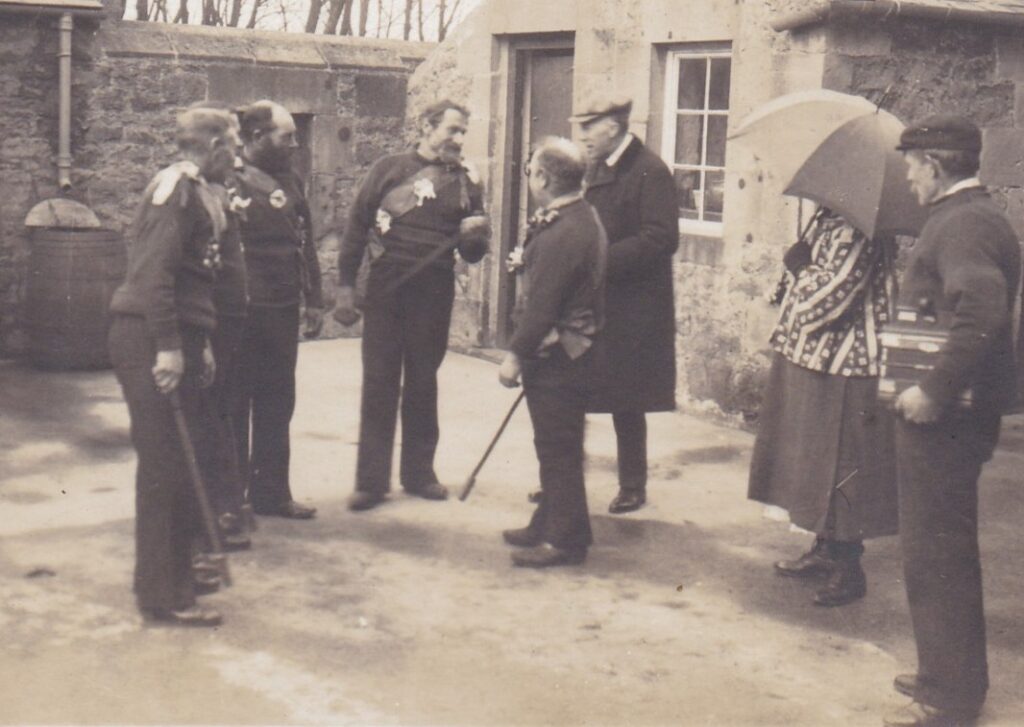
Cecil Sharp shown talking with five rapper sword dancers at Beadnell, Northumberland. On the right or the photograph is a Bessie, carrying a parasol, and a one-row melodeon player.
Cecil Sharp (centre, in cap) collecting the rapper sword dance at Beadnell, Northumberland, 1912 

Anne Geddes Gilchrist

Anne Geddes Gilchrist, 1863-1954

Born in Manchester of Scottish descent, the majority of Gilchrist’s song collecting work took place in Lancashire. However in the 1890s and 1900s her brother William was Presbyterian minister at Blackham in Sussex, and on visits to stay with her brother she took the opportunity to collect songs and children’s games in the local area. Blackham is very close to the border with Kent, and a few of the singers she encountered had been born and brought up in Kent: agricultural labourer Thomas Coomber and William Ford the blacksmith both came originally from Penshurst, while William’s wife Agnes was from Cowden; Mrs Matilda Jenner was still living in Kent, at Ashurst, but once again, was originally from Penshurst.

You can read more about Anne Gilchrist and her collecting work on the VWML website: Anne Geddes Gilchrist Papers; and in this article by Peter Snape: In Search of Folk Song: The Story of Anne Geddes Gilchrist.

Proudly powered by WordPress | Theme: Baskerville 2 by Anders Noren.

Up ↑