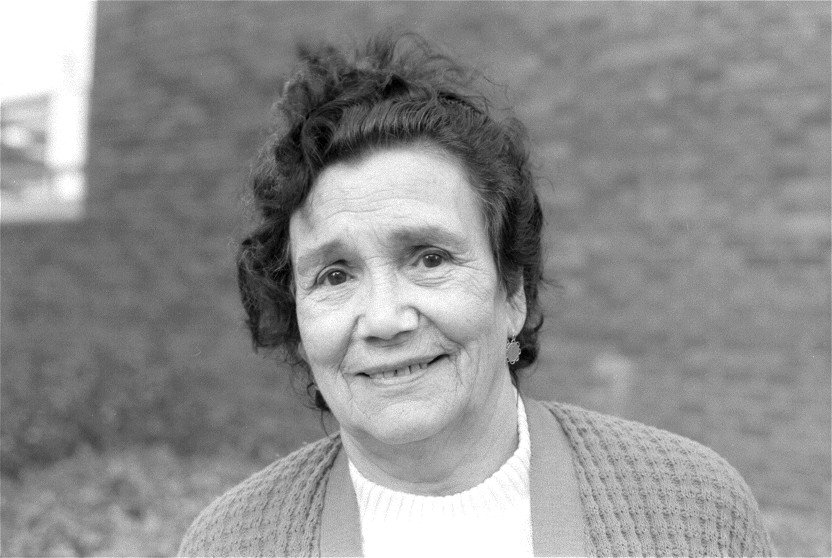
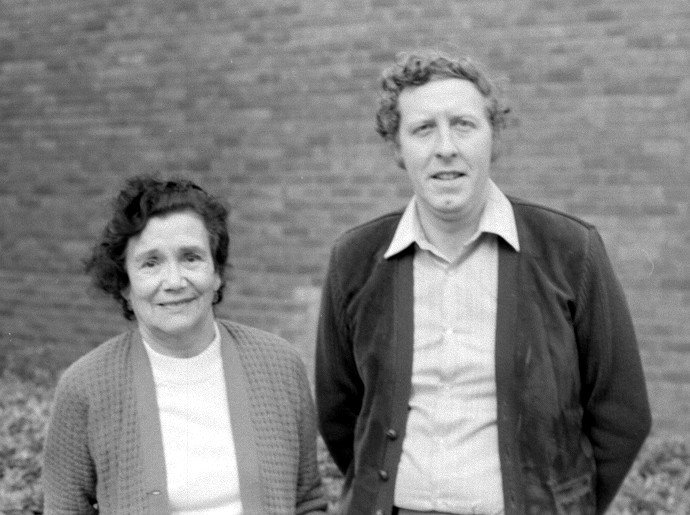
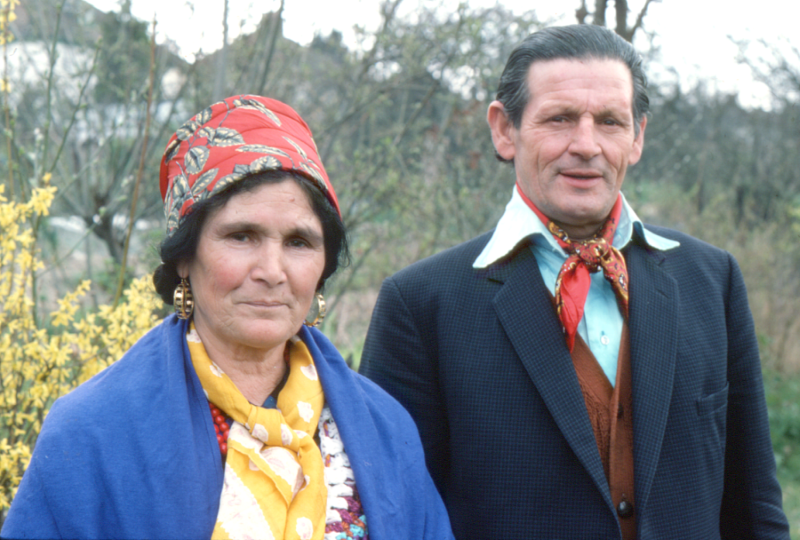
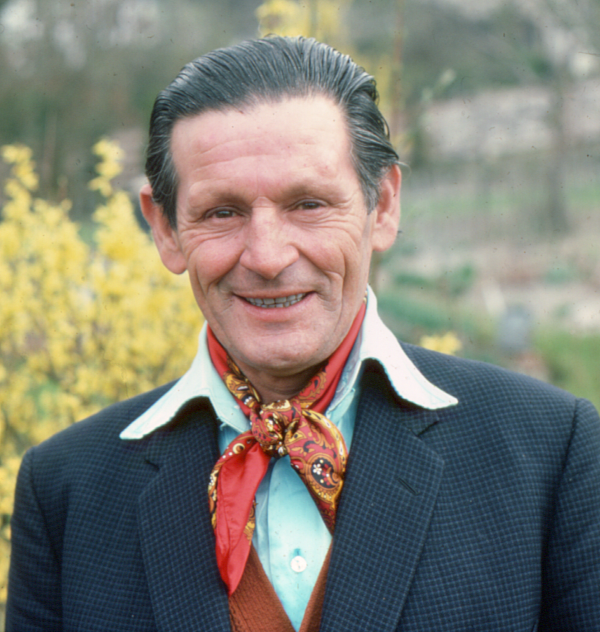
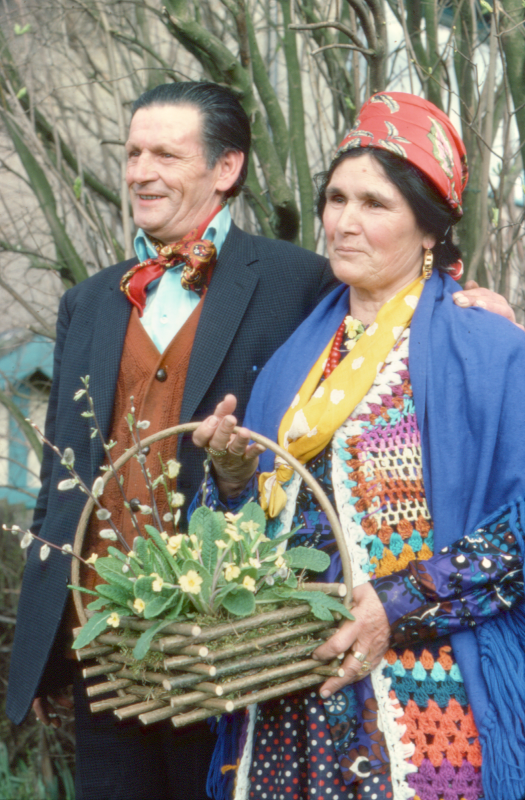
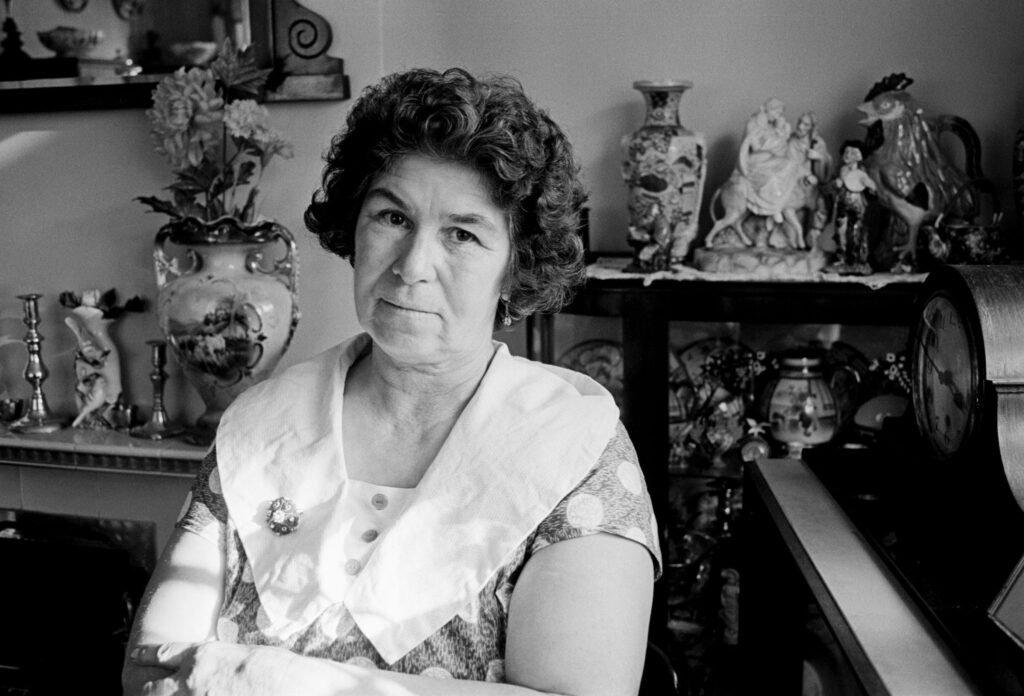
Stephen Sedley recorded a number of songs from the Gypsy singers Joe and Lena Cooper, camped near Edenbridge, and it was they who suggested he should visit Joe Saunders; indeed, their son Bert accompanied Sedley on his first visit, to show him the way.
The Coopers were insistent that I should record their kinsman Joe Saunders [Sedley records in a footnote “I think he had one or two spare names; one was Ridley”]. Joe’s caravan, which he shared with his grown-up daughter Liza, was stationed on farmland on Biggin Hill with the agreement of a friendly farmer. I visited him there at least twice in 1965-7.
Joe was a veteran poacher (I suspect he paid rent in the form of an occasional hare or pheasant). He was also a bird-breeder. He told me that as a boy he would teach a canary to sing a linnet’s note, then use it as live bait to trap a linnet. The offspring were sterile and hence known as mule-birds, but they were superb singers. ‘You could get five pound for one at the big houses.’ It’s at least possible that he also bred fighting cocks.
Liza had a superb voice, but she preferred to sing Jim Reeves classics that she’d learnt from the radio. Joe wouldn’t sing a note without a quart of cider, but once this was provided he was unstoppable. His songs, as the tapes illustrate, were in large part the classic English rural repertoire, enhanced by Irish rebel songs (‘Kevin Barry’) and subversive army songs (‘McCafferty’). Their fit with the traditional repertoire can perhaps be best seen from the use made of them in two anthologies, The Seeds of Love (1967) and Who Killed Cock Robin? (2021, with Martin Carthy).1
Sedley – who found himself defending Gypsies in court on more than one occasion – notes that Joe Saunders “had the unusual good fortune of a year-round standing for his caravan on a friendly farmer’s land on Biggin Hill, so he was safe from harassment”.2
Piecing together any kind of biographical picture of Joe Saunders has proved very difficult. Stephen Sedley believes that Joe had been in the army as a young man, and that he might have been aged around eighty at the time that he met him.3 Based on this information, one possible match is found in a Militia Attestation dated 31st December 1900, where a 22-year-old Joseph Saunders from Croydon in Surrey was signing up to serve in the 3rd Battalion, East Surrey Regiment. His residence was given as 82 Wilford Road, Croydon, his trade or calling was shown as Costermonger, and his most recent master was a Mr McDonell of Croydon. Looking at the Census records for 82 Wilford Road in 1901 – just a few months later – we find that the Head of the Household is William Saunders, aged 41, whose occupation is Hawker. Living with him are his wife Mary Ann, and eight children, the two eldest of whom are also shown as Hawkers. Ten years earlier, in 1891, William and Mary Saunders were living at 17 Union Street, Croydon. At the same address were four sons, aged from five to ten, but Joseph was not among them, nor has any record of his birth or baptism been located as yet. There is absolutely no guarantee that this is the same person as the Joe Saunders whom Stephen Sedley met in the 1960s, but no more likely match has so far been found.
The situation is further complicated by the fact that the singer who Mike Yates recorded in the 1970s as Joe Jones (aka “Sharper’s Joe”) appears in fact to be Joe Saunders, under a different name. It is not simply that those songs recorded from Saunders / Jones by both Sedley and Yates share the same tunes and words, but comparison of the recordings suggests that it’s the same singer – albeit, almost a decade on, sounding rather older.
Yates appears to have recognised this: there are recordings in his collection where the performer is labelled as “Joe Jones “Sharper’s Joe” 1966.03.26 Biggin Hill, Kent”.4 Listening to these recordings, it is clear that they are identical to those made of Joe Saunders by Stephen Sedley; not only that, but the date and location tally exactly with those of Sedley’s recordings.
In the same way as Joe and Lena Cooper had pointed Stephen Sedley towards their kinsman Joe Jones, Mike Yates was directed to Sharper’s Joe by a Gypsy called Joe Cooper (whom I have assumed, perhaps incorrectly, to be the same Joe Cooper as Sedley had recorded).
The first gypsy that I met was Joe Cooper, an old man who had parked his trailer in a country lane near to where I live. I saw him one afternoon sitting bolt upright on a wooden chair which had been conveniently placed by the side of an open wood fire. Joe was cleaning a fiddle and I could hear him humming a tune to himself as he went about his work. The fiddle provided a mutual topic of conversation and, before long, we were talking like long lost friends. On the subject of songs I found Joe to be somewhat reticent. He sang me three or four, but confessed that his heart really wasn’t in the singing, explaining that he had just lost his wife and that songs had meant a great deal to her. Anyway, he said, why didn’t I go and see ” Sharper’s Joe ” who was only camped a few miles away. He would certainly oblige.
And oblige he did. I met Joe Jones within the week and discovered that his father’s name was Sharper — hence his own nickname ” Sharper’s Joe” — and that, although aged about ninety, he was only too willing to sing. In fact, once started it was almost impossible to get him to stop! On one memorable October morning I switched on a tape recorder and recorded the following songs: Van Dieman’s Land. The Box Upon Her Head. The Farmer of Chester. King William and the Keeper. Shooting Goshen’s Cock Ups. I Wish, I Wish. The Banks of Sweet Primroses. Hares in the Old Plantation. Brian O’Lynn. The Banks of Claudy. In Thorneymoor Park. Brennan on the Moor. John Barleycorn. It soon became apparent that Joe was not only a singer but an expert story teller, a non-stop riddle teller and a champion toast master as well. His favourite toast runs like this:
Lending and spending and giving away Are the three easiest things you can do in a day. But working and labouring and earning your own Are the three hardest things that man’s ever known. Here’s to the man that’s industrious. Here’s to the man that works hard for his brass And never denies his own country.5
Writing in the 1975 Folk Music Journal, which included transcriptions of three of Joe’s songs, Mike Yates wrote
Although now in his nineties, Mr Jones has a good memory. In his youth he was a poaching companion of the late George “Pop” Maynard of Copthorne6
George Maynard was a well-known singer from Sussex, recorded in the 1950s and early 60s by Peter Kennedy and Ken Stubbs7. There are at least two songs – ‘Shooting Goshen’s Cock-Ups’ and ‘William Taylor’ (‘You Subjects of England’), both poaching songs – which were found in the repertoire of both Pop Maynard and Joe Jones.
Yates’ recordings of Sharper’s Joe were made between 1973 and May 1975. It’s worth noting that, if he really was born in 1878, he must have been aged around 97 when the last of these recordings were made, and was still in remarkably fine voice.
Included in the 1975 FMJ article was a full list of the songs that Yates had now recorded from Joe. Several of these recordings subsequently appeared on the Musical Traditions CD, Here’s Luck to a Man… released in 2003. In the CD booklet Yates wrote
Joe Jones, or ‘Sharper’s Joe’ – after his father, Sharper Jones – (or even ‘Joe Cooper’ as I heard him addressed on one occasion) and his wife Lena were living in an old caravan on a site at St Mary Cray, Kent. Whenever I called, Joe would be squatting over an outdoor fire, no matter whatever the weather, and all of my recordings were made outdoors. On one occasion, when we were constantly being interrupted by children, we retreated to the edge of a nearby wood. As I set up my mike stand I felt something tapping my shoe. Simultaneously Joe began to frantically point and shout and it was only when I looked down that I noticed that I had stepped backwards onto a rather sleepy adder. Luckily the fangs failed to cut through the shoe and no damage was done.8
This paints a vivid picture. But it creates yet more confusion for anyone trying to unpick the details of these Gypsy singers. While Mike Yates talks about Joe living with his wife, Lena, Stephen Sedley makes no mention of Joe’s wife, saying only that he lived with his daughter Liza. Meanwhile the recordings on Here’s Luck to a Man… ascribed to ‘Lena Jones’ are definitely those made by Sedley in the 1960s of Lena Cooper, while the version of ‘Ripest Apples’ on the CD is not, as the track listing would have you believe, sung by Joe Jones, but by Lena’s husband Joe Cooper (again, recorded by Sedley in 1966).
Songs
“He had a large repertoire. He wouldn’t sing a note until he had a quart of cider, but once started he couldn’t be stopped”.9
Joe Saunders, recorded by Stephen Sedley:
As I was bound apprentice (Roud 299)
The Barley Straw (Roud 19112)
Bold Reynolds (Roud 190 / 358)
Botany Bay (Roud 261 / 519)
Captain Grant (Roud 1286)
The Cuckoo (Roud 413)
The Cuckoo’s Nest (Roud 1506)
Down by some riverside (Roud 564)
The Farmer of Chester (Roud 2638)
The Game of Cards (Roud 232)
Gather round (Roud 23635)
Hares in the old plantation (Roud 363)
Hartlake Bridge (Roud 1729)
I Wish I Wish (Roud 495)
King and the Keeper, The (Roud 853)
Love it is pleasing (Roud 1049)
My single sailor (Roud 264)
Oyster Girl (Roud 875)
The Pear Tree (Roud 1713)
Ripest Apples (Roud 146 / 542)
Squire Poppa’s Park (Botany Bay) (Roud 519)
Ten Penny Walnuts (Roud 2520)
Transportation Song (Roud 519)
When this wicked war is over (Roud 3446)
Yonder Comes The Devil (Roud 16319)
Joe Jones, recorded by Mike Yates:
The Banks of Claudy (Roud 266)
The Banks of Sweet Primroses (Roud 586)
The Barley Straw (Roud 19112)
A Blacksmith Courted Me (Roud 816)
Bold Reynolds (Roud 190 / 358)
Botany Bay (Roud 261)
Box upon her head (Roud 289)
The Brake of Brambles (Roud 47479)
Brennan on the Moor (Roud 476)
Brian O’Lynn (Roud 294)
Captain Grant (Roud 1286)
The Cuckoo (Roud 413)
Cuckoo’s Nest (Roud 1506)
The Farmer of Chester (Roud 2638)
The Game of Cards (Roud 232)
Hares In the old Plantation (Roud 363)
Hartlake Bridge (Roud 1729)
I called for a pot of ale (Roud 47478)
I Wish I Wish (Roud 495)
John Barleycorn (Roud 164)
The King and the Keeper (Roud 853)
Little dun mare (Roud 176)
Love is pleasing (Roud 1049)
On board a Man o’ War (Roud 662)
The Pear Tree (Roud 1713)
Seventeen come Sunday (Roud 277)
Susie Simmonds (Squire Poppa’s Park, Transportation Song, Van Dieman’s Land) (Roud 519)
Thornymoor Park (Roud 222)
Yonder Comes The Devil (Roud 16319)
You rambled up the street, I rambled down (Roud 25885?)
Toast: The Little Bees
Toast: Lending and spending and giving away
Discography
Mike Yates’ recordings of Joe Jones are included on the following releases:
Here’s Luck to a Man: An Anthology of Gypsy Songs & Music from South-East England, Musical Traditions MTCD320 (CD-R, 2003).
Stephen Sedley, Joe and Lena Cooper, Joe and Liza Saunders: A note to accompany tape recordings of Travellers’ songs made in 1966 at Edenbridge, personal communication, August 2023. ↩︎
Stephen Sedley, email correspondence, 12 March 2025 ↩︎
Stephen Sedley, email correspondence, 11 and 12 March 2025 ↩︎
Stephen Sedley, then a young barrister, recorded Joe and Lena Cooper at Edenbridge in March and April 1966, having successfully defended their son Abraham in a court case.
The privilege this earned me was a welcome in any caravan in the Edenbridge area. Abe introduced me to his parents, Joe and Lena Cooper, who readily talked and sang for me as I ran the Uher.
Lena, a Romany from the Lee clan, had danced and sung with her brother on the Dartford stage as a child. Joe, from an urban background, had volunteered in 1914, had been gassed twice but had survived, only to find that Lloyd George’s ‘homes for heroes’ didn’t exist. He went on the road. From him I recorded a version of the trench song ‘When this lousy war is over’ which I used in a centennial presentation of WWI songs1 because Joe’s version began: “When this wicked war is over …”. He described mustard gas rolling knee-high as resembling morning mist in the hopfields.2
This record in the 1939 Register must surely be the family in question, their location being “Caravan in field Off Butts Lane, Sutton, Epsom and Ewell M.B., Surrey”.
First name
Last name
Birth date
Occupation
Marital status
Joe (Joseph)
Cooper
24 May 1896
Travelling Farm Worker
Married
Lena
Cooper
NK 1899
Hawker Unpaid Domestic Duties
Married
Abraham
Cooper
? Aug 1921
Travelling Farm Worker
Single
Lena’s birth year as written on the Register return is unclear. It could be 1879, but is more likely to be 1899 – and even this may not actually be accurate.
Earlier census and BMD records for Joe and Lena are patchy, and decidedly speculative.
Joseph Cooper, 1896–?
As shown above, the 1939 Register states that Joe was born on 24th May 1896. Possibly he was the same Joseph Cooper whose birth was registered in the Bromley District, in the second quarter of 1897, his mother’s maiden name given as Dekins.
Again this is speculative, but he could be the Joe / Joseph Cooper in the following census returns; we should probably not take too much notice of the variations in year and place of birth.
When recorded in 1966 by Stephen Sedley, Joe said that he had run away from home in Walton-on-Thames to join the army when he was 17, claiming to be 23. Based on a birth date of May 1896, that would place his enlistment as 1913-14, before the outbreak of the Great War.
I was not big enough to go into a public house to get a pint of beer with my mum and dad […] That was before the 1914 war. I see some soldiers come by, in these coats and things of London, I thought to myself I’d be happy if I was in that. And I did like the army. I promise you I did like it. I run away from home. From Walton-on-Thames, out against Kingston, and I went over to Weybridge in Surrey and I joined the Army there. Told them I was 23 years of age, but I was nowhere near it. I was only 17, and I told him I was 23 years of age. Asked me my mother’s name. Asked me my father’s name, I told him I did not remember, I did not know ‘em. I was fetched up with some people, I said I run and I left ‘em, because I was working too hard, but it was all the lies in the world to get in the army. And I done that.
Joe’s parents tried to get him out of the army, he said, but to no avail. He was sent to Kingston-on-Thames to have a health test, and thence to Woolwich Arsenal for his army training. There are army service records for a Joseph Cooper which in many respects tally with his reminiscences, but which also throw up inconsistencies. Records – sadly undated – show that his medical examination took place at Kingston, that his trade or occupation was “Dealer”, his birthplace was Mitcham in Surrey, and his stated age was 23. He was 5 feet 5½ inches tall, weighed 122 pounds, and his physical development was good.
Joe recalled that he had three weeks’ training at Woolwich, and then “I was over in France in three weeks”. This suggests that when he enlisted it was not so very long before the outbreak of hostilities – the first contingent of the British Expeditionary Force being sent to France on 15th August 1914. However it must have been before his eighteenth birthday on 24th May 1914; once eighteen he would not have had to lie about his age to be allowed to enlist.
When asked how long he’d been in the trenches, Joe replied “1914 to the end of the war. Yes, right the way through it”. The army records do not cast any light on his early years of service. In fact Joseph Cooper’s army service was recorded as having officially begun on 17th May 1916, and his Enrolment Paper, although undated, references the Military Service Act, 1916 (this was the legislation, introduced in January 1916, which brought in conscription from 2nd March that year). The Enrolment Paper gives Joe’s age as nineteen (which appears to be his true age on this occasion), and his address as Wickes Encampment, Shepperton; again, his occupation is given as “Dealer”. The paper is signed with an X (“his mark”) suggesting that Joe was illiterate – and Stephen Sedley confirms this. His next of kin is stated as his father, William Cooper, also residing at Wickes Encampment. If this is correct, and his father’s name was William rather than Joseph, then clearly it’s a different Joe Cooper to the one shown in the census records reproduced above. But one wonders if Joe was deliberately providing misleading information to the army; it has not been possible to trace a plausible William Cooper in census records, living with his son Joseph, and with an entry in the ‘Occupation’ field which suggests that the person is a gypsy.
Joe told Stephen Sedley that he served as an infantryman, and that he had been at the Somme, and at “the first battle of Cambia” (presumably Cambrai). The first significant use of tanks in battle was at Cambrai, and Joe talked about this, recalling that initially the tanks had been assigned to the Machine Gun Corps, before the formation of the Tank Corps (which later became the Royal Tank Regiment).
Army records show Joseph Cooper being called up and assigned to the Royal Fusiliers on 17th May 1916, transferring to the British Expeditionary Force on 30th August, and embarking for France on 1st September 1916. Initially he joined the 39th Infantry Base Depot (IBDs were holding camps located within easy reach of a Channel port, which received men on arrival from England and kept them in training while they awaited posting to a unit at the front), was then being enrolled in the 27th (Reserve) Battalion, Royal Fusiliers, before transferring to the 11th Battalion, Royal West Kent Regiment on 14th September 1916. He was transferred again on 25th December 1916 to the Heavy Branch of the Machine Gun Corps, and subsequently to the Tank Corps (formed in July 1917). He was demobilised on 14th December 1919.
He may have liked the soldier’s life, but that did not stop him being put on a charge on several occasions – for overstaying a period of leave, for being absent from parade, for “loitering during working hours” and “using threatening language to R.P. [Regimental Police] in execution of their duty”.
Joe Cooper’s reminiscences of life in the trenches were vivid, and entirely unsentimental. He talked of the difficulty of sleeping in a dugout, and of having to be constantly vigilant for snipers:
Now if you see them trees are moving about as green in the summertime, like, moving about… if you could see that tree move you’d know there was a sniper in there. Well you’d report that then. To the machine gun man. Well, the machine gun comes up number one, and he puts a Stokes [?] mortar in there… Well he blows him out of the tree altogether… If we didn’t shoot him, he’d shoot us.
He told of how gas would roll across the fields:
Now just say you been down the hop country, you seen a foggy morning haven’t you? You’ll see the fog off the ground somewhere about a foot to a foot and a half, that’s like the gas used to come up off the trenches, out on the battlefield.
How the British soldiers were initially unprotected against German gas attacks:
When they start using the gas in there, you had no gas helmets, nothing like that. We had to get our own water, our own water, you know, put it into a medicine bottle, soak it into the bottle. And when we seed the gas a-coming up, the gas alarm come through the trenches, ringing a bit of a bell… We had to put that water all in our own mouth. Only our own water mind. Over your nose and over the top…
And that, when they were provided with gas masks, at first these proved unsatisfactory.
When troops were ordered to go over the top
That was from two in the morning, from half past one or two o’clock. The officer used to come round with the orderly officer, with the rum issue, and he used to give him a tot of rum into a glass and we’d drink it. Well that used to put the nerve into you. If you understand what I mean now. Well, when they said boys “Stand to, ready to go”, you couldn’t hear a shell fire, you couldn’t hear a rifle fire or nothing. Not till the big guns started to the back of us, our own guns.
Then
if someone was hit on the battlefield, if he was my own brother I wouldn’t dare touch him. Wouldn’t dare to touch him if his arm was blowed off or his head was blowed off. Wouldn’t dare to touch him… Just take care of yourself. If you did you was entitled to a court martial, if you got catched at it. If they catch you doing it – ’cause we did do it, because we was doing it for the sake of your partner, if you could.
To recover the wounded from No Man’s Land they would use stretchers on wheels, attached to a rope, at night, so as not to be seen. Then they would attend to the wounded as best they could, and take them down the supply trench back to the second line of defence.
Joe spoke dispassionately about the enemy, recognising that “Some was pretty good, some was bad, ’cause we had to do it the same as they did… They tried to blow us up and we tried to blow them up”. But he was far from oblivious to the desperate conditions in which men found themselves:
I should think it was about from three to four weeks when we did get in the real, proper slaughter. We had no dugouts. We had no trenches. We had dug up just a little trench, and told to dig out as well we could from shell hole to shell hole to shell hole, and dig ourself in. But after we’d done that, it was real proper murder, they served us so that you could almost see the blessed angels come down from the sky to stop the war. With my own two loving eyes. And that’s the God’s honest truth, as ever was in heaven.
And when, finally, the armistice came, the men were all infested with lice:
What they call these lice, real proper lice. You’ve heard talk of lice, haven’t you? Well in the front line trenches we got smothered with them things. Even come out the lace holes of our boots, or our shirts. Clothes we had on, they was not fit to wear. We had to take ‘em off and destroy ‘em outside… We did burn them up and put all new clothes on.
Then after the war, as Stephen Sedley recounts, he came home to find that, contrary to Lloyd George’s assurances, there were no “homes fit for heroes”, and he took to (went back to?) a life on the road.
As yet, no record of Joe Cooper’s death has been located.
Lena Cooper, née Lee, 1899(?)/1904(?)–1968?
While the 1939 Register appears to show Lena’s birth year as 1899, other records suggest that she was born in 1904. The birth of a Lena Lee was registered in the Maidstone District in the second quarter of 1904, and this tallies with census records – for instance with the Lee family recorded in the 1911 census at Iron Mill Lane, Crayford:
1911 – Iron Mill Lane, Crayford, Kent
First name
Last name
Relationship to head
Age
Approx. Birth year
Occupation
Birth place
Leonard
Lee
Husband
50
1861
Clothes peg maker, Hawker
Swancombe, Kent
Ellen
Lee
Wife
46
1865
Clothes peg seller, Hawker
Heathfield, Sussex
Louisa
Lee
Daughter
25
1886
Clothes peg seller, Hawker
Hollenton, Sussex
Sarah
Lee
Daughter
23
1888
Clothes peg seller, Hawker, Hawker
Hollenton, Sussex
Walter
Lee
Son
14
1897
Clothes peg maker
Kent, Chatham
Celia
Lee
Daughter
10
1901
School
Kent, Folkestone
Lena
Lee
Daughter
7
1904
School
Kent, Marden
Tilly
Lee
Daughter
4
1907
–
Kent, Swanley
And at Belvedere ten years later:
1921 – Occupation Road, Belvedere, Erith, Kent
First name
Last name
Relationship to head
Approx. Birth year
Age
Occupation
Employer
Birth place
Leonard
Lee
Head
1863
58
Street Hawker
Own Account
Not known
Ellen
Lee
Wife
1866
55
Street Hawker
Own Account
Not known
Lena
Lee
Daughter
1903
18
Street Hawker
Own Account
Epping, Essex
Tilly
Lee
Daughter
1906
15
Home Duties
Epping, Essex
(Clearly this is the same family, although there are inconsistencies between 1911 and 1921 with the girls’ ages and place of birth).
If this is the right Lena Lee, then she only had one brother, Walter, so it must have been with him that she danced and sung on the Dartford stage as a child – although when recounting how she and her brother used to dance, she seems to refer to him as Billy.
As well as singing songs, Lena diddled several dance tunes. She recalled that she would perform on the Dartford stage at 11 or 12 o’clock at night. She had a brother who used to play the tambourine and the mouth organ while she danced – “shuffle on, cakewalk, and step dance – any step tune you could play, he’d do it”. When she was twelve years of age they had been performing in the street when they came to the notice of a gentleman who, having followed them for a while, bought them both a cup of tea, gave them a golden sovereign, and subsequently on a Sunday visited their home to speak to their mother, arranging for a car to come and pick them up at 6 o’clock that day – presumably so that they could perform at a local theatre.
Lena said that her paternal grandfather “was a bit of a Spain man” and “my father, you would take him to be, if he was alive… he would look if he was a Spain man. There was a bit of a mix-up in the blood, you see, but he is a bit of a Spain man, my father is”. When asked, did she mean that he was from Spain, Lena answered “Yes, from Rome”.
It is not known when Lena and Joe met and married. In the 1939 Register, their son Abraham’s date of birth was given as August 1921. If that date is correct, then it casts doubt on the relevance of the other census records quoted here, since both Joe Cooper and Lena Lee appear to have been single, and living with their parents at the time of the 1921 census, taken just two months earlier.
The death of a Lena Cooper – probably the same person – was recorded in the Tonbridge district, in the second quarter of 1968.
Mike Yates and Joe Cooper
Writing in English Dance and Song in 1975, Mike Yates recorded that
The first gypsy that I met was Joe Cooper, an old man who had parked his trailer in a country lane near to where I live. I saw him one afternoon sitting bolt upright on a wooden chair which had been conveniently placed by the side of an open wood fire. Joe was cleaning a fiddle and I could hear him humming a tune to himself as he went about his work. The fiddle provided a mutual topic of conversation and, before long, we were talking like long lost friends. On the subject of songs I found Joe to be somewhat reticent. He sang me three or four, but confessed that his heart really wasn’t in the singing, explaining that he had just lost his wife and that songs had meant a great deal to her. Anyway, he said, why didn’t I go and see “Sharper’s Joe” who was only camped a few miles away.3
Mike Yates does not specifically say that he recorded the few songs which Joe Cooper sang for him, and there do not appear to be any recordings of him among the Yates recordings deposited with the British Library and Vaughan Williams Memorial Library. However the same article in English Dance and Song included a transcription of ‘Ripest Apples’, collected from Joe Cooper in January 1970. This is similar, but not identical, to the version of the song which Stephen Sedley had recorded. Cooper is a common Gypsy surname, so we can’t be sure if the Joe Cooper that Mike Yates met is the same man as Stephen Sedley recorded in 1966. On the other hand, the fact that this singer had recently lost his wife would tally with Lena having died eighteen months or so previously.
The Musical Traditions CD Here’s Luck to a Man… An Anthology of Gypsy Songs & Music from South-East England (MTCD320, 2003), featuring recordings made by Mike Yates, includes one song and a toast credited to “Lena Jones”, but careful listening suggests that these are in fact Stepehen Sedley’s recordings of Lena Cooper.
Songs
Recorded by Stephen Sedley, 26th March and 19th April 1966:
Joe Cooper
Gather Round (Roud 23635)
Love it is pleasing (Roud 1049)
My single sailor (Roud 264)
Ripest Apples (Roud 542)
When this wicked war is over (Roud 3446)
Collected by Mike Yates, January 1970:
Ripest Apples (Roud 542)
Lena Cooper
Recorded by Stephen Sedley, 26th March and 19th April 1966:
Barbara Allen (Roud 54)
Died for love (Roud 60)
Don’t think by my clothes (Roud 7337)
Down by the riverside (Roud 564)
Forgive and forget (Roud 21545)
Gypsy girl (Roud 7337)
How much is that doggie in the window? (Roud 23633)
I owe my landlord three weeks’ rent (Roud 1455)
If I was a blackbird (Roud 387)
I’m mother’s baby boy (Roud 23639)
I’m the bloke you don’t meet every day (Roud 975)
In the shade of the old apple tree (Roud 10242)
Just an old fashioned lady (Roud 23644)
Just like the ivy (Roud 16228)
Knees up Mother Brown (Roud 23634)
Love it is pleasing (Roud 1049)
Meet me by moonlight (Roud 767)
The old brass ring (Roud 23643)
Only a beautiful picture in a lovely golden frame (Roud 13625)
Only a leaf (Roud 23645)
Pleasant Dreams (Roud 23637)
A pub with no beer (Roud 23631)
There was an old farmer in Chester (Roud 2638)
There was an old tailor in London (Roud 311)
Waiting for the Robert E Lee (Roud 23632)
When this wicked war is over (Roud 3446)
Wild colonial boy (Roud 677)
Young sailor cut down in his prime (Roud 2)
Toast: Here’s good luck to a man (Roud 23648)
The bells of hell, initially compiled as the keynote lecture for the Oxford history faculty centenary conference 2014, and last performed at Cecil Sharp House on 11 November 2018 (recording archived in the Vaughan Williams Memorial Library). ↩︎
Stephen Sedley, Joe and Lena Cooper, Joe and Liza Saunders: A note to accompany tape recordingsof Travellers’ songs made in 1966 at Edenbridge, personal communication, August 2023. ↩︎
Mike Yates, Some Gypsy Singers in South East England, English Dance & Song 37:1 (1975) pp.14-15 ↩︎
This is a parody of the Music Hall song ‘Our threepenny hop’, the chorus of which runs
At our threepenny hop, our threepenny hop; Where the boys and girls are found Hopping it round and round and round; When you start a-dancing you never know when to stop. It’s Hi! Hi! Go as you please, at our threepenny hop.
This detailed transcription of the tune and its variations is as printed in the Folk Music Journal, although in practice it is quite likely that Mary Ann Haynes never sang the song the same way twice.
Given that she was born in Portsmouth and spent much of her life in Brighton, it would be extremely bold to claim Mary Ann Haynes as a Kentish singer. However she came to Kent regularly for seasonal agricultural work, and deserves a mention on this website as singer of a particularly fine version of the song ‘Hopping down in Kent’.
Mike Yates recorded three dozen songs from Mary Ann Haynes in the 1970s. In the notes for the Musical Traditions CD Here’s Luck to a Man… he wrote:
One of the first Gypsy singers that I met was Mary Ann Haynes. I had been told that her son, Ted, was a singer and I drove down to Sussex one Sunday afternoon, looking for his trailer. Eventually, I found Ted and his trailer in a field. He was busy and directed me to his mother, who ‘knew all the old songs’. Mary lived in High Street, Brighton, where, according to Ted, she was known to ‘everybody’. High Street turned out to be a narrow street off the sea-front and was full of large tower blocks. I started knocking on doors, only to be told that nobody knew a Mrs Haynes. I found that when I mentioned that she was a Gypsy doors were closed very quickly in my face. I began to wonder if I would ever find Mary, and was about to give up, when a lady said that there were no Gypsies in the area, only ‘an Italian looking lady’. This was, of course, Mary. When I arrived she was sleeping off a lunchtime session in the pub, but, once roused, she set about making a cup of tea and, having said that I knew her son (sort of), she began to sing as soon as I mentioned songs. Mary had been born in 1905, in a Faversham waggon parked behind The Coach and Horses in Portsmouth, Hampshire. Her father, Richard Milest, was a horse-dealer whose family would accompany him across England during the summer as he made his way from fair to fair. “We used to go to the Vinegar & Pepper Fair at Bristol, then to Chichester, Lewes, Canterbury and Oxford, then up to Appleby and back down to Yalding.” Mary’s husband died suddenly, leaving her with a large family, and, having settled in Brighton, she worked as a flower-seller, earning enough to support her family. 1
I was unable to find any trace in official records of her father under the name Richard Milest (or Millest, which seems to be the more usual spelling of the surname). However evidence suggests that the family’s name was in fact Millis, and he was probably the Richard Millis whose birth was recorded in the Battle district of Sussex in 1863, and who, at the time of the 1881 census, was residing at 25 St Mary Magdalene Street in Brighton. 19 years old at the time, Richard was working as a Bricklayer’s labourer. His father Henry was listed as a Horsedealer.
Janet Keet-Black, co-founder of the Romany and Traveller Family History Society, confirms that Mary Ann’s maiden name was Millis in a 2025 interview with Will Duke:
Janet: Brighton used to get a lot of Travellers stopping, for short term, short times, around, up on the downland around Brighton, and they, some of them, would become settled, but still retain their ‘Gypsyness’, if you like. And one of those families were the Millis family. They had wagons, in the 1900s, worked with horses, hawked, whatever, did farm work. And you could find them at Falmer, up on the Downs at Woodingdean, all over. They’re still very much in Brighton, the Millis family.
Will: Millis, M I …
Janet: It’s M, I, double L, I, S: Millis, or it also became Mellish, M, E, double L, I, S, H, same family, Millises, Mellishes. One of the most famous Millises was Mary Anne Haynes.
Will: Right. Okay, yeah.
Janet: Her dad was a Millis.
Will: She was a great singer, when she wasn’t working, yes …
Janet: … when she wasn’t working. She was born down in Southampton, I think … Portsmouth, behind a pub in Portsmouth, but she died in Brighton. She became a flower seller. Yeah, her dad was a Millis, Mellish. I think he turned out, I think he ended up as a Mellish.
Will: And she married a Haynes.
Janet: She married somebody called Ted Haynes, who was a basket maker. But the interesting thing with Mary Anne is that, I think it was her grandmother who was a Willet, Elizabeth Willet …
Will: tell us more …
Janet: which made Mary Ann Haynes’s father, first cousin to Tom Willet, which sort of makes sense, if you think about it … 2
Mary Ann married Ted Haynes, also from Brighton, in the second quarter of 1922, and their first child; also Edward, was born in February 1925. At the time of the 1939 Register, taken in September of that year, it is no surprise that she was to be found in Kent, hop-picking. Specifically, she was at “Spelmonden Farm, Hazel Street” – this was probably Hazel Street Farm, Spelmonden Road, Horsmonden. Her occupation was given as “Hawker. Gen Dealer”, and her date of birth as 9th April 1904 (when her death was recorded in 1977, her birthday was also shown as 9th April, but the year as 1905). With her in the hop-pickers’ huts were her fourteen-year old son Edward (Ted), and four other children: Alice Mary, Kathleen, Elizabeth (Betty) and one-year-old John.
The birth records for Alice (registered in the Reigate district, 1931), and her sister Elizabeth (registered in Brighton, 1936), both give the mother’s maiden name as Millis. It was presumably Alice who accompanied her mother to prison in October 1932, as reported widely in newspapers including the Daily News and Daily Mirror. The Belfast Telegraph for Saturday, 22nd October 1932 reported as follows:
BABY TO GO TO PRISON.
MOTHER’S BEQUEST GRANTED.
When Mrs. Mary Ann Haynes, a 26-year-old gipsy woman, was sentenced to a month’s hard labour at Brighton Police Court yesterday for being drunk in charge of a horse and cart and obstructing a policeman, she exclaimed: “Please let my baby go with me.”
The magistrates, after conferring together, agreed, and Mrs. Haynes, smiling happily, said: “Oh, thank you very much”.
A later court report gives Mary Ann’s address as 37 Edward Street, Brighton:
HURSTPIERPOINT
For depositing rubbish in the Brighton-rd. a short distance from Muddleswood cross-roads on February 7, Mrs. Mary Ann Haynes, of 37, Edward-s. Brighton, was fined 10s. at Haywards Heath Magistrates’ Court.3
Edward Street is literally just around the corner from High Street, Brighton, where Mike Yates would find her in the 1970s.
David Stacey, who in between archaeological digs spent a good deal of time apple-picking and hop-picking in Kent in the 1960s and 1970s, met Mary Ann’s son Ted Haynes – himself a singer – in The White Hart at Claygate.
Towards the end of the season Ted, after a particularly good session, said “You like the old songs, boy, don’t yer – you ought to meet my mother, she’s a bit of a rough’un but she can sing” and he handed me his card.
Although my girl partner of the time and I were due to move to warmer climes before the winter set in I persuaded her that we should make the effort to find, and if possible, to record Ted’s mother, as I would like to learn some of the songs I felt sure she knew. We had little money to spare on such a venture and no recording equipment of any sort but we set off across southern Britain, finishing up in Brighton where Ted’s mother, Mary, lived.
Travellers, justifiably, keep themselves to themselves and, although I had Ted’s invitation to meet his mother, there were many delays before I was given the name of a pub where I would find Mary and other members of her family. Meanwhile there were two mouths to feed and the chills of winter were setting in. Approaches to the folk clubs of Brighton for any sort of assistance were generally greeted with scorn although students who ran a club at the University of Sussex did find us an empty room in a dorm and another club allowed us to hold a raffle. By then, if we had delayed our departure any longer we would have been too broke to travel. We had to leave, but the meeting with Mary Haynes had confirmed that she had a wealth of songs. I knew she should be recorded and searched desperately for somebody who could get her repertoire on tape. Eventually I gave her contact details to Dave Bland, at that time doing some field recordings for Bill Leader. In the end David passed her details on to Mike Yates who eventually did record Mary and went on to describe her as “one of the most outstanding folksinging discoveries to be made in recent years” (Green Grow the Laurels Topic 12TS285).4
Mary Ann Haynes died on the 10th November 1977, and was buried in Brighton and Preston Cemetery.5
For a full list of songs collected from Mary Ann Haynes, search the Roud Index.
Writing in 1975, Mike Yates provided this list of songs which he had recorded from Mary Ann Haynes:
All For the Grog
All Through Mi Rakli
American Stranger, The
At the Atchin
Tan Barbara Allen (Child 84)
Bold Drunkard
The Bold Robert Emmet
Bonny Black Bess (Laws L9)
Botany Bay (Laws L16A)
Coachman’s Whip, The
Colour of Amber, The
Erin’s Lovely Home (Laws M6)
Farmer of Chester, The (Laws L2)
Farmer’s Boy, The (Laws Q30)
Father Build me a Boat (Laws MI)
Female Drummer, The
Floating on the Tide (The Lilly White Hand)( Laws P18)
Folkestone Murder,
The Game of Cards, The
Give me Back the One I Love
Green Bushes, The (Laws P2)
Green Grow the Laurels
Hares in the Old Plantation
Hopping Down in Kent
I Am a Rakish Young Fellow
I’m A Girl that’s Done Wrong to my Parents
I’m a Romany Rye
If I Were a Blackbird
In Thorneymoor Fields
Jim the Carter’s Boy
Little Ball of Yarn, The
Little Dun Dee Long A-Growing (Laws 035)
Lord Bateman (Child 53)
Lovely Johnny
McCafferty
Master and Man
Mossy Green Banks of the Lea (Laws 015)
My Lovely Hops
“New” Deserter, The
Old Gypsy’s Waggon, The
Old Plaid Shawl, The
Old Miser, The
Old Rugged Cross, The
Outlandish Knight, The (Child 4)
Oyster Girl, The (Laws Q13)
Poor Leonard (Laws Q33)
Poor Old Horse Rambling Sailor, The
Riding Down to Portsmouth
Seventeen on Sunday (Laws 017)
Shamrock Shore, The
Sheepfold, The (Laws 010)
Shooting Goshen’s Cock-Ups
Song of the Thrush, The
Tanyard Side, The (Laws M28)
Those Cruel Slavery Days
Twenty-One Years (Laws E16)
Unfortunate Rake, The (Laws Q26)
Wexford Murder, The (Laws P35)
Yellow Handkerchief, The
Yates noted
Not all the above songs were known as complete versions. Furthermore, the list is, by choice, selective. I have recorded some music hall songs from Mrs Haynes, and these are shown above, but I have not listed the large number of 20th century pop songs which she also knows.6
Discography
Recordings of Mary Ann Haynes appear on the following albums:
Many thanks to Mike Yates for permission to reproduce the photographs on this page.
Mike Yates, booklet notes for Here’s Luck to a Man… An Anthology of Gypsy Songs & Music from South-East England, Musical Traditions, MTCD320, 2003, https://mustrad.co.uk/articles/luck.htm#sing↩︎
This article deals with the Romany Gypsy singer Minty Smith, and two of her brothers, Levi and Jasper Smith. Rather than give each person a separate web page, I have covered all three together here, since their lives were so closely intertwined – not just as children, but in adult life too, they often travelled together or were encamped not far from each other. That is one reason why this page is so long. The other is the wealth of sources in which they appear. I have quoted at length from an interview with Jasper recorded in the mid-1960s. And also from the numerous local newspaper reports where one or other of the Smiths is quoted in an article on “the gipsy problem” (as it was invariably described), or where details are given of their many court appearances on charges of being encamped by the highway, or obstructing the highway. Readers may find the latter reports repetitious, and you may choose to skip through them; but I have quoted so many at length simply because this serves to bring home the extent to which travellers were subject to harassment from the authorities – for example, in 1967 Levi seems to have been in court facing the same charges, but with a rising scale of fines, on an almost monthly basis.
The following links may help to navigate this long article:
Minty and Jasper Smith, 1970s. Photo by Mike Yates.
The Romany singers Minty, Levi and Jasper Smith were recorded by Mike Yates in the 1970s, at various locations in Kent and Surrey, and Mike’s recordings of the siblings have appeared on LP and CD releases on the Topic and Musical Traditions labels (details in the Discography). They were among the children of Liza, née Cooper, and Derby Smith who, according to an obituary of his son Jasper, “in 1887 was ushered into this world in a tent on Derby day”1. Actually, most official records suggest Derby’s birth year was 1899 or, based on his given age in the 1921 census, 1895.
Derby’s parents were Alfred, known as Alf or Elf, born around 1854, and Charlotte (Lottie) née Lee, the daughter of a gypsy hawker. They were married in 1879 at Christ Church, Battersea, 1879. Elf made chairs which he sold door to door, while Lottie told fortunes. They travelled around London – Fulham and Battersea – and Surrey, and would always go to the Epsom Derby in June.2
Derby Smith and Eliza Cooper were married on 3rd January 1911 at St James’ church, Shere, in Surrey. He was 22 years old, and his occupation was given as Hawker. His bride’s name was on this occasion spelled “Elisa”. She was 20 years old, and her father William Cooper – known as ‘Bundle’ – was listed as a Hawker3. Both Derby and Eliza were recorded as residing at Hackhurst Downs (about 1 mile North of Abinger Hammer in Surrey); neither was able to sign their name on the register, so left their mark.
The 1921 census found the family living in a caravan on Epsom Downs, Walton on the Hill, Surrey. Both Derby and Liza were Licensed Hawkers. His age was given as 36, and hers as 32. Living with them were 7 year old Minty, 5 year old Amy, and 3 year old Levi. In total, Eliza and Derby had seven children: Minty, Amy, Levy, Jasper, Rachel, Reuben, and Emily.4
In the booklet to the Topic LP The Travelling Songster (12TS304, 1977) Mike Yates wrote:
The Smiths have certainly had plenty of practice in survival techniques. At the time the family of seven was left motherless, Minty was twelve, Levy seven and Jasper five. ‘It was like a loadstone on Father’, remembers Minty, who took over the mothering from then on. The children had to help as best they could, making pegs, skewers, wooden chrysanthemums, as they followed the traditional family routes – going off through Surrey and Kent for seasonal work on the fruit and hop farms, and always returning to the Epsom/Leatherhead area for the winter. Down at the pub someone would say: ‘There’s a boy outside who can sing’, and Jasper would come to the doorway, too young to go in, and sing for halfpennies.
Every summer, of course, the family never missed a Derby, the time when vast numbers of Travellers always congregate on the Downs for their annual get-together. It is a source of pride to the Smiths that Father was named after the race – he was born on the Downs one Derby Day, and there has been a ‘Derby’ in each generation ever since – the latest being a great-grandson who is now four years old.
From a young age the family would augment their meagre income by entertaining the racegoers. Sometimes the children dressed up in old pyjama trousers from the totting, and blacked their faces like the n****r minstrels who were there. Levy sang or tuned5, and played his tambourine, and Jasper taught himself the mouth organ: ‘Well, I kep blowing and blowing till it come to me – then I was away!’
Eliza’s death was recorded at Epsom in the second quarter of 1927, when she was 39 years old. This tallies with Minty being around twelve years old (at least, according to her age as recorded in the 1921 census). Her funeral was covered in local newspapers and, indeed, further afield. This report from the Sutton & Epsom Advertiser, 26th May 1927, is typical:
GIPSY’S FUNERAL.
Scenes on Epsom Downs.
Strange scenes were witnessed on Epsom Downs on Tuesday afternoon on the occasion of the funeral of Mrs. Eliza Smith wife of Derby Smith, so named because he was born on the Downs on Derby Day, a well known member of the gipsy fraternity.
Mrs. Smith died in the Epsom Infirmary last week and on Sunday, when the gipsies commenced to assemble on the Downs for next week’s race meeting they placed the coffin containing the body in a specially constructed tent at the rear of the grand stand where the gipsy encampment is pitched.
There, with the lid unscrewed, it remained till Tuesday, when friends took their last view of the deceased woman, men, women and children surrounding the coffin and showing unmistakable signs of grief.
There was a walking procession to the cemetery about half a mile away, the coffin being carried by eight male relatives in two relays of four each.
The husband walked behind the coffin carrying a child, four other children toddled by his side and two others followed, all carrying flowers.
The service was conducted by the Vicar of Epsom, the Rev. C. Pattison Muir.
A report in the Liverpool Echo, 25th May 1927, began “A gipsy funeral on Epsom Downs has cast a gloom over the annual gathering of the tribes for the Derby”, and spoke of “many affecting scenes as men, women, and children filed past the coffin”. The report stated that “Mrs. Smith has left seven children under the age of fifteen”. Eliza had in fact borne at least one other child – the West Surrey Times, 6th August 1920, reported as follows:
An inquest was held at the Leatherhead Institute on Saturday on the female child of Derby and Eliza Smith, gipsies. The mother gave evidence that the child was born five weeks ago on Epsom Downs. They were now living in a tent on Great Bookham Common. On the night of July 29th when she went to bed the child was lying on her left arm. She did not wake until 7.30 the next morning, and then found the child dead. Its face was buried in her clothes. Dr. G. Spence Candy said death was due to asphyxia. A verdict of accidental death, due to suffocation, was returned, and the Coroner told the parents to be more careful in the future.
Sadly, the only mentions of gypsies in local newspapers tend to be in relation to deaths, or brushes with the authorities. The name of Derby Smith certainly occurs regularly in Surrey newspaper reports between the Wars. The following examples serve to show the nature of their offences, and the regularity with which they attracted the attention of the local constabulary.
Surrey Advertiser, 8th February 1919:
DAMAGE ON EPSOM DOWNS.
“Derby Smith,” Hy. Cooper, and Alfd. Collins, gipsies, were summoned at the Epsom Police Court on Monday for being concerned together with three other men, whose cases have already been dealt with, in doing damage to the amount of £30 to dolls, hurdles, turf and underwood, on the gallops at Epsom Downs, the property , of the Grand Stand Association.—Mr. P. M. MacMahon, who prosecuted, said the previous week three other gipsies were bound over in the sum of £20 to keep away and not frequent the gallops on Epsom or Walton Downs with horses, carts or caravans for two years. He would be satisfied if the present defendants would enter into a similar undertaking.—This they agreed to do, and they were bound over as in the previous case.
Surrey Mirror, 19th March 1926:
GIPSIES’ OFFENCES.– J. Winsor, gipsy, of no fixed abode, was summoned for obstructing the highway on the White-road, Chipstead, by leaving a caravan upon it.—P.C. King stated that defendant’s caravan was on the highway at 12.30 p.m. on February 26th, and he requested him to move it. He did so, but only 800 yards away, where witness found it the next morning. Fined 5s.– For a similar offence on the same date, Derby Smith was fined 10s., the defendant in this case making two moves on the highway of 400 yards each. P.C. King said that the caravans gave much trouble up and down the roads, and some of the owners kept the same name for only a week.—Abraham Lee and William Harbour were each fined 10s. for obstruction, and 10s. for having no lights on the caravans, and the latter an extra 5s. for not having his name painted on the caravan. P.C. Brake proved these cases, and said that he could not find the defendants for a long time, children being left in charge of the caravans.
Surrey Advertiser, 30th May 1931:
Derby Smith was fined 10s. at the Epsom Police Court on Wednesday for camping on the highway at Forty-foot-road, Leatherhead.
Surrey Mirror, 23rd August 1935
CAMPING ON THE HIGHWAY.—Two gipsies, Darby and Jack Smith. were summoned for camping on the highway in Tandridge-lane, on August 9th, and also for not having their names and addresses on their vans. Inspector Brake said that in consequence of complaints he went to Tandridge-lane and saw two vans drawn on the greensward of the highway. He had requested defendants to move two days before. There were no names or addresses on the vans. In a letter enclosing a postal order for 7s. Darby Smith wrote that he had had a breakdown and therefore was forced to stop at the side of the road. Jack Smith, who sent 5s. said he repainted the van and put his name on the top “where he (Inspector Brake) did not look.” Both defendants stated that they would pay any balance not covered by the postal orders they had sent. Defendants were fined 10s. each for camping on the highway and 10s. each for not having their names and addresses on the vans.
Surrey Advertiser, 24th August 1935:
For allowing a horse to stray on the highway at Burstow on August 3rd. Derby Smith, a gipsy, whose address was given as Guildford, was fined 5s. and costs at Dorking on Wednesday.
Surrey Mirror, 9th April 1937:
Six gipsies were summoned at the Godstone Sessions on Monday for camping or lighting fires on the highway. Eliza Harbour, who camped in Bones-lane, Horne, on March 18th and 19th, was fined 5s. for each offence; George Harbour, camp, on March 19th, fined 5s.; Derby Smith, who was in Horley-road on the 20th, had to pay 5s.; Bentley William Bentley (sic), camp, on the 20th, 5s.; and Mary Chapman, camp and fire, on the 21st, 2s. 6d. on each offence.
Surrey Mirror, 14 May 1937:
GYPSIES FINED. — Six gipsies were summoned for encamping on the highway, two in White Hill-lane, Blechingley, on April 29th, and four White-lane, Titsey, on May 6th. Two of them were also summoned for doing wilful damage at Pendell Farm, Blechingley, on April 28th. Frank and Derby Smith were fined 5s. each for camping, and 5s. fine and £1 each for the damage done, and Jack Winson, jun., G. Smith, Ned Brazil and William Smith, 10s. each for camping.— Hubert Tobitt, Sandhills Farm, Blechingley, said he had been worried very much by these gipsies in his grazing meadows. He saw one of them in the lane and told him this trespassing, breaking down hedges and grazing horses had got to stop, and if they did not go he would summon them. Defendants took no notice, but turned out their horses and broke down the fences.—Supt. Cox said the police received complaints every day about these gipsies. They were frequently moved on from place to place, but they just went round the district, in circles.
Surrey Mirror, 6th January 1939:
GIPSIES FINED.—Four gipsies were summoned at the Godstone Sessions on Monday for various offences when encamped at Grants-lane, Limpsfield, on the previous Friday. Arthur Chapman, Jack Fuller and Albert Chapman were all summoned for camping and lighting fires on the highway, and for leaving their caravans on the road without lights. Derby Smith was summoned only for leaving his caravan without lights. P.C. Wellington said three vans were on the highway at 4 p.m. and they were still there at 7.20; in the meantime, Derby Smith had arrived with a van. The vans were unlighted and between the shafts of three of them fires had been lighted. The horses were in a nearby meadow. The road was only 18ft. wide. Three defendants pointed out there were lights inside the vans and that the rear windows were covered in red. They denied there were any fires on the ground. Jack Fuller and Albert Chapman both said their vans belonged to their wives. Arthur and Albert Chapman and Jack Fuller were each fined 5s. for camping, 4s. lighting fires and 1s. for having no lights on the caravans; Smith was fined 1s. for no lights.
Surrey Mirror, 27 March 1942:
GODSTONE PETTY SESSIONS.
Oxted, Monday. — Before Mr. F. H. Elliott (Chairman). Mrs. O. B. Toynbee, Brigadier-General A. H. Cotes James, Capt. C E. Hoskins Master and Mr. A. W. Bruce-Roberts/
GIPSIES FINED. — Jack and Derby Smith were summoned for obstructing White Hill-lane, Blechingley, with two caravans, and also with lighting fires near the highway on March 16th —P.C. Robinson gave evidence.—The Chairman asked if anything was known of these defendants, and Supt. King replied, “Yes, sir, all over the county.” — They were each fined £1, or seven days’ imprisonment in default.
Derby’s son Jasper, interviewed by John Brune in around 1965, recalled that
before the war, I mean, the gypsy’s life was very, very hard. It was a lot sight harder than it was now, because, I mean, I remember the time when my father’s travelled all day long. From daylight to dusk, at night. And he sent my brother out with a few pegs round the houses to see if he could get a bit of food, like. And he says to the… to him “Well, you’ll come out to such a place. I’ll wait there for you”. But before you get there, like, the police have been on and moved us on further. So they followed us from one boundary to another.
[…]
Well, in the old days what we used to do is, uh, get to a place, a spot that we thought we could be all right in the winter. But then sometimes it wasn’t all, it didn’t always work, I mean. You got travelling just as much in the winter as you did in the summer, you see, as you did in the other time, but… only the best part you had about it was in the summer time, that’s when you got on the farms, then you got to work on the farms. And for the period of time you was there on these farms working, well then they allowed you to stay. After the work was done, well, then you had to go on the road. You see? But I mean, them days, the policeman would come along and they’d just give you ten minutes to put your horse in shafts. Say probably 7 or 8 o’clock in the morning they’d come and tap on the door and say “Come on, governor, get going”. See. “You been here all night. And I’ll give you ten minutes to put the harness on the horse”. And if you didn’t put it on in ten minutes you was knocked in the hedge, or in the ditch. See, you just had to stood standing and take it. “It’s all right, governor, all right, just pick your harness up, put it on your horse, and put it in your caravan and go”.
Well, then, probably when you put your horse in your caravan and pulled off with it, then probably that policeman, he would jump on his bike. And he would follow you behind, do you see, to the end of his boundary. By the time you got to the end of his boundary, there’d be another one a-waiting for you, at that boundary, where his boundary ended, to follow you all again from his boundary. Out of his boundary.
Well, I remember the time when I came home on leave in the army in the war. I came ‘ome on fourteen days’ leave from Middenhall (?) Barracks, London. Fourteen days’ leave. Just before I was going abroad. And I came back to Epsom, a place called Ashton Gap, Epsom, where my father wrote a letter and told me he’d be. When I got to Epsom it took me three days to find him, and when I found him I found him at Yalding Lees in Kent. Where the police had shifted him on. And the War was on then… I mean, didn’t give me a chance.6
In the same interview, Jasper talked about the gypsies music-making:
Jasper Smith: Well, we… used to play the old Epsom Downs years ago for to get a living, and in the street we used to play tambourines and mouth organs.
[…]
John Brune: And Jews harps and fiddles?
JS: Yeah, Jews harps
JB: Some played fiddle?
JS: Yeah. And the flute. Yeah.
[…]
Our father and parents before us, I mean, when I was a kid, I remember that they used to go to the pub and… have a few pints of beer when… they had a good day, mostly up Epsom Downs, you know, because they was allowed to stop on there for three weeks… when there was a race on, you was allowed to stay there for three weeks, you see. And when they used to go to the pub, they used to meet all different sort of relations and people that they knew. Because they all get to get over the old pub and used to fetch a lot of beer back around the fire. Well that’s when it used to start. They used to have a big fire built up there, and some, they used to pick up the best tap dancers, and one bloke would say, “Well, I bet you a quid my daughter will beat you on tap dancing”, or “I bet you, a gallon of beer”. And there was some pretty good tap dancers. I had Uncle Bill Smith, Billy the pro. His name was Billy, the pro. He danced on the stage in London. My father’s brother, tap dancing. Until he met his wife, Minnie the travelling girl, gypsy girl, and then… He had plenty of offers to get married to other girls. But he wouldn’t. He just wanted a gypsy girl… And then because they got married, he never danced no more. He learned her the dance then they used to go on Epsom Downs and… Ascot races and Goodwood races and… tap dancing on a board while another one played a tambourine and mouth organ.
JB: That was before the War?
JS: Yeah, well I’m talking about when I was about 15 years of age, and I’m 45 now.7
Questioned further about music-making, Jasper listed the main instruments that gypsies would play, and gave example of his father’s skills:
JS: It was mouth organs, tambourines, accordions, the old button accordions, you know, and fiddles, and that sort of thing, and flutes.
JB: Yeah, that’s the penny whistle sort of thing.
JS: Well, sometimes the old travellers used to make them themself. They used to get the… The thing that grows along the road, I forget the name of the weed, it growed hollow in the middle. Very hollow, it’s a big…
JB: Yeah, like a bamboo almost.
JS: That’s something like a bamboo, and they used to cut it and make it, make the flute out of it, the sort of flute out of it for their self, that’s the old, the old people, but there’s not many of the young ones taking that up now. But I have knowed my father years ago, he could… cut one out of the hedge. Just walking along with the old horse and van. And he could just… say “‘ere Boy, ‘old the horse, and lead the horse along for a minute”. While you’re leading the horse, he’d be with this old flute, cutting it out with his old ‘ooking knife, what we used to call ‘ooking knife, was a peg knife that we used to make pegs with, clothes pegs. It was in the shape of a half a moon with a handle that we made ourselves.
And he’d cut this thing out and he’d go along and he’d play some of the beautifullest tunes on it, play all the old jigs, the same as I’ve been playing now, but he’d play them on that flute…
JB: If he’d get some grass growing anywhere, he could make music with it?
JS: Yes, anywhere, anywhere. And sometimes he’d go to the pub and they’d say, “Give us a tune on that”, and he’d start playing the mouth organ and all that, and they’d be buying his beer all night long.
…he’d either play a mouth organ or this old flute or sometimes these jujars, you know, what do they call them?… What, you know, a little, a little…
JB: Oh, a Jews harp.
JS: A Jews harp, yeah. Sometimes he used to play those and all.8
The death of Darby Smith was recorded in Surrey in 1966; his age was given as 82, although this was probably an overestimate, as it would place his birth in 18849. He was buried in St Peter and St Paul Churchyard, Lingfield, Surrey.
Mike Yates met and recorded Minty, Levi and Jasper Smith in the mid-1970s. In his notes to the Musical Traditions CD Here’s Luck to a Man… he wrote:
Shortly after meeting Mary [Sussex Gypsy singer Mary Ann Haynes], Tony Engle of Topic Records mentioned that he had been approached by friends of Jasper and Levi Smith, who felt that somebody should record their songs. One of the friends, Cecily Taylor, allowed me to meet Jasper, Levi and their sister Minty, at her home where many of these recordings were made. Minty was born c.1910, Levi in 1915 and Jasper c.1920. Their father [actually, their mother] died in the mid 1920s10 and Minty, then only aged about 12, took on the job of looking after her siblings. To earn money, Minty would tell fortunes (they called it dukkering), a skill taught to her by her Granny Charlotte, though she ran away from home when she was sixteen to marry her husband Frank, a knife-grinder. The couple raised thirteen children and they were living in a lay-by at Sevenoaks, Kent, when I first met them. Levi was also camped by the roadside, just outside Westerham, Kent, though he was moved-on by the police shortly after I came across him. He then moved to Epsom, to an unofficial site where Jasper and his family were living. Derby Smith, one of Jasper’s sons, came with his father to one of the recording sessions at Cecily Taylor’s house and it was then that we recorded his superb protest song Will There Be Any Travellers in Heaven?11
Minty Smith, 1911(?)–2000
Minty Smith, 1970s. Photo by Mike Yates.
A baptism or birth record for Minty has not so far been located. The 1921 census gives Minty’s age as seven, suggesting that she was born in 1913 or 1914. However when her death was recorded in 2000 her birth date was given as 8th January 1911.
Following her mother’s death, when Minty was not yet in her teens, she had to take on much of the responsibility for looking after her six siblings. In the booklet notes for the Topic LP The Travelling Songster Mike Yates writes:
Minty danced and sang when she was a little girl, but as she grew older she did more dukkering (fortune telling) like Granny Charlotte12 before her. Now she is very shy about performing, and doesn’t consider herself a singer at all.
At the age of sixteen she ran off with Frank and ‘jumped the broomstick’. Her husband was a knife-grinder like Father’s brother, but he also recaned chairs and taught the others mat repairing – how to plait coconut string into a border and sew it on to the mat edges with a big hooked needle. Minty and Frank had a family of thirteen and now she is the proud grandmother of fifty-four grandchildren, which the Gypsies think must be an all-time record.
In Old ways, new days: a family history of Gypsy life in South London and Kent Minty’s granddaughter Rosie Smith paints a vivid picture of the hard life which Gypsy women led:
When I think of all the women in my family, from a time and way of life long gone now, I can’t help but feel great respect. It’s true that life was hard for all Gypsies in the years passed, but it was the Gypsy women I feel that suffered the most. Gypsy girls would start cleaning and looking after younger brothers and sisters from a very young age, taking on the role of mother and cleaner until their own mother would return from hawking.
Although they worked hard as children, it was not until they became wives at ages as young as fifteen and sixteen that life really became hard for them. Almost every year a baby would be born until their bodies could no longer conceive children. They would give birth with little or no help, many dying in childbirth.
Pregnancy was not a reason not to work and most Gypsy women would go out hawking until they gave birth. Most times with a basket in their arms and baby tied to them in a blanket, they would walk for miles like this in all weathers munging whatever they could such as shoes and clothes and selling whatever their husbands had made for them to sell out of their baskets. They would have many doors slammed in their faces and insults spat at them but still go on to the next door with a smile forced on to their faces.
Many would tell fortunes making up whatever stories they thought the person wanted to hear and the better storyteller they were the more money they would earn.
At the end of their workday when they returned home, still their work would not be finished for they would still have the night’s meal to prepare and children to wash for bed. Then at night, when they were so tired they would fall into bed, their husbands would want loving which for Gypsy women just meant the fear of another pregnancy.
They would wake next morning and cook breakfast on the fire their husbands had made for them, and then wash the children, then it would be another day of walking and tapping doors. In most Gypsy families, although the father was loved and was the head of the family it was the mothers that were adored by their children. My father has always spoke of his mother with great pride, love, and respect, and it is little wonder, for the old Gypsy women, truly were women to be admired.
[…]
All of the sisters lived hard lives, all having big families of children and struggling through the war, and after the war when times were hard, they were always worrying about where the next meal for the children would come from.
Granny, aunt Amy and aunt Rachel all went out with baskets over their arms, most times with a tikna [baby girl] in one arm and the basket in the other, tapping doors, selling pegs, wooden flowers or primrose baskets. Some days they would walk for miles trying to get enough money to take grub home for their chavvys [children], only to get back to where the wagons had been and find they had been moved on by the gavvers [police]. Then they would have to follow the signs left for them by their families such as broken sticks pointing in the direction they had gone. All day they had walked and now they would have to walk until they found where the families had gone. Always their husbands would ask the gavvers could they just wait until the women came back, but rarely would the gavvers agree to this.13
The author describes her Granny going hop-picking, with a tikna in one arm enrobed in a blanket, leaving the other arm free to work. The family also went cherry-picking. “Every summer for the first eighteen years of my life we did cherrying down in Kent” – the work was hard but “I remember them summers as the best in my life… At night when the work was done we would all sit round the yog an rokker, joke, or listen to older ones tell stories and some nights me dad would play his accordion and we’d all have a sing-song. On most of these times Ambrose Cooper (Smith) would be there and play his guitar and sing his songs or just sing country songs”. On Saturday nights, they would go to the Two Brewers in Yalding.14
While Jasper Smith recalled the harassment which Gypsies received at the hands of local police before the Second World War, the 1960s were not a happy time for travellers in Kent. There had always been a large number of travellers in the county – indeed farmers relied on them to provide additional temporary labour, for instance at hop-picking time, and in the cherry and apple picking seasons. After World War 2 the number of travellers was swollen by former house-dwellers.
Wartime bombing had created an acute housing shortage and in the immediate post-war years the number of people on the large, established sites had increased considerably as more former house-dwellers joined these traditional Gypsy communities. Amongst them were de-mobbed soldiers, perhaps experiencing emotional or family difficulties and unable to fit back into a more settled existence. There were many others made homeless by bombing or otherwise displaced by the turmoil of war. They lived in whatever they could get hold of and converted vans, lorries and buses, sheds and tents appeared next to the Gypsy caravans. During the war a considerable number of East Enders had simply upped and left London when the bombing started. They were familiar with Kent and the ways of the Traveller, having lived the outdoor life alongside them for a month every autumn during hopping.15
In addition, mechanisation of farming meant that the number of temporary agricultural jobs was declining, while the number of stopping places was also getting fewer. This was partly because the motorised caravans now being used by travellers could not simply be parked on any vacant piece of rough land, as had been the case with the old horse-drawn wagons. But it was also because the Town and Country Planning Act of 1947, which aimed at ensuring the proper control of development and preventing uncontrolled urban sprawl, was increasingly used to close down sites used by travellers (permanent caravan sites could be classed as sub-standard accommodation, while camps with little or no sanitation could be closed as they contravened the 1936 Public Health Act). The Caravan Sites and Control of Development Act 1960 gave local borough or district councils the responsibility of licensing and regulating caravan sites. In practice this gave councils powers to close down sites used by Gypsies, and it was not until the Caravan Sites Act of 1968 that local authorities had any responsibility to provide sites for travellers.
In 1960 there were around one hundred Gypsy families living on a site at Darenth Woods, near the A2 at Cobham, and Minty Smith’s family was among them. Responding to the vocal opposition of local residents, both Darenth Parish Council and Dartford Rural District Council were keen to close the camp down. Despite gaining the active support of Norman Dodds, Labour MP for Erith and Crayford, the travellers were eventually evicted on 20th January 1962 – even though this left some 300 people living by the side of a busy road.
John Brune met Minty at Stone near Dartford in 1962, and recorded her singing the newly composed song ‘Me Brother’s ‘Orse’, along with this explanation:
Now I was squatting out in these woods at Darenth for years, and the vicar in charge of the land did not really mind me or any of the other gipsies staying there, but the local council requisitioned the land and had us evicted on to the side of this trunk road.
My brother [Levy] had a very clever horse—the finest horse that ever was seen on the road. The grass was a bit more lush on the other side of the road; a car ran into him and there he was lying dead. Along came a policeman and took down our names and postal addresses and we gave him a lot of wrong information.16
A clip from another recording of Minty “recorded in a field in Cobham, Kent, 1964” was used in Ewan MacColl’s Radio Ballad The Travelling People, first broadcast by the BBC on 17th April 1964:
I was expecting one of my children, y’know, one of my babies, and my son ran for the midwife. In the time he was going after the midwife, the policeman came along. ‘Come on!’ he said, ‘Get a move on! Shift on! Don’t want you here on my beat.’ So my husband says, ‘Look, sir, let me stay. My wife is going to have a baby.’ ‘No, it doesn’t matter about that,’ he says, ‘you get off.’ They made my husband move and my baby was born going along while my husband stayed on the road… born on the crossroads in my caravan. The horse was in harness and the policeman was following along, y’know, drumming us along. Born on the crossroads.17
In the Radio Ballad this clip is immediately followed by MacColl’s powerful Moving On Song, which must surely have been inspired at least in part by Minty’s experience.
Minty features in Philip Donnellan’s film, Where Do We Go from Here? first shown on BBC in April 1969, and her complaints about the way that travellers were treated can be found in local newspapers in the 1960s and 1970s. Under the heading “GIPSIES COULD BE CLEAN AND DECENT” the Sevenoaks Chronicle and Kentish Advertiser, 27th November 1964, contains this letter from a Mrs Higgs of Kemsing:
I asked two gipsies in for a cup of coffee the other day when they called at my house selling lace and, while discussing their problems, one of them asked me if I would write a letter for her to the papers.
This is what she said:—
“What can the poor gipsies do? They’ve got to live ain’t they? They go around scrap dealing to get an honest living. If they had a permanent site to put their caravans on they could live clean and decent. The caravans are clean inside, but there is so much mud and water it is difficult to keep them clean. All the children could go to school to learn to read and write. As I cannot read and write myself, I would like my children to read and write.
“Lots of ladies and gentlemen do not like the gipsies and they do all they can to get us shifted on.. They only call us gipsies because we travel around in caravans, but we are BRITISH people! Perhaps some kind lady or gentleman who has lots of land will see this letter and give us somewhere to put our caravans on.”
Minty Smith, Dry Hill Quarry, Sundridge.
I would like to add that the last plea was not made in a bitter or sarcastic manner, but with simple faith and honesty. I, too, would be glad to hear of a kind lady or gentleman who would offer land to homeless people, and a parish who would welcome the gipsies instead of petitioning to be rid of them. what offers?
Much space was devoted in this newspaper to what should be done to solve the “gipsy problem”, particularly after the death in December 1964 of a three month old baby, Minty Rose Smith. A report on the inquest into the baby’s death was on the front page, 8th January 1965:
GIPSY CAMP APPALLING SAYS Dr. HARRISON
The “appalling conditions” of the gipsy encampment at Dry Hill Quarry, Hill Lane, Sevenoaks, was detailed by the staff medical officer at Sevenoaks Hospital, Dr. Geoffrey Harrison, at the inquest at Tonbridge on Wednesday on three-month-old Minty Rose Smith, who died in hospital on December 30.
“There is no sanitation and no permanent water supply,” he said. “The whole camp is a sea of mud, the caravans are grossly overcrowded, and the conditions outside, make it impossible for the children to play in the open air, so they are kept shut up in the caravans all day.
“On December 30 and 31 six other children were admitted to the hospital with chest infections. Two of them had septic rashes on their bodies and four of the six were anaemic.”
Dr. Harrison said that when he examined baby Rose she had a temperature of 107 degrees – “I couldn’t believe it so I took it myself” he said.
The coroner recorded a verdict of death from natural causes. “There is no question of the child being ill treated. It seems to have been properly looked after as far as the mother was able”
The Sevenoaks Chronicle took the child’s death as an urgent sign that action must be taken, and quickly. On 15th January V. W. Froud, the editor, wrote an impassioned piece headed “We beg to be ashamed. DID ANY OF US KNOW OR CARE WHY THIS GIPSY BABY DIED?” starting as follows:
The article and pictures published on this page will shock many readers of the “Chronicle.” Some readers will be offended and will dismiss the whole matter as, at worst, sensational journalism or, at best, as mawkish sentimentality. It is a risk which we take deliberately.
We do so because the “Sevenoaks Chronicle” is a paper with a conscience and because we seek to rouse the public’s conscience over a matter which we say is a disgrace to our affluent community.
It could not be said that Froud painted a rosy picture of gypsies and their behaviour:
The “Chronicle” holds no brief for people who cannot observe reasonable standards of conduct, and upholds public policy of making gipsies part of the normal community as quickly as possible.
However unpleasant and unwelcome they may be, as near neighbours, gipsies are human beings and are as much entitled to expect the same regard for sanctity of human life as convicted murderers are now given.
The newspaper organised a public meeting on 26th January, which was attended by 250 people, including some members of the gypsy community. In the short term, the gypsies were forced to move out of Dry Hill Quarry early in February. They went initially to Ide Hill, but stayed there only one night before “scattering elsewhere”, some to Hosey Common and others to Westerham.18 It was some months before the new Council site opened at Hever Road, Edenbridge, and it was not large enough to accommodate all of the families who wished to stay there.
Needless to say, not all local residents were sympathetic to the situation in which local gypsies found themselves. Local landowner, 84 year old Lord Stanhope, was particularly vocal on the topic. In February 1965 he threatened to sue Sevenoaks District Council if they allowed gypsies to camp near his land (he had recently bequeathed his Chevening estate to the Prince of Wales, and was reported as having said that “when the Royal family takes over his house and estate they don’t want a lot of scruffy gipsies on their doorstep”).19 In a letter printed on the front page of the Sevenoaks Chronicle, 5th February 1965, he drew attention to the growth in the numbers of gypsies in the area in recent years, questioned whether modern gypsies actually meet the definition of a traveller, as so many of them stayed in one place for extended periods of time, and painted a grim picture of the state of sanitation and cleanliness in gypsy camps. The letter concluded
How do these gipsies earn a living and how do they feed, clothe and educate their children? It is true that some of them work as scrap merchants and do odd repair jobs, leaving in most cases a considerable amount of junk and residue to be cleared by the local authority at the expense of the ratepayers. Few are employed on farms in these days of mechanisation, and what else is there for them to do in these country districts? In one case that I know about the lady of the house near to an improvised gipsy encampment, having shown kindness in several ways to them, ended by having her poultry stolen, fencing cut down for firewood and young trees from a neighbouring wood cut up.
Surely it is time that these so-called gipsies should be registered for employment and, if they refuse work offered to them, their children should be placed in county council homes until their parents can find work and are prepared to provide suitable homes. This would at least give the children a chance to be properly clothed, fed and educated and, knowing how dearly the gipsies love their children, it would give the parents an incentive to earn an honest living.
The following week, 12th February, the newspaper printed a letter from a Mr F.G. Eglesfield, who praised it as “refreshing”, and said that it “gave a more realistic approach to the gipsy problem than much of the sentimental clap-trap which has been published in recent weeks”.
Clearly these letters were drawn to the attention of Minty Smith, as the Sevenoaks Chronicle for 19th February printed her response, under the heading “PLEA FROM A GIPSY MOTHER”:
I have had the letters from Lord Stanhope and Mr. Eglesfield in your paper read out to me.
My answer to these gentlemen is that the council have not tried the gipsies yet. They have not tried giving us sites with water and sanitary places, a settled place to stay. If they did, the children would go to school and we would go to work.
The gipsy children are as clean as those that live in houses. We can’t be all that dirty because we have our babies in the caravans and the midwives come to us. We don’t go to the hospital. I have a daughter who had a baby girl born on May 4 and the midwife from Otford tended her. The baby was delivered in the caravan and the nurse was wondering at how clean the caravan was. She said it was cleaner than some of the houses she goes to.
Me and my husband have brought up a large family of children and have never given any trouble to anyone. The police move us on but we want a place to stay.
When the foreign people come over here they get given a place to sleep and jobs, but we are English people.
There are some ladies and gentlemen who like the gipsies, but there are some that don’t and want them moved on.
As for the idea of the County Council taking our children away from us, I wonder if the kind gentleman had children, would he like them taken away if he wasn’t able to work. To take the children away, just would be the worst burden on his mind, to do a thing like that to the gipsies.
If there is a lady or gentlemen what has a bit of land to share, would they let the council have it for a caravan site? I would thank them for it very much and we would be pleased to pay a little. It would be a tidy bit of money for the council to pay out, but they would get it back from the gipsies paying each week.
How can the gipsies go to work and send the children to school if they are travelling and have no place to stay? There is plenty of ladies and gentlemen who have a lot of land and don’t know what to do with it.
Written for
Mrs MINNIE MINTY SMITH From a caravan, Chevening Road, Nr Sevenoaks
With regard to gypsies and cleanliness, when I met Stephen Sedley – who made numerous visits to gypsy sites in West Kent in the mid 1960s – he was keen to point out that, despite the unfavourable surroundings in which they found themselves, the interiors of gypsies’ caravans were invariably spotless.
Of course that was not the view most commonly presented to the public. The Sevenoaks Chronicle for 11th March 1966 reported that Minty and her husband Frank had been evicted from the new site in Edenbridge:
Following strong complaints from the warden of the rural council gipsy encampment at Hever Road, Edenbridge, two tenants have been evicted from the site.
Meeting on Thursday of last week, Sevenoaks Rural Councils public health committee were told that the warden. Mr. E. J. Bignell, had written to the rural surveyor, Mr. N. W. Cole saying his authority is being “completely flouted by those families occupying sites 11 and 12.” The tenants were Frank Smith and Francis Frank Smith.
Mr. Bignell continued:
“From the early days of the camp the well known character ‘Minty Smith’ has quarrelled with other occupants.
“Only last week I had a complaint again from other licencees to the effect that not only had foul language been used to them, but that their caravan had been pelted with bricks by members of the families in question, causing damage.”
He also observed that “the occupants of these two sites are dirty in appearance, the children especially so, and I feel that we are courting trouble by letting them remain on the camp.
Minty featured prominently in a two-page spread in the Sevenoaks Chronicle for 5th July 1968, headed “THE GIPSY STORY”:
‘It’s the life we know, I’d be lost in a house’ says grandmother Minty Smith
Minty Smith has 11 children and 40 grandchildren and flits about the Edenbridge camp like a colourful bird.
Any question she cannot answer she calls to one of the men and he comes over. Anybody who interrupts is told to be quiet. People do not answer back to Minty Smith.
She is 57, pure Romany and looks it. Her vivacious, sunburned face is attractive and laughing, black eyes obviously see a lot of fun in life.
A true Romany aristocrat, Minty was born in a caravan. She has a new one coming in a few weeks’ time, complete with bathroom and three bedrooms.
“It is the life we know,” she said, carrying on three conversations at the same time. “It is what we are brought up to. If they were to offer me a house I would be lost in it, I would be lost without my caravan.”
HOUSE PREFERRED
An exception to the rule is Jasper Smith’s family at Edenbridge. They would rather live in a house if they could get one.
Mrs. Priscilla Smith, Jasper’s 39-year-old wife, who was born in a caravan, said: “We have been travelling about the roads all our lives. Now we would rather live in a house.”
Elsewhere in the same feature, Minty’s brother Jack (husband of her sister Rachel) is quoted as saying “Minty is a very religious woman… She sleeps with a Bible under her pillow and says her prayers every night.”
Clearly, in July 1968 Minty was resident once again at the Edenbridge camp, but it seems that this was not permanent. In June 1974, at the age of 64, she was cited as the oldest resident on the gypsy site at Cold Arbor Road, Riverhead, when Jim Fleming, a local builder, deliberately drove a lorry onto the site and emptied a load of rubbish – in protest against Sevenoaks District Council allowing the travellers to stay there free of charge. Minty was quoted as saying
We were told that there was a place for us at Kemsing, by the brick works, but now we are told that we can’t go there.
The men are frightened to go away to work for the summer, in case they come back for the winter and find they’ve got nowhere to live. We don’t want to go on living here, but where else can we go?20
Mike Yates’ notes for the LP The Travelling Songster, released in 1977, say:
She and some of her family have been living at the side of the dual-carriage at Sevenoaks for about fourteen years now. They are still waiting for caravan pitches having been in and around the area over the last 25 years. Two years ago a passing lorry went out of control killing her daughter‘s husband and injuring one of the Gypsy boys.
That same year a newspaper report showed that even when they had the best of intentions, a Gypsy was all too likely to end up being fined for an infringement of the law:
Gipsy Minty Smith encamped on the roadside at Badgers Mount because she wanted to meet the social security officer there.
She had already given her address as c/o the Badgers Mount Post Office and she had her caravan towed to the spot in order to be there to receive her mail.
But a policeman turned up before the security officer, and Minty was charged on Tuesday at Sevenoaks with encamping on the highway.
There had been some better news in 1973 when Kent Education Committee opened a school for gypsy children in the Memorial Hall at Riverhead. A report in the Sevenoaks Chronicle, 27 January 1973, said that the school would run for ten weeks. The classes would be “of a remedial nature, designed to bring the children, aged from seven to 12 years, to an educational standard at which they could be integrated into schools… It was hoped later to substitute a mobile classroom which could be parked nearby a school somewhere in the area”. The following week, in the issue for 3rd February 1973, Minty Smith was quoted as saying “We are very grateful to all the good people that have done this for our children. We want our kids to go to school and get an education”.
Minty – collectors and recordings
As noted above, John Brune recorded at least one song from Minty at Stone near Dartford, in 1962.
Mike Yates’ recordings of Minty were made between 1974 and 1976. Two songs (‘Basket of Eggs’ and ‘The Jew’s Garden) were included on the Topic LP The Travelling Songster in 1977, along with ‘Derby, Derby’, an example of “tuning” i.e. diddling or singing to accompany step dancing. These songs, along with the handful of other pieces which Mike recorded from Minty, were subsequently included on CD releases from the Topic and Musical Traditions labels.
Denise Stanley met and recorded Minty Smith and members of her family in March 1981, as part of the research for her PhD on Gypsy singing. At that time they were camped on a site at Green Street Green, just off the A21 near Darenth. The singing session which Stanley recorded took place in the sitting room of Minty’s trailer – although initially there was some reluctance from the Smith family to have anything to do with this gaujo.
(R) in the following account refers to the researcher, Denise Stanley:
The family had previously encountered gaujo collectors and a gaujo, Cecily Taylor, was currently working on the biography of Jasper Smith. Mrs Taylor was apparently recording the ‘old’ songs, paying for them and telling the Smith family not to record them for anyone else. Minty had suggested that (R) made contact with Mrs Taylor but (R) found Mrs Taylor did not wish to communicate with (R). Michael Yates had previously recorded both Jasper and Minty Smith singing the ‘old’ songs and a record had been produced on the Topic Records label. The Smith family were convinced that ‘old’ songs were valuable to the gaujo collector and that, therefore, the collector would pay for them.
[…]
(R) had been directed to Minty Smith by Levi Smith of the Powerscroft Road site, Footscray and arrived at the site at about 4.30pm. Two Gypsy men directed her to Minty’s trailer and Minty just happened to be outside. After talking to both her and her daughter, Louie, who seemed quite suspicious and reluctant to discuss singing, (R) spoke to Louie’s son, Fred. He, then, invited (R) into the trailer and pointed at a steel-strung guitar with the high E-string missing and invited (R) to play him a song.
Her performance of “The streets of London” brought Louie and Minty back into the trailer and when the song was finished Fred took the guitar and started to sing. The trailer became crowded as Minty, Louis, Fred, and (R) were joined by Rita, Pearly, Nancy and Johnny.22
The singers included Minty’s daughter-in-law Louie, Louie’s son Fred, and others whose relationship is not specified. Of the 30 songs – or fragments of songs – performed in the trailer, the majority were sung by Fred. Minty sang seven, while others were contributed by Louie, Rita, Pearly, Nancy and Johnny. One of the purposes of Denise Stanley’s research was to document what contemporary Gypsies were actually singing, without privileging traditional songs and ballads, as earlier collectors had done. The material on this occasion ranged from solidly traditional songs such as ‘Barbara Allen’, through parlour songs like ‘A group of young fellows’, to country numbers (‘Your cheatin’ heart’, ‘Honky Tonk Angels’) and pop songs (‘Beautiful dreamer’).
Denise Stanley’s PhD thesis records a great deal of contextual information about the singing session – for instance, the social interactions between the singers present – and she describes their physical actions while singing. For example, when singing ‘I’ve left my mother’ Minty, sitting directly opposite Stanley, “leaned forward and stared directly in front of her as she sang”; during her animated singing of ‘Still I love him’ and ‘Bread and Marmalade’ “She sat on the edge of her seat as she sang and throughout the second song she slapped her thighs on certain words”.
Echoing Mike Yates’ comment in 1977 that “Now she is very shy about performing, and doesn’t consider herself a singer at all”, Stanley notes that
Minty, at one point, stated that she was not, now, a Singer… “don’t laugh at me… because I can’t sing” and declared after three songs that wouldn’t sing anymore [sic]
– although actually she contributed a further four songs to the session, and clearly still fulfilled the role of, using Stanley’s categorisation, a “Specialist Singer”.
In 2025 the short film ‘A Basket Full of Eggs’ showed Minty’s great granddaughter Liza Mortimer exploring the archives of the Vaughan Williams Memorial Library to uncover her family’s musical legacy – “Through conversations with collectors and singers, she discovers how her great-grandmother Minty Smith and other Romani people played an important role in preserving England’s traditional folk songs”. The film can be viewed at https://youtu.be/9RSxcDe2Zto
Minty’s death was recorded at Sutton in Surrey in the third quarter of 2000. Photographs of Minty, for instance on the cover of the Musical Traditions CD Here’s Luck to a Man, show that she was a very striking woman – as the Sevenoaks Chronicle reporter wrote “She is… pure Romany and looks it”. In Old ways, new days Minty’s granddaughter Rosie Smith wrote:
Me granny Minty and sisters were said to be some of the most beautiful Gypsy women that ever were born. Me granny had three sisters Amy, Rachel and Emily, and except aunt Emily they were all as dark as night with coal black hair that was so long and thick that when let down, it hung down their backs like a blanket.
Me granny always was a beautiful women [sic]. When she died at the age of 89 you could still see the beauty in her. Aunt Amy even now at the age of 95 is a truly beautiful old woman.23
Minty – Songs
Recorded by John Brune, 1962:
Me Brother’s ‘Orse (Roud 2161)
Recorded by Mike Yates, 1974-1976:
Are you married or are you free (Roud 17037)
The Basket of Eggs (Roud 377)
The Cuckoo is a Merry Bird (Roud 413)
Derby Derby (Roud 17027)
The Jew’s Garden (Roud 73)
Recorded by Denise Stanley, 1981:
Are we to part like this dear (Roud 17700)
Bread and Marmalade (Roud 47483)
I’ve left my mother (Roud 1049)
Buttercup Jo (Roud 1635)
A Group of young fellows (Roud 1783)
She was a dear little dicky bird (Roud 12183)
She’s an old fashioned lady (Roud 23644)
Sure if I had the wings of a Swallow (Roud 13214)
Levi Smith, 1918–?
Levi (or Levy) was Derby and Eliza Smith’s third child, and their first son. His birth was registered at Epsom in Surrey in the third quarter of 1918, and in 1921, when the census enumerator found the Smiths camped on Epsom Downs, he was three years old, still the youngest child in the family.
Writing in 1977, Mike Yates recorded that
Levy has travelled round Kent and Surrey for most of his life. He only gave up his horsedrawn wagon because he thought he would stand more chance of getting on to a site, but he has still not managed to find one. He kept a couple of horses to pull his cart for totting, scrap collecting and transporting his grinding barrow. A friendly farmer at Westerham let him keep the horses in his wood, so Levy lived on the adjoining grassy lay-by for many years, until the local Council summonsed him for ‘obstructing the highway’, and dumped rubbish on his vegetable patch to encourage him to move on. In the end Jasper came and towed him to Epsom where he continues his knife-grinding trade and other jobs that come along.24
Not unexpectedly, Levi’s name appears fairly frequently in the local press in reports on court proceedings. In December 1947 he appeared alongside two other travellers at Kingston County Court:
THEFT OF LOGS
CLAYGATE DEALER ROBBED BY CARAVAN DWELLERS
An impudent theft of logs by three caravan dwellers was described at Kingston county magistrates’ court on Monday. when Levi Smith (27), Frank Shepherd (22), described as rag and bone merchants, and Ephraim King (24), a clothes peg maker, all of no fixed abode, pleaded guilty to a charge of being concerned together in stealing on Saturday from woods adjacent to Fairoak-lane, Oxshott, a quantity of logs valued together at £4, the property of Mr. C. W. Brown, a dealer, of 136, Coverts-road, Claygate.
P.s. Caveli said that acting on information received he was on duty in a police wireless car on Saturday morning when he saw the three men driving on the road in horsed vans, laden with logs, near the woods, which were owned by the Crown. Upon being stopped and questioned all admitted that the logs had been taken by them from the woods.
P.c. Bates stated that the cut wood had been purchased by Mr. Brown, and that overnight defendants had sawn it up into logs and were pulled up the next morning by the previous witness as they were driving away with the logs in their vans, one of which bore a notice in chalk “logs 1s. a hundred.” The vans were each laden with about 250 logs.
Smith, in pleading guilty, said that seeing the wood in heaps he took some because he could get no coal rations, and the other two defendants pleaded that they did not think that they were robbing anyone in getting firewood.
P.c. Bates, in reply to the Bench, said that both King and Smith were married men with families, with no previous convictions, but Shepherd was recently released from prison after a conviction at Maidstone for horse stealing.25
The three defendants were each fined £5, and advised by the chairman of the court to leave the district.
Subsequent court appearances almost invariably concerned prosecutions for obstruction, i.e. camping by the roadside, and often highlight the difficulties that Gypsies faced in finding anywhere legal to stay. For instance:
Kent & Sussex Courier, 1st June 1956
Jack Smith, caravan dweller [probably Levi’s brother-in-law], was fined 10s. by Sevenoaks Magistrates on Friday for camping on Hosey Common on April 20, and a further 10s for camping on the highway at Riverhead on May 10. Levi Smith, another caravan dweller, was similarly fined tor camping on the highway on May 10.
Sevenoaks Chronicle and Kentish Advertiser, 28th July 1967
Levi Smith, aged 50, summonsed for seven cases of obstructing the free passage of the highway, told Sevenoaks court on Tuesday that he had nowhere to go. He is at present living in a caravan on the Croydon Road, Westerham.
When a police officer spoke to him about the offences at his caravan, he told him: “If you find me a place where I could stay all the time you wouldn’t have any trouble.
He was fined 2s. 6d. on each offence.
In February 1967 Levi was represented in court by Stephen Sedley, who was able to get supporting statements from not one but two clergymen:
Vicar speaks in gipsies’ defence
The Vicar of Riverhead, the Rev. G. K. St. John Potter, appeared as a defence witness at Sevenoaks on Tuesday when three gipsies were found guilty of a total 80 obstruction offences.
In court were 23-year-old George Ripley, Tom Smith, 28, and Levi Smith, 50, who pleaded not guilty to the charges.
P-c. Harris told the court he had seen two caravans parked on the grass verge at Croydon Road, Westerham, on November 29. He spoke to one of the owners, Levi Smith, who refused to move when asked.
On a subsequent visit he interviewed another caravan owner, Tom Smith, who was also parked on the verge. Smith told the constable: “If I had somewhere to go, I would.”
Later P-c. Harris saw the third man, George Ripley, who said: “There is nowhere we can go. We have come from Dartford and it’s dangerous there.”
At a further interview with the caravan owners, Tom Smith commented: “They ought to get a gun and shoot us all.”
NO ALTERNATIVE
Questioned by defence counsel, Mr. Stephen Sedley, Mr. Potter said he knew Levi Smith and in his opinion he had broken the law because he had no alternative.
“I am quite sure he would be willing to accept an alternative if one was available,” he said.
A Free Church minister from Goudhurst, Mr. Charles Lywood, told the court he knew all three men. “It is only through necessity that they are there. I am sure they would be prepared to pay rent if a proper site was available to them.”
Asked by acting chairman Mr. K. Ritchie if this was witness’s own opinion or an impression given by the defendants, Mr. Lywood said: “My work takes me into contact with caravan dwellers of every kind.
Ripley was fined £13 on 26 charges, Tom Smith and Levi Smith were each fined £13 10s. of 27 charges.26
According to Sedley’s own recollection, he bitterly regretted calling Pastor Lywood to the witness box, since Lywood “launched into a sermon about the flames of torment that awaited magistrates who oppressed the poor. Neither the chairman nor I could stop him or distract him. The fines were colossal”.
In fact, according to the Sevenoaks Chronicle, 24th March, the Gypsies’ fines were subsequently reduced on appeal:
COURT CUTS GIPSIES’ FINES
The plight of caravan dwellers was spotlighted at the Kent Quarter Sessions at Canterbury on Thursday of last week when three of them, George Ridley (22), Frank (or Tom) Smith (23) and Levi Smith (51), appealed against the sentences of fines of 10s. per case imposed upon them by the Sevenoaks magistrates for obstructing the free passage of the highway at Croydon Road, Westerham, on various dates between November 29 and January.
Ripley’s fines for 26 offences totalled £26 and the other two had had totals of £13 10s. for 27 offences each.
For the magistrates, Mr. Michael Parker said it was a fairly wide road and there was a fairly wide grass verge behind some temporary fencing as the highway authority intended to re-grass the verge and cultivate trees.
On November 29 P.c. Harris went to the spot and saw two caravans parked there. He spoke to Levi Smith and pointed out that he could not settle down there or he would be committing an offence. He told him to move the caravans and he refused.
By the evening, Ripley’s caravan was also there. Tom Smith said: “If I had somewhere to go, I would. They ought to get a gun and shoot us all.” No doubt there was some degree of bitterness. Observation was kept on the caravans on various dates. On January 1, Tom Smith said he did not know what to do about it and Ripley said he would try to get somewhere else to go. Levi Smith said, “Whatever they fine me, they’ll have to give me time to pay.”
ON GRASS VERGE
The deputy chairman, Mr. John Streeter, asked how appellants could be obstructing the free passage of the highway when their caravans were parked on the grass verge behind a fence.
Mr. Parker replied that the verge had been held to be part or the highway and although a fence had been put up, the verge was still part of the highway. The fence did not prevent pedestrians from walking along the grass, which they had a right to do.
The deputy chairman said the court was just as well aware of the problem as anybody else and the court could not provide a solution, but as far as they were concerned, they were really only dealing with the appeal against sentence. Those fines of 10s. a day were likely to go on and on. The court was bound to agree that the obstruction in the case was negligible and was a technical matter. The sentence would be varied by reducing the fines to one shilling a day.
On 21st April 1967 the Sevenoaks Chronicle printed a letter from Levi Smith:
NOWHERE TO GO
I had the story in your paper about the Croydon Road read to me.
I have got nowhere else to go, I wish you could find me a house to go into or just find me somewhere else to stay.
I can’t stand responsibility for the motors that have been dumped alongside of the road, because I can’t drive a motor, only a horse and cart with a grinding barrow. I am trying to get somebody to take the motors away, because they are dumped alongside of the road, and it looks bad on me.
When I first pulled on here, I cleared six loads of rubbish that the others had left, and took it away with my pony and cart. I have witnesses who saw me do it.
Please leave me alone until I can find a place to settle down. I shall be more than pleased when I am settled down for good.
LEVI SMITH Croydon Road, Westerham.
The prosecutions did not stop, however. Just one month later, on 12th May, the paper printed the following account:
WHEN IS CARAVAN DWELLER A GIPSY?
The problem of roadside caravan dwellers confronted Sevenoaks magistrates on Tuesday, when Levi Smith, aged 50, of no fixed address, contended that just because he had nowhere to go he was not a gipsy.
He had pleaded not guilty to 12 offences of being a gipsy and encamping on the highway. Levi Smith appeared with 24-year-old Frank Smith, who pleaded guilty to nine similar offences.
P.c. John Harris said that on 12 occasions between March 7 and April 5 he had seen Levi Smith’s caravan parked on the grass verge at Croydon Road, Westerham, and that on nine occasions he had seen Frank Smith’s caravan parked near it.
When he spoke to Levi Smith about the offences he told the officer: “How can I move it. We are prepared to pay for somewhere to go.” He added that he was a local man, and that there were people from over the “water” occupying the Edenbridge site.
Insp. Peter Finn told the court that the legal definition of a gipsy had recently been decided, and meant a person leading a nomadic life with no fixed address or no fixed employment.
Both Levi and Frank Smith were fined 2s. 6d on each offence.
Levi was proud of his Romany Gypsy heritage. The fact that he attempted to argue here that he wasn’t a gypsy was most likely because clause 127 of the Highways Act of 1959 specifically targeted gypsies and made it an offence for them to encamp on the highway. In June 1966 Stephen Sedley had managed to win an acquittal for Abe Cooper by putting the onus on the prosecution to prove that his client was a Gypsy.
Sedley was once again representing Levi in court in July – and once again he made use of a supportive local vicar (but notably not the evangelical Pastor Lywood!) to provide evidence of good character:
VICAR SPEAKS FOR GIPSIES
Two families of gipsies, living on the roadside of Croydon Road, Westerham were said at Sevenoaks Court on Tuesday to be “model families, honest hard-working with children who were polite and a credit to them.”
Before the magistrates were Levi and Frank Smith, both living in caravans with their families. Levi with six children and his wife. Frank with seven children and a wife.
Both were charged with unlawfully encamping on the highway. Both were fined 25s. Each.
Mr. Stephen Sedley told the magistrates that the two men both had horse-drawn vehicles up to three years ago, when a man approached them and said if they got rid of the horse drawn caravans for the modern horseless type, they would be eligible for a site.
They did this and now they had caravans which could not be moved by a pony.
WELL BEHAVED
Mr. Sedley said: “These are honest, hard working people, whose only wrong is living by the side of the roadside.”
The G. K. Potter, vicar of St. Mary’s, Riverhead had written to the magistrates on behalf of the two families.
“They are very well behaved, not in the category of scrap dealers who ride rough shod over a district leaving litter everywhere they go—but decent living people who should be accorded protection in living as well as any other citizen.”
Chairman Capt. R. F. M. Goad said: “This is difficult for everyone concerned.”
P.c. Harris added that he had known the families for 10 years, and they were very satisfactory.27
With no solution offered as to where they should live, Levi and Jack were, unsurprisingly, back in court in August. The Sevenoaks Chronicle for 18th August reported that
GIPSIES CAUSED OBSTRUCTION
Jack Smith, a gipsy, camping on the grass verge at New Cut, Chevening, between July 4 and 13, was fined a total of £1 4s. 6d. at Sevenoaks Court on Friday for obstructing the highway.
Levi Smith, charged with the same offence for a period between June 15 and July 13, was fined a total of £2 9s. Both were fined at the rate of 3s. 6d. a day.
29th September 1967 the Sevenoaks Chronicle reported that Jack and Levi Smith “both of Fig Street, Sevenoaks” were each fined £5 for not having a vehicle excise licence for a two-ton open-back lorry. “Pleading guilty on their behalf, Mr. A. Liston said that they were unable to attend court as they were at a gipsy funeral”.
Then on 27th October we’re back on familiar ground with Levi fined for being encamped by the roadside, despite being supported once again by the Reverend St. John Potter:
The vicar of Riverhead, Rev. G. K. St. John Potter, gave a good report on the character of gipsy Levi Smith who appeared before Sevenoaks magistrates on Friday charged with seven offences of obstructing the highway.
Pleading guilty to the offences, which arose when his two caravans were parked on the verge in Croydon Road, Westerham, between September 4 and 13, Smith was fined a total of 17s. 6d.
Mr. Potter told the court that he had known Smith over the past five years during which he had been a frequent visitor to the vicarage.
LIKE TO SETTLE
“He and his family are extremely honest, clean and well-behaved,” said the vicar adding that their offences had not been committed at their own will.
“Where is he and his family to go?” asked Mr. Potter, explaining that the county council had been unable to meet the need for sites in full.
Smith has stated that he would like to settle into a house and the community and give his children the proper education.
“He is not one of these people who litters the countryside with his filthy debris,” said Mr. Potter.
Levi was still parked on the Croydon Road at Westerham in November, and was fined once more for doing so – a total of £1 16s. for nine offences of parking and obstructing the highway between 7th and 20th November. Similar cases brought against nine other caravan dwellers were adjourned, as they failed to show up in court.28
And then, as reported in the newspaper on 26th January 1968:
Caravan dwellers charged with 160 offences
SEVENOAKS magistrates on Friday were faced with a list of 160 offences against 12 caravan dwellers for unlawfully obstructing the highway at Croydon Road, Westerham.
Only five of the dwellers came to court and these were fined 3s. 6d. on each offence. The other cases were adjourned.
Mary King (30), Jim Smith (25), Mercy Ridley (40) and Levi Smith (50) were all fined a total of 35s., and Phoebe Smith (25), with 20 offences recorded against her, a total of 70s.
It was agreed that they should pay the fines at the rate of 5s. a week.29
Insp. Brian Fowler told the court that Mr. R. J. Mitchell, the divisionl [sic] surveyor, is responsible for the Croydon Road area.
Maintenance work on the roadside verges, such as grass cutting, is hampered by the presence of caravans and the footpath is blocked.
As a result of complaints, P-c. Childs went to the encampment at the beginning of November and spoke to the caravan owners.
SOMEWHERE TO GO
Mary King said: “It’s a question of finding somewhere to go.”
“If they want to move me they will have to hitch up the caravan and move it,” said Mercy Ridley.
On behalf of Levi Smith, the Vicar of Riverhead, the Rev. G. K. St. John Potter, sent a letter to say that he had known him for five years, in which time he had been a constant visitor to the vicarage.
Mr. Potter described Smith as “honest, hard working and courteous.”
“He is an unfortunate victim of the law,” said Mr. Potter, adding: “A man and his family have the right to live somewhere.”
It was pointed out that Smith was not a car-breaker littering the countryside.
It seems likely that this was the same letter that the vicar had written in support of Levi prior to his October court appearance. Indeed it may well have been the same letter which Stephen Sedley had made use of when defending Levi Smith back in July 1967.
It is hardly surprising that the continuous rounds of prosecutions and fines, with no reasonable alternative accommodation being offered, took their toll on Levi. On 31st May 1968 the Sevenoaks Chronicle included a short article headed “’I’M SICK OF LIVING’ GIPSY TELLS COURT”:
A 50-year-old gipsy, Levi Smith, who is living in a caravan at the Croydon Road, Westerham, told Sevenoaks court on Tuesday that he was “sick of living” because he had nowhere to go.
He had pleaded guilty to 30 offences of obstructing Croydon Road with his three caravans.
The vehicles could not be towed away, he said, because all he had was one horse.
“If you could find me a house to live in I would pay rent,” Levi told the court. “I was born and bred here, and I haven’t done anyone any harm.”
“It is an extremely difficult problem,” said the chairman of the bench, Capt. R. Goad. Smith was fined 5s. on each offence.
Eight other gipsies were also fined 5s. Each for committing similar offences on Croydon Road. They are Isaac Ridley, 12 offences, Jim Smith, 20 offences, Billy Smith, 20 offences, Valentine Smith, 20 offences, Amos Smith, 20 offences, Henry Smith, 20 offences and Aaron Duvall, 20 offences.
Both Minty and Levi Smith featured in the two-page feature on Gypsies which the Sevenoaks Chronicle ran on 5th July 1968. The article about Levi focused on the distinction which he drew between the “pure Romany” and other travellers:
Levi condemns ‘spike runners’
LEVI SMITH at Croydon Road, Westerham, is a snob and makes no bones about it. “The pure Romanie are good types, the others are all layabouts on National Assistance” he said. Levi Smith, brother of Rachel Smith at Brasted, is, needles [sic] to say, a pure Romany and has never drawn National Assistance.
“My mother died when she was 35 and I brought up seven brothers and sisters when I was 13 years old,” he said.
His parents and grandparents were all Romanies, touring the country.
Levi, 53, and father of five children, makes no effort to hide the fact that he does not think a lot of people should be on the road at all. At any rate, not mixing with respectable Romanies.
“The pure Romany keeps himself clean,” he said. “When we go out on a Saturday or Sunday we put a tie on and nobody would know we are gipsies. We never have any trouble.”
Levi Smith threw a glance down the mile of Croydon Road towards Westerham that separates him from the nearest caravan dwellers.
“Spike-runners is what I call them. They leave all this mess all over the place. I don’t like any mess around my place.”
KNIFE GRINDER
He would like to live in a house “but I have got to have a place for my pony and trolley.” He is a knife grinder by trade and does not want to go to the Edenbridge camp.
Like his brother-in-law, Jack Smith at Brasted, he likes to be on his own with his family. He summed it up with another glance down the road. “The proper Romany likes to keep to himself.”
There are four caravans accommodating 12 people, including three families up at the far end of Croydon Road. They are all related. His mother-in-law, old Lily Lee who is nearly 90, sits round the camp fire watching the kettle most the time until somebody speaks to her. Then she looks up with a wave and a cheerful grin. “How are you, Mister, how are you?”
Levi Smith is a bit vague about his birth. “I was born somewhere around here. I couldn’t tell you where I was born, guvnor. I don’t know that. My uncle had some property at Lingfield but he is dead now.”
His wife, Emily, was born in Seal Chart. She is about 46 or 47.”
SICK OF IT
Levi Smith has had enough and wants to settle down. “It is a hard life and I am sick of it,” he said. “You don’t know if you are going to get pulled off the road or get summonses but I would not go in with that other crowd or the people at Edenbridge.”
Even with thoughts of house dwelling, Levi is still a Romany who would rather stay where he is if he could have a little security.
The newspaper emphasised the difference between Romanies and other travellers30, picking up on comments by Levi, and other gypsies quoted in the piece, in particular Levi’s brother-in-law Jack Smith:
Caravans carry seeds of persecution because gipsies are different
EVEN the gipsies have a class-filled society but the grass verge aristocrats are more clearly defined than their Ascot counterparts.
The true Romany, born at the side of the road to a peripatetic way of life, scorns other caravan dwellers who have opted out of a society they have never known. They are two hundred years behind the times and wedded to a gentle anarchy that Leviathan cannot tolerate and society finds offensive.
They have been overtaken by civilisation and carry in their caravans the seeds of their own persecution because they are different.
They are proud of their difference. Very few of them would have it any other way. Jack Smith at Brasted who had petrol bombs thrown at his caravan a few weeks ago, was born in a tent. He is not sure where but within two miles of Westerham.
“I have never lived in a house, mister,” he said. “I’d be lost in a house, it would be like living in a prison.”
Jack Smith, christened 54 years ago in Westerham church, told his story over a glass of beer outside a public house. It had to be outside. He would not have been served at the bar. The nearest public house to serve gipsies is in Croydon [some 15 miles away].
Hard Life
“I like the life, mister. You have your freedom to go where you like. You are here some day and if you don’t like it you can go somewhere else which you can’t do if you have a house. It is just a question of freedom, see mister.”
[…]
“It’s some of those other chaps give us a bad name,” he said, He deals in scrap metal. “Some weeks are better than others but we get by.” The children playing around the caravan were well fed and warmly clothed.
The aristocrat shows when Jack talks about the non-Romany caravan dwellers. “There has been trouble in some places,” he said. “More than half these so-called gipsies are thieves and rogues. They make trouble in the pubs, that’s why we can’t go in.”
[…]
Like the other aristocracy, Jack wants his children to marry their own sort. His 19-year-old daughter, Rachel, married a man who allegedly deserted her. “He wasn’t a caravan dweller,” said Jack as if that explained everything. “He didn’t understand the life.”
[…]
A gentle man, Jack comes close to contempt when he talks of “the others”. According to him there are only two pure Romany families at Croydon Road, Westerham. “Most of the others were born in houses. One family comes from Sussex and another from Essex.”
Close ties
Pure Romanies stick together and help each other, he said, but there are not many left. He is proud of his wife’s Romany descent. He met her at Epsom Races. There was no benefit of clergy. They just set up together. “But true gipsy people stay together, you don’t often get a marriage busting up,” he said.
Family ties are close. Rachel has a brother, Levi Smith, at the Croydon Road site, a brother, Jasper Smith, who did seven years in the army, at the Edenbridge camp, and a sister, Minty Smith, also at the Edenbridge camp.
These newspaper articles do seem like an honest attempt to examine the “gipsy problem”, to understand the travellers and present them to the paper’s readership as real human beings. As well as the Romanies included in the feature, there was an interview with June and Frederick Jones, not gypsies but former house dwellers who took to life on the road – along with their five children, and other family members – as a result of overcrowding in the house where they had been living. “From being just another ordinary citizen, Mrs. Jones has suddenly found herself branded as a gipsy, and often refused service in shops where she buys food”. Like Levi they were illicitly encamped on the Croydon Road at Westerham, and as a result found themselves having to pay £3 10s. a week in court fines.
One of the articles in this 1968 feature referred to the work of the Kent Gipsy Support Committee (originally the Sevenoaks Gipsy Resettlement Committee) in providing assistance to travellers. Mrs. Jean Hutchinson, a member of the Committee, spoke in support of Levi Smith at Sevenoaks court in July 1968. He pleaded not guilty to ten summonses for obstructing the highway at Croydon Road. Mrs Hutchinson said in court
that Smith was regarded to be within the district, a man of integrity. “I submit that his excuse is that he has nowhere to go,” she told the court.
His caravan was positioned behind some trees at Croydon Road. “This is not an ideal place to bring up children,” she said, “but Mr. Smith can’t do anything else.”
Moreover
Because of the progress of the new Gipsy Bill in Parliament31, she contended that the court should know that the gipsy situation was under close examination at present.
“If the Bill does go through then local authorities will be compelled to provide adequate accommodation for the gipsies in their area.”
Smith said that although he was guilty of stopping on the highway, he was not guilty of obstructing it.
The chairman of the bench, Capt. R. Goad said: “We appreciate you coming here.”
Nevertheless, he proceeded to fine Levi 10 shillings for each offence.32
At a further court hearing Levi was fined at the rate of 15 shillings per offence. He appealed this decision, as reported in the Sevenoaks Chronicle on 25th October:
CARAVAN DWELLER LOSES APPEAL
Westerham caravan dweller Levi Smith had his appeal against Sevenoaks magistrates’ sentence for obstructing the highway dismissed by Kent Sessions, West Mailing, on Friday.
Smith appealed on the grounds that the fine of 15s. On each of 26 summonses was excessive.
Outlining the facts Mr. B. Pryor, for the respondents, said that four caravans belonging to Smith and his family were seen parked on the grass verge at Croydon Road, Westerham, by P-c. Miles on January 30.
The officer spoke to Smith and told him of the offence he was committing. He visited the site on 10 subsequent days and on the last occasion told Smith he would be reported.
Mr. Pryor added that P-c. Carter saw Smith on May 30 and told him he was committing an offence and saw him again on 15 days in June.
LOCAL PERSON
Insp. Brian Thomas said that Smith had 14 previous convictions for camping on the highway or causing an obstruction.
Mr. A. T. Glass, for Smith, said that he was a local person.
“If he could go to a site he would go there straightaway. It is no pleasure for him to live in that way and he would move as soon as possible,” he added.
He said that Smith, who earned his living fruit picking and knife sharpening, was on the local housing list.
In December that year, Levi was back in court, along with a Jasper Smith – possibly, but not necessarily his brother. As reported in the Sevenoaks Chronicle, 6th December 1968:
GIPSIES FACE 58 CHARGES
Two gipsies, defended by counsel at a nominal fee from an anonymous person faced a total of 58 charges of obstructing the free passage of the highway when they appeared at Sevenoaks magistrates’ court on Friday.
They are Levi and Jasper Smith of no fixed abode, both living in caravans on Croydon Road near Westerham.
They pleaded not guilty but were found guilty on all charges and fined 15s. per charge, a total of £43 10s.
Levi Smith faced 48 charges, Jasper 10. Their counsel was Mr. Stephen Sedley.
At the conclusion of the case the magistrates, headed by Mr. E. Comer allowed a certificate of legal aid, and made no order as to costs.
Levi’s name seems to disappear from local newspaper reports through the 1970s – in Kent at least. There are reports of various court hearings involving a man named Levi Smith, accused of a range of crimes; but where an age for the defendant is given this is clearly a completely different, much younger person. Where no age is given, it still seems likely to be the younger man, especially when one takes into account the numerous references to Levi, from the vicar and various other local residents, being “honest, hard working and courteous”; as noted above, even one member of the constabulary was prepared to describe the Smith family as “very satisfactory”.
Levi – collectors and recordings
Ken Stubbs recorded Levi singing four songs at Edenbridge in 1965. These can be heard as part of the via the VWML Archive Catalogue: Ken Stubbs Field Collection, Tape 14, Track 1, at https://archives.vwml.org/records/KS/14/1.
Ewan MacColl and Peggy Seeger met Levi in 1971, and recorded at least two songs from him (‘Geordie’ and ‘All Fours’), transcriptions of which were included in their book Travellers’ Songs From England and Scotland (Routledge & Kegan Paul, 1977). They wrote of Levi:
Like most of the southern English Travellers he prefers to travel in a comparatively small area. In his case, this is mainly Surrey and Kent. When we recorded him, his caravan was parked on the grass verge of the Croydon-Westerham road. Since that time he has been evicted and is now almost certainly constantly on the move.
Mike Yates was actively collecting songs from gypsies in southern England during the period 1972-1975. His article ‘Some Gypsy Singers in South East England’, in English Dance & Song, Spring 1975 refers to a forthcoming Topic LP featuring some of the recordings which he had made (Songs of the Open Road, Topic 12T253). The album included songs from both Levi and Jasper, and Yates wrote that “Without doubt Levi’s version of Georgie, with its splendid tune, will be one of the album’s highlights”. ‘Georgie’ was one of two songs from Levi where a transcription was included in Mike Yates’ 1975 Folk Music Journal article ‘English Gypsy Songs’ (the other being ‘The Broomdasher’), while a subsequent Topic LP, The Travelling Songster (12TS304, 1977) featured recordings of Levi, Jasper and Minty.
Levi was also recorded by Denise Stanley in March 1981, as part of her PhD research. At that time he was living at the Powerscroft site, Foots-cray, (now in the London Borough of Bexley, although historically in Kent). Stanley included the lyrics of two songs –fragments of Jimmie Rodgers’ ‘Waiting for a train’ and the cowboy song ‘Strawberry Roan’ – in her PhD thesis.
Levi and Jasper Smith both attended the Croydon Folk Club a few times in the 1970s. Chris Roche remembers that they first came to the club, which ran at the Swan and Sugarloaf, South Croydon, on 25th May 1973, and returned on several subsequent occasions33. They had been camping in a field on a farm which belonged to the family of club member Liz Ryan. They saw her with a guitar and asked where she was going. She then brought them to the folk club.
For around 6 weeks they came to the club that was mid 70s we bought their drinks as no gypsies was the order of the day back then, at the end of an evening they would go round the room and shake hands with all present it was wonderful. The pair were smartly dressed Jasper in a as I recall sports jacket and cravat his hair slicked back, Levi in a long flowing overcoat and trilby.34
One night Ewan MacColl and Peggy Seeger were guests at the club. Ewan remarked “I know clubs that would move premises 20 miles to have singers such as these”.
I have not so far been able to trace a record of Levi Smith’s death, nor does his passing appear to have been recorded in the Folk Music Journal or other traditional music publications.
Levi – Songs
Recorded by Ken Stubbs, 1965:
Common Deserter (Roud 25892)
The Game of Cards (Roud 232)
Geordie (Roud 90)
The Haymakers (Roud 153)
Recorded by Ewan MaColl and Peggy Seeger, 1971:
All Fours (Roud 232)
Geordie (Roud 90)
Recorded by Mike Yates, 1970-1976:
Barnet Fair (Roud 24565)
The Broomdasher (Roud 1733)
For I come home one evening (Roud 4475)
The Game of Cards (Roud 232)
Georgie (Roud 90)
The Haymakers (Roud 153)
Home in Texas (Roud 9708)
The Irish Girl (Roud 308)
One Penny (Roud 393)
Smiling Through (Roud 24564)
Two Convicts (Roud 4475)
Wings of a Swallow (Old Rocky Road) (Roud 13214)
Recorded by Denise Stanley, 1981:
All around the Water Tank (Roud 699)
Two Convicts Deserters (Roud 4475)
I’m Nobody’s Child (Roud 10718)
Jasper Derby Smith, 1921–2003
Jasper Smith, 1970s. Photo by Mike Yates.
According to Cecily Taylor’s obituary of Jasper Smith, he was born in a wagon at the side of Walton Lane, Epsom. Indeed, when the 1921 census was taken on 19th June, Derby and Eliza Smith and their three children were residing in a caravan on Epsom Downs, Walton on the Hill, Surrey. Jasper was born on 25th June 1921 – so just a few days too late to be included in that year’s 1921 census. His birth was registered in the Reigate district in the third quarter of that year.
Jasper spent seven years in the Army35, and served overseas during World War 2.
Interviewed by John Brune in around 1965, Jasper said he and his wife had been together for 24 years. The family was mentioned in a feature in the Sevenoaks Chronicle,5th July 1968:
Mrs. Priscilla Smith, Jasper’s 39-year-old wife, who was born in a caravan, said: “We have been travelling about the roads all our lives. Now we would rather live in a house.”
After Mr. and Mrs. Smith, the family consists of Jasper Smith junior, 23, Mrs. Margaret Smith, his wife, aged 23, Joey Smith, aged eight, Jasper Smith junior’s 10-month-old son, also Jasper Smith, and Mrs. Priscilla Smith’s five-week-old child, Lena Smith. They have been at the Edenbridge camp for about two years and pay £1 a week rent.
Assuming these ages are correct, it would mean that Priscilla was born around 1929, and her son Jasper (one assumes her eldest son) was born around 1942. The birth of a Jasper Smith, mother’s maiden name Smith, was registered in the Surrey Mid Eastern district in the second quarter of 1944, and this is probably Jasper and Priscilla’s son. However if Priscilla was born in 1929, that means she was only fifteen in 1944; and it certainly rules out her and Jasper having been married for 24 years in 1965, as she would not yet have been thirteen years old in 1941. Jasper told John Brune that a woman had to be “at least 18 or 19 before a Gypsy boy can take off with her”. The other oddity is that if Jasper junior was born in 1944, Jasper and Priscilla must have got married during the Second World War, when Jasper was, presumably, still in the Army. Obviously they could have married while he was on leave, but he makes no reference to having to return back to his regiment shortly after the marriage. It’s possible that Jasper’s memory was at fault, or the ages quoted in the newspaper are not quite right or, indeed, that Brune’s interview was actually conducted later than 1965. There’s no official registration of marriage to check – Jasper and Priscilla simply “bunked off” together and were thereafter considered husband and wife:
I’m not married to my wife. I mean, I’ve had my wife now for 24 years. And all as we did when I run off with my wife, I just says “I’ll meet you at Epsom pictures tonight”. She says “All right”, ‘cause we’d been courting. Her mother didn’t even know we were courting nor did her father, nor did my mum nor did my dad. So I said, “Meet you at Epsom pictures tonight”. We go to Epsom pictures, and… I says “Let’s bunk off. Let’s go off”. So she says, “Well. Do you think it’ll be all right?” I said “Yeah, they’ll have to put up with it”. I said “What can they do about it after it’s done?” So me and her, away we go. Then we finish this up about, oh, six months afterwards before we see our mums and dads, and… the same night as I taken her off, like, oh, we sent a message back with one of the other boys, to tell her mum and dad not to worry, that I’ve took her off so she’ll know where she is to stop the police searching for her. Because I know she’s old enough to take off. And then I take her off back. She’s gotta be 18, at least 18 or 19 before a Gypsy boy can take off with her. Otherwise they will put him inside. I mean, she’s got to be of age to get married. And then, when we come home.
When I came home to my father-in-law, he says, “Well, I see you’ve done it then, son”. I said “Yes”. I said, “Well, you done it once didn’t you?” He says “Yeah”. That’s, well, everybody gotta do it sometime or other. “Well,” he says, “now you’ve got to look after her,” he says, “and I hope you’ll turn out to be good to her”. I said “Well, I’ll do the best I can”. And of course, the girl already had the same words spoken to her, like, by my parents, and, we’ve been together ever since, and we’ve never left one another or, run away from one another. We don’t… the Gypsy marriage is the truest marriage in the world. We believe in having one another. We had a nice, when I came out to my father-in-law and and… mother-in-law, we had a nice drop o’ beer around the fire, a few crates o’ beer, and a few sing-songs and dance and those jigs and that, you know. And… sort of a party, and then… “I never had no money and… nor did me wife. I had about, might have had about 30 bob. Between us. And, of course, the next thing you know that my father and… her father was giving us so much each, and people was lending us ‘orse to pull the van along. We bought the van and then people was lending us so much… some were saying “Here’s a couple of blankets for you”. Some were saying “Here’s a couple of plates”. You see gypsies all ‘elp one other… on things, you know. If one gypsy’s in trouble, so they all ‘elp.
[…]
So that’s how… that’s what happens to the marriages. But the Gypsy marriages are a true marriage, because they never leave one another. They don’t believe in going with other women after they’ve got a wife and the wives don’t believe in going with other men after they got their husbands. Unless, that one of them die, then probably they could. But it’s up until that time.36
Writing in 1999, Minty Smith’s granddaughter Rosie painted a similar picture:
Although it’s becoming more the way with Gypsies to have big church or register office weddings, still you don’t need to do either of these to be thought of as ‘married’ by other Gypsies. To us there is no ‘living together as boyfriend and girlfriend’, for as soon as you move in together, you are thought of as ‘married’. Gypsies call it ‘taking off’. A young boy and girl will decide they want to be married ‘the Gypsy way’, so will go off on the night and when they come back next morning everyone among the Gypsies will think of them as married. This can happen as young as fifteen, but the average age for a girl is seventeen and for a boy eighteen or nineteen. Girls as young as twenty-five will be thought of on the shelf. Although I have heard people say about ‘jumping sticks’ or ‘jumping the broomstick’, this is just a saying and what they really mean is that the girl and boy moved in together or went off like I just said and came back husband and wife… I’m not sure if Gypsies hundreds of years ago did ‘jump sticks’ or the ‘broomstick’ but if so, it has not been done in this country for years. One of the reasons I think why Gypsies see a girl and boy as married once they have spent the night together, is because it is our beliefs that a girl should only have sex with her husband and should be pure on her wedding night, so once a girl and boy have spent the night together they are thought of as married. Divorce is very rare among Gypsies with most marriages lasting a lifetime.37
John Brune’s recordings of Jasper Smith are well worth listening to – they are available online, as part of the Ken Stubbs collection in the VWML Archive Catalogue, at https://archives.vwml.org/records/KS/20. As well as Gypsy marriages, Jasper talks about Gypsy clothes, music-making, horse-dealing (“a traveller, I reckon he was the best judge in the world of horse, the gypsy was. True bred Gypsy that ‘ad ‘orses he was… the best judge in the world of horses. Of good horses and bad horses”), life before the Second World War, and life in the 1960s.
Jasper Smith: Well… it’s a struggle, sir. I mean, the trouble is this, you see, I mean nine gypsies out of ten… I mean, I’m 45 year old. I can’t read nor write and there’s hundreds and hundreds and hundreds of us that can’t read nor write. You see, because we can’t read nor write, they won’t give us a job. They think… Well, I didn’t have to read and write to fire a rifle. Why should I have to read and write… to have a job? In a factory, or anything… I mean, long as the bloke show you the job and says, “Well, look, there’s the job, get on with it”. Well, all right, that’s good enough. Nine gypsies out of ten can do that. See. But I mean we got to live somehow.
JB: You do a bit of poaching of course.
JS: Well we do a bit of poaching and a bit of old car breaking in… the winter, and in the summer we work on farms. We go from… I’ll go from here up Wisbech, and Cambridge. Hoeing sugar beet and, fodder beet and that. Then we come back from there and go down Kent hop picking, cherry picking and apple picking and all that sort of work. And course, we have to try and pick up enough then, if we can, to try and put us as far as we can into the winter. But we don’t. We don’t never do it. I mean we, we can never get enough money to put us through. Don’t matter how much we work. Because I mean, you got all them months, all them winter months ‘head of you. And then we go to the labour and we says, well, we sign on for a job. They don’t want to give us £5 a week. They says, “Well, we can’t give you a job, but we give you £5 a week on assistance. See. So they give us £5 a week. For a wife, for a man. Woman and two children. Out of that you buy a bottle of gas, half hundredweight of coal. Pound for rent. You got about £2 five left out of it…
…they just can’t find a job, and wherever they do send you for a job, they send you to a factory, anywhere like that. They did my boy, a few months ago, they send him to the factory says “Well, you go down there, down that egg packing station. And after he’s gone down this station, they give him this green card. He took it into the manager and he says “I’ve been sent from the labour exchange down here for this job. Shows him the job, the card rather. And then he says, “Oh, where do you come from? Uh, oh, you’re a gypsy. Oh, I’m sorry, he says we’re full up”.
JB: So you really couldn’t live if you didn’t do any poaching…
JS: Well, if you didn’t, if you didn’t poach or anything like that you wouldn’t… you have to do something. What I do, I’ll go with my old dogs and kill a hare now and again and a few rabbits, the old ferrets and that. And try to make ends meet, you know, that way on.38
Cecily Taylor’s obituary of Jasper Smith says that
Before the mechanisation of agriculture he, with all the members of his family, was employed in seasonal jobs on the farms of Surrey and Kent and mostly travelled the two counties.
[…]
By the 1950s when the Gypsies were beginning to change from their horse-drawn wagons to modern caravans it was easier to travel further afield. After the traditional meeting up with relations and friends at Derby time, the family would additionally travel as far as ‘The Black Fens’ for work in the market gardens.39
A court case reported in the Surrey Advertiser, 12th November 1955 probably refers to the Jasper Smith under consideration here:
EFFINGHAM CHILDREN WERE AWAY HOP-PICKING
Jasper Smith, whose address was given as a caravan at Calvert Road, Effingham, admitted to Godalming County Magistrates yesterday that his sons, aged 9½ and 5½, failed to attend school between September 1st and 28th. He was fined a total of 10s.
Mr. C. V. Jenkins (divisional education officer) said the children had been with their father who was hop-picking in Kent.
“I’m sorry they were away longer than they should have been, but hop-picking is the only holiday I have,” said Smith. “They went back to school as soon I got back.”
Newspaper reports quoted earlier show that Minty and Levy Smith had both been camped in Darenth Woods before being evicted. It would appear that the same was true of Jasper – the Kent & Sussex Courier for 27th April 1962 reported that:
Jasper Smith, a gipsy with a wife and four children, who was one of those evicted from Darenth Woods gipsy encampment in North Kent recently, was fined £3 at Tonbridge Court on Thursday last week for driving a lorry without an excise licence.
Smith, who now lives on an encampment on the A.2 at Stone, said he had only 10s. He was given 14 days to pay.
Subsequent reports were of a depressingly familiar nature, but with Jasper prominent in giving voice to the gypsies’ concerns. Tonbridge Free Press, 10th January 1964:
GYPSIES ASK COURT ‘WHAT ARE WE GOING TO DO NOW?’
Twenty gipsies, including 10 members of the Smith family. were each fined £1 at a special sitting of Sevenoaks Court on Tuesday, for unlawfully placing caravans on Hosey Common, near Westerham.
The prosecutions were the first brought under the new Sevenoaks Rural by-laws governing Hosey Common and the gypsies faced five charges for parking caravans there on five consecutive dates from November 25th.
Similar charges against another gipsy, Emily Webb (27), were not heard, as the court was told she had not been served with a summons.
LATE ARRIVALS
There was over half-an-hour’s delay before court commenced as a number of the defendants were late in arriving. Their relatives said that they had “broken down at Bessels Green”.
Eight of the 20 failed to appear. Some were said to be ill and two others, Aaron and Valentine Smith, had sent letters apologising for their absence.
The wives of two missing defendants, Kenneth Rignall and Joe Cooper, wanted to appear for them but were informed that they could not do so.
In three separate groups the gipsies were called before the magistrates and all except one, Frank Smith (60), pleaded guilty to the first charge. After advice they pleaded not guilty to the remaining four.
PROHIBITION
Mr. Ben Edwards, Sevenoaks Rural Council Clerk, told the bench that the by-laws prohibiting, among other things, the parking of caravans on Hosey Common, came into operation on October 1st.
The gipsies been parked on the common for some time and there had been a number of complaints about their activities there. Chief Inspector H. Hosier stated.
P.C. John Harris of Westerham said that he saw 31 caravans on the site when he visited it on November 17th with another policeman.
He had interviewed the occupants and after being told that only two of them could read, had explained the contents of the posters displayed on the common giving the requirements of the by-law and had also told the gipsies that if they had not moved by November 25th they would be prosecuted.
[One of the] men, Job Chapman, had commented “We ought to take all our caravans and put them on the green at Westerham”.
Others had asked where they could move to and Bill Smith junior had said “Our kids are at school and we can’t move away”.
During the week, six caravans had moved away but the others were still on the site after the 25th, P.C. Harris stated.
His fellow officer, P.C. Alan Bateup, said that the general reaction to their interviews had been, “Where can we go? The council won’t find us a site. We won’t pay the fines. Prison isn’t too bad and the Government will have to look after our wives and children”.
Frank Smith, who had pleaded not guilty, based his plea on the fact that he had not been interviewed by police the first time they called.
He admitted that his caravan was there at the time and said that the police talked to him on another occasion.
Asked if he wished to question the R.D.C. clerk about the by-laws, Jasper Smith (40) opened his remarks by saying that he was a “little better educated than the others”
Claiming that they had been moved from the site by the council last year and that the council had promised to find them somewhere to park, Jasper Smith added “Supposing they make by-laws like this all over the country? We have kids to bring up and we have to live somewhere”.
After the Chairman of the bench, Mr. Alec Young had found Frank Smith guilty on the first charge and had dismissed the four charges to which each of the defendants had pleaded not guilty, Jasper Smith asked if he could make one further comment.
“We are paying these fines but what are we going to do now?” he asked.
“l am afraid that we cannot do anything about that” replied Mr. Young.
A similar report appeared in the Sevenoaks Chronicle for 10th January. This clarified that the offences of which they were accused each carried a maximum fine of £2, but the Chairman of the bench dismissed four of the charges as unproven. The article also gave a list of all of the defendants:
Ernest Harber, 25, Jasper Smith, 40, Jobe Chapman, 35, Eileen Smith, 28, Bill Smith Snr., 65, Joe Smith, 35, Abraham Cooper, 40, Betsy Eastwood, 35, Frank Smith, 60, Jane Smith, 27, Frederick Eastwood, 30, Sam Jones, 35, Aaron Smith, 25 Amos Smith, 70, Valentine Smith, 25, Bill Smith Jnr, 38, Joe Cooper Jnr., 28, Joe Cooper Snr., 65, Kenneth Bignall, 32, and Tom Arnold, 45. All gave their address as Hosey Common, Westerham.
Elsewhere in the same newspaper it was reported that Sevenoaks Rural District Council Public Health Committee had accepted the recommendations of the council’s “special gipsy sub-committee” that Brasted Sandpits should be the location of a new Gypsy site. Needless to say, this proposal was met with dismay by many Brasted residents, and was formally condemned by Brasted Parish Council. Meanwhile, although on 24th January the Sevenoaks Chronicle included the headline “HOSEY COMMON GIPSIES GET REPRIEVE” (pending a review of the situation by the Planning Committee), that did not prevent Nelson Best and Nelson Best, two residents of the Common, being fined at the end of the month.40
It must have been around this time that Jasper Smith became involved with the Sevenoaks Gypsy Liaison Committee, campaigning for a local authority caravan site for travellers to be opened at Edenbridge. The Sevenoaks Chronicle, 20th November 1964, reported the news that the Minister for Housing and Local Government had approved Sevenoaks R.D.C.’s proposal to open such a site, on what had previously been a council refuse dump, Hever Road, Edenbridge. Mind you, the Hosey Lane residents had an understandable scepticism:
NEWS GETS ICY HAND AT HOSEY
At Hosey Common this week, the news of the ministry’s approval met with an ice-cold reception from gipsy families.
“A permanent site at last? We’ll believe that when we see it, and even then it will be hard to accept,” said 28-year old Henry Smith, father of two.
Thirty-year-old Jobi Chapman, father of seven children whom he accommodates in two caravans, said that he had recently moved on to the Hosey Common site for the express purpose of getting “first pickings” on the new Edenbridge encampment.
Allowed to stay
“The police have already been up here but said we would be allowed to stay until the new site at Edenbridge was completed.”
Standing in mud up to his ankles, he added: “Not one of my children goes to school. They are not allowed to until they live on a permanent site. I could do with two council houses really.
“We have to make the best living we can. It’s a struggle to feed the kids let alone anything else,” he added.
On Tuesday there were 15 caravans on the common.
Clearly the new Edenbridge site, when it did open, did not meet the needs of all the travellers looking for a place to stay. In the Sevenoaks Chronicle article previously quoted, 5th June 1968, the majority of Gypsies interviewed by the paper said they wouldn’t want to live in a house, but
An exception to the rule is Jasper Smith’s family at Edenbridge. They would rather live in a house if they could get one.
Mrs. Priscilla Smith, Jasper’s 39-year-old wife, who was born in a caravan, said: “We have been travelling about the roads all our lives. Now we would rather live in a house.”
There are various newspaper reports from December 1968 to 1973 where a Jasper Smith is fined for camping on / obstructing the highway in the Sevenoaks area. This may or may not be the same Jasper – in one case the age of the Jasper in question is given as 29, so is clearly a different person. In other cases, no age is given, so it’s not possible to say which of them is being referred to.
Jasper’s local activism led to him becoming a founder member of the Gypsy Council, which met for the first time at the Bull Inn, St.Paul’s Cray, on December 11th 1966. The Gypsy Council was established “to gain social justice, along with education, accommodation and civil rights for the Gypsy and Traveller community”.41
As a member of the Council he attended the first World Roma Congress, held in London, 8th – 12th April 1971:
Back at Cannock house, the Congress draws to a close. The final plenary session in the assembly hall is packed out. Gypsies from the local roadsides have come to participate. They had lost Corke’s Meadow and been towed out of Darenth Wood, stopping places used for generations. Now many were camped on the side of the A2, menaced by the heavy traffic, and frequently visited by the police. Jasper Smith was there and Abe Cooper, along with others who had joined the Gypsy Council. Women held infants in their arms. Children were soon kicking restlessly among the chairs.42
Cecily Taylor relates that Jasper was among those who met and provided evidence to Sir John Cripps when he was compiling his 1977 report for the Department of the Environment, Accommodation for gypsies: a report on the working of the Caravan Sites Act 1968.
By 1973, Jasper had left Kent, moving back to Surrey:
From 1973 onwards he had been negotiating with Epsom to provide government funded sites for their Gypsies. Whan this eventually happened, Jasper became warden of the one in Cox Lane. From there, for many years he helped Surrey’s Gypsy Projects’ Manager, liaising when needed with the county’s Travellers.43
Many of Mike Yates’ recordings of Jasper were made in Epsom, although for some the location is given as Biggin Hill. His views on living on a permanent site were captured in this article in the Surrey Herald, 24th November 1988:
Jasper misses open road
Surrey gipsy Jasper Smith, 68, lives on an official site, but misses the open road.
“I was born in Surrey and have lived here all my life,” he said. “I used to travel, but I always came back to Surrey”.
In his days he has all over the country, up to Scotland, down to the coast, picking up work as he went.
“I used to go hop-picking, then it was the fruit and the strawberries, ” he said.
But mechanisation put an end to all that and today he is a site warden working for Surrey County Council and Epsom Council.
He has three daughters and three sons who have been to school
Mr Smith says Surrey’s target or 370 sites across the county should be increased to 500. He suggests the county puts compulsory purchase orders on suitable land to speed the process up.
He likes being on an official site in winter with a warm caravan and electricity and water, but still yearns for the old days.
“Some of us get used to it, others don’t,” he said. “It’s like putting a bird in a cage… it pines.”
Jasper – collectors and recordings
Ken Stubbs recorded Jasper singing around a dozen songs – traditional songs and more modern popular songs – and a recitation, at Epsom in 1965. These can be heard as part of the via the VWML Archive Catalogue: Ken Stubbs Field Collection, Tape 14, Track1, at https://archives.vwml.org/records/KS/14/1.
As previously noted, John Brune recorded Jasper at Edenbridge around the same time, and these recordings can also be accessed as part of the Ken Stubbs Field Collection in the VWML Archive Catalogue, at https://archives.vwml.org/records/KS/20. The recordings include Jasper talking, reciting a rhyme of his own composition, and singing songs. Again, there are a few traditional songs, but most are more modern songs, including Jasper’s rewrite of ‘It’s Later than You Think’ and George Formby’s ‘Trailing Around In A Trailer’.
Mike Yates’ recordings appeared of Jasper’s singing and mouth-organ playing appeared on the Topic LPs Songs of the Open Road (1975) and The Travelling Songster (1977), while the 1985 LP Travellers also included two of his stories, ‘Pepper and Salt’ and ‘Waxey Candles’. Jasper’s son Derby Smith appears on this album as well, singing ‘Will There Be Any Travellers In Heaven?’ (a rewrite of Jimmie Rodgers’ ‘Hobo’s Meditation’), accompanying himself on guitar. Yates’ recordings have subsequently appeared on CD releases on the Topic and Musical Traditions labels.
Both Jasper and Derby appeared as guests at the National Folk Festival at Loughborough circa 1979. This festival, which sadly stopped running over 20 years ago, brought together “traditional” and “revival” performers in a fairly intimate setting. It was one of the few places where performers and enthusiasts from the folk scene could get to see the “source singers” featured on albums of field recordings put out by the likes of Topic and Veteran.
Some obituaries of Jasper mention television appearances: he was apparently included in an ITV film called ‘Hopping Down in Kent’, and a Thames TV Schools Programme.
Jasper’s wife Priscilla died in 1998. He died in Epsom Hospital on 16th April 2003. He had suffered a stroke the previous week. His funeral was held at Christ Church, Epsom Common on 30th April. There was a funeral procession of a hundred vehicles, and the church was full of Romanies paying their respects to a man described in the Friends, Families & Travellers’ Newsletter as “This well respected, good natured Romany”.44
The obituary which appeared on the Musical Traditions website included the following:
A splendid singer and story-teller, and a well-loved and much respected leader of the Romani community, Jasper Smith died in hospital in the early hours of Wednesday 16th April, aged 82. He had been unwell for some time.
An early activist with the Sevenoaks Gypsy Liaison Committee, Jasper became a founder member of the Gypsy Council, when that body was inaugurated on 10 December 1966. He attended the first World Romani Congress in 1971 and was proud to call himself a Gypsy Councillor right up until his 82nd year.
From the roadside, Jasper campaigned for the opening of the Edenbridge caravan site – one of the first provided by a local authority. Later he moved with other members of his family to Cox’s Lane, Epsom. While this site was under threat of closure, Jasper built his famous ‘rocket to the moon’. This 25 foot high cardboard contraption was to carry them to a home in the sky, “As the council won’t leave us anywhere to live down here.” He subsequently became the site warden there, advised Epsom Council in setting up its second Traveller site and assisted Surrey’s Gypsy Projects manager, who commented “Frankly, he is irreplaceable.”
I’m indebted to Chris Roche of Croydon for sending me a photocopy of The Post, dated 7th May, which contained an obit and account of the 100 vehicle funeral procession, including this picture of the Chair of Flowers, a Romani tradition, in which the traveller may ‘sit down for a while and rest in Heaven’.
Chris remembers Jasper and his brother Levi first coming to Croydon’s Swan and Sugarloaf folk club on 25th May, 1973, and on several subsequent occasions. Despite the pub’s ban on serving Gypsies, Jasper and Levi sang – and the club members bought them drinks. They would also shake hands with everyone in the room before leaving. Jasper also sang at the club the night that Ewan MacColl was booked; Ewan said that he knew of clubs which would move their premises 20 miles to have singers such as Jasper among their regulars.45
Cecily Taylor, who had first introduced Mike Yates to the Smith family, wrote a tribute for English Dance & Song, from which several quotations have already been taken. She also submitted an obituary of Jasper to The Times, and this was included in the newspaper’s ‘Lives In Brief’ section, 3rd May 2003.
Jasper – Songs
Recorded by Ken Stubbs, 1965:
The Coachman (Roud 862)
Goodbye my darling (Roud 25868)
Hartlake Bridge (Roud 1729)
I’m making headway now (Roud 25860)
One night it was raining and stormy (Roud 768)
Pardner (Roud 25893)
The River of no return (Roud 25861)
Shooting Goschen’s Cocks Up (Roud 902)
There’s a lovely blue-eyed blondie girl (Roud 25859)
Here’s Luck to a Man: An Anthology of Gypsy Songs & Music from South-East England, Musical Traditions MTCD320 (CD-R, 2003) – Minty, Levi, Jasper and Derby.
Jasper and Minty Smith, 1970s. Photo by Mike Yates.
Many thanks to Mike Yates for permission to reproduce his photographs on this website.
Cecily Taylor, ‘Jasper Derby Smith’ (obituary), English Dance and Song, 65 no. 3 (Autumn 2003), p. 30. ↩︎
Rosie Smith & Lindsey Marsh, Old ways, new days: a family history of Gypsy life in South London and Kent, Francis Boutle Publishers, 2009. ↩︎
When Eliza was baptised, 21st October 1890 at St Peter’s church, Walton on the Hill, Surrey, her father William’s occupation was recorded as “Sojourner” – in other words a temporary resident in the parish. ↩︎
Rosie Smith & Lindsey Marsh, Old ways, new days. ↩︎
“Tuning” is singing or diddling for step-dancing. See Gwilym Davies, ‘Step it Away’: Mouth Music for English Step-Dancing, Folk Music Journal, Vol. 12, No. 2 (2022), pp. 6-22, https://www.jstor.org/stable/45407240↩︎
Sevenoaks Chronicle and Kentish Advertiser, 24 February 1967 ↩︎
Sevenoaks Chronicle and Kentish Advertiser, 07 July 1967 ↩︎
Sevenoaks Chronicle and Kentish Advertiser, 22 December 1967 ↩︎
Presumably, since the families had nowhere else to go, they were expected to pay off these fines at 5 shillings a week whilst continuing to accrue further fines at the rate of 3 shillings and 6 pence per week, or maybe more. ↩︎
In the interests of balance, it is perhaps worth giving this alternative view from Simon Evans: “in common with the rest of humanity, there never have been any racially or culturally ‘pure’ Gypsies. All races of people have evolved over the centuries; cultures are a blend of nationalities and global influences, the product of invasion, immigration and colonisation, of trade, travel and communication. The English Gypsies are no different from anyone else in this respect: contemporary Traveller culture is the product of generations of influence and interaction” (from the Introduction to Stopping Places, p2). ↩︎
A reference to the Caravan Sites Act, 1968 – long title “An Act to restrict the eviction from caravan sites of occupiers of caravans and make other provision for the benefit of such occupiers; to secure the establishment of such sites by local authorities for the use of gipsies and other persons of nomadic habit, and control in certain areas the unauthorised occupation of land by such persons; to amend the definition of “caravan” in Part I of the Caravan Sites and Control of Development Act 1960; and for purposes connected with the matters aforesaid”. ↩︎
Sevenoaks Chronicle and Kentish Advertiser, 19 July 1968 ↩︎
Jack Goodban was born on 9th April 1910. His mother was Alice, née Mockett; his father Thomas was a waggoner on a farm. The family lived at Martin, near East Langdon, about 4 miles from Dover. When the Second World War began, Jack was still living with his parents and his younger brother Thomas, at “Bungalow, Martin Vale, St Margaret’s At Cliffe”. Both he and Thomas were cowmen. Jack’s sister-in-law Irene “recalled [Jack] as being a cowman at Reach Farm, St Margarets-at-Cliffe, working from the War onwards for Gilbert Mitchell”.1
Jack married Dorothy Florence Harvey2 at St. Augustine’s Church, East Langdon on 6th March 1943. She was the granddaughter of Ike Harvey, landlord of The Rose at West Langdon. By 1955 they were living at 2 The Avenue, St Margaret’s-at-Cliffe. We know the address thanks to an article which appeared in the Maidstone Telegraph, 10th June 1955:
Lament of the singing cowman
Many Kent folk songs may be forgotten
Pass by the gardens in front of 2, The Avenue. St. Margaret’s Bay, any evening and the chances are that you will hear someone singing songs that you have never heard before.
For you will hear 45-years-old Mr. Jack Goodban, who works by day as a cowman at Reach Court Farm, singing some of the hundreds of folk songs that he knows. Many of these are hundreds of years old and have never been published.
Jack Goodban learnt them, as a boy, from his father, Mr. Tom Goodban, and many of them have strong local influences, like “Murder at Folkstone,” a narrative song, which recounts the shocking murder, long ago, of two young girls at Folkestone.
But, nowadays, Tom Goodban finds that he cannot remember many of the folksongs he once knew so well.
There is little or no opportunity to sing them to anyone, and, because he has no children, Jack fears that many of the songs handed down through his family will pass into oblivion.
Some time ago, Peter Kennedy, of the B.B.C. folk song unit, was in touch with Mr. Goodban, but nothing has materialised to date.
Peter Kennedy was the presenter of the BBC radio programme As I Roved Out between 1953 and 1958, and it may well be that Jack Goodban or his father listened to this programme, and wrote to Kennedy suggesting that he come to St Margaret’s to record Tom’s songs. Kennedy’s failure to follow up on this lead has to go down as one more lost opportunity to document the stock of songs sung in Kent. In the event, it would be August 1975 before a folk song collector visited Jack. This was Mike Yates, who was following up on names given to him by George Spicer – a singer who had lived in Sussex since the 1940s, but who was born at Little Chart and, as a young man, had worked as a cowman at Abbey Farm, West Langdon from 1928 to 1935, and had learned a significant part of his repertoire in this part of Kent.
There was obviously once quite a tradition of pub-singing in the villages just inland from Dover and Deal and George was only too happy to give me a list of singers who used to sing there. Sadly, only Jack Goodban was still alive, and his repertoire, though extremely interesting, was small. When we first met, Jack was helping a neighbour put up fence poles in a field that bordered the top of the famous White Cliffs. When I mentioned old songs, Jack asked me if I was from the BBC, adding that they had written to him in the ’50s to say that they would like to record him. Sadly though, they never turned up! To begin with, Jack denied knowing any songs at all and it was only as I turned to leave that he said, “You mean those old historical songs… like The Shannon Frigate?” If anything was guaranteed to stop me dead in my tracks, then it was a comment such as that.
Jack, like George and so many other singers that I have known, was a keen gardener and these recordings were made in the kitchen as his wife sat quietly salting runner beans into large earthenware pots. Jack, it turned out, had also sung in The Wheatsheaf at Martin, where his father sang and taught him The Shannon Frigate and The Aylesbury Girl, a song that was also sung by a couple of brothers called Wood.3
‘The Aylesbury Girl’ and the rarely collected ‘The Shannon Frigate’ were in fact the only songs which Mike Yates was able to record from Jack. Sadly, the rest of his and his father’s repertoire were thus lost. However George Frampton conducted a considerable amount of research into the singers with whom George Spicer had mixed in his West Langdon days, and was able to elicit further information from several of the singers’ surviving relations. The following quotations are taken from George’s article on George Spicer on the Musical Traditions website:
Jack’s sister4 was Irene Granger of Shepherdswell, near Dover. She recalled her brother as being a cowman at Reach Farm, St Margarets-at-Cliffe, working from the War onwards for Gilbert Mitchell. However, although acknowledging his renown as a singer, could only recall him performing Paddy McGinty’s Goat, adding that he ‘would also be in demand at weddings and parties on account of this.’
[…]
Tommy’s son Tom [i.e. Jack’s older brother] was a shepherd on the cliffs between Dover and St Margaret-at-Cliffe, adding that ‘Uncle Jack was a cowman. Jack was always singing the old songs…
[…]
A second letter from Mrs Bushell [Mrs Margaret Bushell, née Goodban, of East Studdal, Jack’s niece] added: ‘My mother can remember Uncle Jack singing Don’t Let your braces dingle dangle. Poor old sports, he got caught and dragged through the mangle. I think it is the chorus. And the other one, The Ring my Mother Wore.’5
[…]
Mrs Jennifer Fletcher of St Margarets-at-Cliffe told me “Jack Goodban was my grandmother’s brother … I know he appeared on Down Your Way on radio6… He used to sing at local flower shows and gatherings, such as family weddings and parties. He worked as a farm labourer and then as a gardener at an Old Peoples’ Home.
Jack Goodban died at his home in The Avenue, St Margaret’s-at-Cliffe in April 1988, four years after the his wife Dorothy had passed away.
Thomas Charles Goodban, 1871–1945
Jack’s father Tom was born at East Langdon on 10th November 1871, the son of Edward Goodban, and Eliz, née Pilcher. In the 1871 census their surnames had been recorded as Goodburn rather than Goodban, and their address simply as “East Langdon”. Edward was employed as a Miller’s labourer. At the time of the 1881 census, the family were living at “W Oaks Cottage, Ripple, Eastry” – this was probably Winkland Oaks Cottages, which is actually closer to the village of Sutton. Edward’s occupation was now Farm labourer.
While Edward, Eliza and family were still living at “W’Oaks Cottage” in 1891, 19 year old Thomas is not listed at that residence, and I’ve been unable to trace him elsewhere. However, the following year he got married, on 15th October 1892, at St Margaret’s, St Margaret At Cliffe. His bride – like Thomas, 21 years old – was Alice Louisa Mockett.
In both the 1901 and 1911 censuses, Thomas, Alice and their growing family were living at Martin, near East Langdon, about 4 miles from Dover. Thomas worked as a carter, or waggoner, on a farm. They were still living at Martin in 1921, with Thomas’ occupation now shown as Agricultural Worker, working for the Mitchell family, at Martin Lodge Farm. The 1939 Register listed him as “Farm Waggoner Retired”, living with Alice, and two of his five sons, Jack and Thomas, at “Bungalow, Martin Vale, St Margaret’s At Cliffe”. The next entry on the Register was for Martin Vale farm in Station Road, and it seems likely that this had been the farm where he had ended his working life. He died on 26th March 1945, and was buried in St Augustine’s Churchyard, East Langdon.
The website of the St Margaret’s History Society records that Thomas was one of 13 children, although only ten of these survived to adulthood. Two of his younger brothers, Edward and Charles, ran a boot and shoe shop in Chapel Lane, which also acted as the premises for Goodban Bros. Cycle Agents, offering new bicycles to purchase, plus repairs of cycles and prams.7
In the 1970s, when Mike Yates recorded the singer George Spicer – by then a long time Sussex resident, but who had worked at West Langdon before the Second World War – George recalled the names of other singers from whom he had learned songs while living and working in the area. One of these was “Tommy Goodburn, a regular at The Wheatsheaf Inn, Martin, who used to sing Henry, My Son”8. Actually, this must have been Tom Goodban – as we’ve seen, the Goodban surname was sometimes recorded as ‘Goodburn’.
According to the 1955 newspaper article quoted above, Jack Goodban learned many songs from his father, but no songs were collected directly from Tom.
Alice Louisa Goodban, née Mockett, 1872–1958
In a letter to George Frampton from Jack Goodban’s sister Irene Granger, she mentions that her mother used to sing ‘The Faithful Sailor Boy’ (Roud 376) with the chorus “Farewell, farewell, my own true love, such parting brings me pain”. This is the only known reference to Alice as a singer.9
Alice was born on 1st November 1871, and baptised at St Margaret-at-Cliffe on 31st December; her mother’s name was given as Elizabeth Mockett. No name was recorded for her father, and subsequent records do not really clarify the situation. The log books of the Church of England School in St Margaret-at-Cliffe for 1879 and 1884 have “George Mockett” as the only parental name to be recorded – but might this actually have been her grandfather, agricultural labourer George Finnis? The 1881 census shows Alice living with her grandparents George and Mary Finnis in a cottage in St Margaret-at-Cliffe. These were most likely Alice’s father’s parents, as they do not appear to have had any daughters.
When Alice married Thomas Goodban in 1892 the marriage records give her father’s name as “Charles Mockett”, but census records cast no light on who this might have been. As Alice Goodban she lived with her husband at Martin until at least 1921, subsequently returning to St Margaret-at-Cliffe. Alice died on 9th February 1958, and was buried in the Churchyard of St Augustine, East Langdon.
Songs
Recorded by Mike Yates, 27th August 1975:
The Aylesbury Girl (Roud 364)
The Shannon Frigate (Roud 963)
Both songs appear on Green Grow the Laurels, Topic LP 12TS 285 (1976), and on Up in the North and Down in the South, Musical Traditions MT CD 311-2 (2001).
Other songs known to have been in Jack Goodban’s repertoire:
Don’t let your braces dingle dangle (Roud 27923)
Murder at Folkstone (Roud 897)
Paddy McGinty’s Goat (Roud 18235)
The Ring my Mother Wore (Roud 7372)
George Frampton, “I don’t know if this is actually a folk song”: The Life and Music of George Spicer (1906-1981), Part 2: The West Langdon Years, 1928-35, Musical Traditions, 2012, https://www.mustrad.org.uk/articles/g_spice2.htm↩︎
A wedding notice in the Dover Express, 26th March 1943 is headed GOODBAN—HARVEY but Dorothy is listed as “eldest daughter of Mr. and Mrs. J. Pilcher, of Langdon Abbey”. The 1921 census shows John and Matilda Pilcher residing in East Langdon with their 1 year old son, Albert, and 9 year old daughter, Dorothy Florence Harvey. She is recorded as “Daughter (father dead)”. She had presumably been born out of wedlock. ↩︎
Actually Jack’s sister-in-law. Born Irene Pilcher in 1924, Jack’s wife Dorothy was her half-sister. ↩︎
George Frampton, “I don’t know if this is actually a folk song”: The Life and Music of George Spicer (1906-1981), Part 2: The West Langdon Years, 1928-35, Musical Traditions, 2012, https://www.mustrad.org.uk/articles/g_spice2.htm↩︎
The popular radio programme Down Your Way was broadcast on the Home Service / Radio 4 between 1946 and 1992. ↩︎
Mike Yates, booklet notes for Up in the North, Down in the South: songs and tunes from the Mike Yates collection 1964-2000, Musical Traditions, 2001, https://www.mustrad.org.uk/articles/yates.htm↩︎
George Frampton, “I don’t know if this is actually a folk song”: The Life and Music of George Spicer (1906-1981), Part 2: The West Langdon Years, 1928-35, Musical Traditions, 2012, https://www.mustrad.org.uk/articles/g_spice2.htm ↩︎
The Romany gypsy Phoebe Smith is widely regarded as one of the greatest English traditional singers to have been recorded. When recorded by folk song collectors, from the 1950s onwards, she was living with her husband Joe near Woodbridge in Suffolk. However she was born in Faversham, spent much of her early life in Kent, and acquired her repertoire of songs primarily from family members..
It is usually stated that she was born in Tanner Street (now Tanners Street), Faversham in 1913. Certainly her birth was registered in the first quarter of 1913, and she was baptised at Elmsted on 4th April 1913. In the 1939 Register her birth date is given as 7th March 1912, but 7th March 1913 is the more likely date – this was the date given when her death was registered in 2001. She was the youngest of at least eight children born to Bill Scamp and his second wife Ann, née Jones. Bill Scamp was born at Selling on 18th December 1851, Ann in 1873 at Forest Row, between East Grinsted and Crowborough in Sussex. Bill’s first wife, Louisa née Lee (1850-1892), bore him sixteen children between 1870 and 1890, giving birth to her youngest child one week prior to being admitted to Cane Hill Asylum, Coulsdon, Surrey, where she died and was buried in 1892.1
Phoebe’s parents had settled, and worked on fruit farms in East Kent, but would still travel around Kent and Essex for seasonal work, as Phoebe’s son Manny told Mike Yates:
I suppose life was like a holiday in those days: we would spend a couple of months here to work, then move on to another area for the next harvest, and we’d meet up with our aunties and uncles and cousins. It would be Essex, near Chelmsford for the sugarbeeting, Kent for the cherries, apples, plums and pears, then up to the Fens for the potatoes. That would be the times when the singing was practised. You’d be by yourself six or seven hours, no-one to please, no-one to offend, and an old uncle in the next orchard would shout over, ‘Have you heard this one?2
When she was about four years old the family went to live in Herne Bay. They moved again, to Ramsgate, when she was about ten, and later to Ickham. Phoebe recalled that
We used to live on the fruit farm, you see. Seven score, Minster. Used to work for Mr Pearce, my brothers did.3
No Scamps appear in Faversham or any of those other locations in the early 20th century census records, but there were numerous Scamps living in East Kent, often with occupations such as “horse dealer” which suggest that they might be of Romany stock (also “hawker”, “general dealer”, “vagrant” or, occasionally, simply “gypsy”). At the time of the 1861 census Phoebe’s forebears were recorded as living “In Tents, Broom Street, Graveney, Faversham”. The head of the household was Riley Scamp, occupation shown as “Vagrant”. Living with him were his wife Sarah, née Lee, six sons (Oliver, Riley, William, Samson, Clarence and George) and three daughters (Charlotte, Cinamentta and Mary). All of the family had been born in Kent. Riley Scamp was born in 1819, and when he died in 1899 his funeral merited a mention in the Folkestone Express, Sandgate, Shorncliffe & Hythe Advertiser, 8th March 1899:
A ROMANY FUNERAL. —Last week at Ramsgate Cemetery, the funeral took place of Riley Scamp, a picturesque figure in Thanet for many years, and the head of a gipsy family well known throughout East
Kent. The deceased, who was of the Romany type, was 79 years old. Formerly he was a van-dweller ; latterly he abandoned that free mode of life. At the funeral quite large crowd assembled, including many of the gipsy tribe.
Comments by family members on various internet forums revealed that the Scamps sometimes went by the surname Matthews, and in fact it was under this name that Phoebe’s family were listed in both the 1901 and 1921 census. In June 1921 they were camped with other families including Lees and Ripleys, at Mystole Encampment, near Chilham.Her father William Matthews was listed as “General Dealer”, her mother as “Licence Hawker”. With them were 6 sons and 2 daughters, Louisa (14 years old) and Phoebe (7 years old). The places of birth of the children attest to the family’s travelling lifestyle: Bexhill in Sussex, Hunton, Tenterden, Chilham and Faversham. Phoebe’s birth place is given here – probably erroneously – as Preston in Kent.
Phoebe’s family were living at Ickham when she married Joe Smith, a scrap dealer, in 1930. They had met the previous year, at hop-picking time:
Joe: Well, round the campfire at night after we finished hop-picking. She come down to see my sister-in-law, you see, to have a word or two with her, I suppose. And I sat there playing the violin. And we started speaking, and…
Phoebe: My husband, he started to talk about the hop picking, and I was rather bashful and shy. And I didn’t know much to say at all. As a matter of fact, I was afraid, really, to speak to him, thinking my father and mother would hear me.
Joe: Well… I thought you were shy and so was I.
Phoebe: I were really smiling at him playing the fiddle, you know, and his brother, you see. Keep looking at me and he keep nodding his head, you see, ‘awards ‘im playing this fiddle, because his brother just couldn’t stand the row. We were grinning at each other, you know, but at the time being I never had any more thought of courting or marrying him than flying. And then he said to me “I’d like to write to you when I go home, would you like to write to me?” I said “Well, you can write and I’ll answer your letters”. And then next year, they come down hop-picking and you said to me, “Would you marry me?” I said, “Well, I’m not old enough really. I’m only seventeen”. So he said there’s lots of girls and boys get married at seventeen and eighteen.
Joe: She was a trouble. I kept writing, you know? And she kept saying she’d see, and all this sort of thing and I got fed up. And every weekend I had off I used to go down there. Never used to go down home because I wouldn’t dare, you see. Her father wouldn’t let her out if I went down home. She say to me “Well, I’ll meet you at the bus stop at Canterbury”, which was the nearest point, you see, where the buses come in, and that’s how we done our courting, and we never did go to the pictures.
Phoebe recalled that she was desperate to go to see Sonny Boy, the first talkie to come to Canterbury (actually she probably meant the film The Singing Fool, Al Jolson’s follow-up to The Jazz Singer, which featured the song ‘Sonny Boy’, and which was released in the UK in November 1928). But her brother Charlie said “it’s not good for girls to go to the pictures… it learns them things they never ought to know” and the resultant argument led to her father forbidding either of them from going.
Joe: We never did go to the pictures and I never did walk nowhere with her, only from the bus to the bus stop, put her on the bus that used to go home. That’s where I used to meet her and where I used to leave her, at the bus stop. That used to annoy me, you know, I used to get fair bored with it. All my worries were not getting her in a row, you see […]
Phoebe: So of course we just signed the register and away we come out. He got hold of my hand, and then he said “God bless you, Phoebe, you’re a nice girl”.
Joe: I remember that. I remember saying that, and I remember you wished me the best of luck.
Their marriage was registered in the Orsett district of Essex on 27th October 1930. The bride’s name was recorded as Phoebe Matthews. Phoebe’s father said that he wouldn’t have given consent for her to marry so young, only when she was 21, but “that’s three more years, perhaps I wouldn’t live that long anyway”. And indeed he died within a year. Phoebe said that “He died 12 months after I were married”; in fact he died aged 79 on 27th May 1931, at Minster-in-Thanet.4
Phoebe and Joe’s first child – also named Joe – arrived within a year of their marriage, and money was tight. Joe recalled that “It was very hard times then, wasn’t it? I’m working steady […] But still, we carried on. We didn’t owe anybody nothing. That was a job to make ends meet”. When she was able to, Phoebe started to make floral Christmas decorations to earn some extra cash, and also did farmwork, “fruit-picking or pea-picking or anything”.
Joe found them a home to move to at 57 St Chad’s Road, Tilbury, Essex, and they were living here at the time of the 1939 Register. Joe’s occupation was given as “Caterpillar Driver – Oil Co”. He was navvying with pick and shovel at the start of the war, but then moved on to operating a D8 Caterpillar, cutting chalk. This may have been a sedentary job, but it was physically demanding – “I have come ‘ome of a night time with, with my arms aching so I could hardly make a cigarette”. Joe’s work took him to Scotland at one point, although Phoebe stayed behind in Essex, doing agricultural work. And then, when the farmwork stopped, “I’d go on making these wax roses, roses, daffs, tulips […] I think it’s the most nicest job I’ve ever done is going selling flowers”.
As a port town on the Thames, Tilbury was frequently the target of German air raids. During one heavy raid, when they had had to abandon their home and take shelter elsewhere, a policeman came to find Phoebe to tell her that her mother had died.
Then that’s when I began to realise that everything was gone. At the beginning, I didn’t bother about the ‘ome, I didn’t bother about anything, as long as we were alive. That was everything you see. But when I lost my mother, I thought, well, I don’t know, everything seemed to be going…
Her mother’s grave records that she died on 3rd September 1940, aged 67 years. She was buried in All Saints Churchyard, Biddenden.5
At some point around 1943 Phoebe and Joe moved to Melton near Woodbridge, where they remained for the rest of their lives. Initially Joe worked as a firewood merchant, before moving into the scrap-metal business. Phoebe did a bit of buying antiques – “old churns and kettles and all these plates and bowls and things… Georgian silver candlesticks and all such things as that” – which Joe would sell on.
Frank Purslow described their home thus:
Near a small Suffolk market town is a well-conducted scrap metal business run by Joe Smith and some of his sons. Next to the yard, in a neat garden, stands the Smiths’ bungalow (built mostly by family labour) surrounded by the trailers of the Smith boys and their families.6
Mike Yates recalled
In those days Phoebe and her husband Joe were living in a bungalow at the side of a moderately busy road. There was a small scrap yard at the side of their home, where Joe and his sons worked. I think what most impressed me on my first visit was Joe and Phoebe’s large collection of Crown Derby porcelain. Every shelf and furniture top seemed to be holding yet another prize piece. They clearly loved their collection and were only too happy to tell me how the horse-drawn gypsy waggons of old had always been full of similar items.7
Although settled, for some time they continued to travel for seasonal agricultural work. After her father died, Phoebe would go down to Kent to see her mother, when she was able – “Mostly in the fruit picking time or, you know, when it was nice weather”. And, later, she and Joe would travel in the summer from Woodbridge to Potton in Bedfordshire, where they had a caravan, to work on local farms.
Phoebe had learned most of her song repertoire in Kent. Mike Yates notes that “Phoebe learnt many of her songs as a young girl from her elder sisters. Her uncle, Oliver Scamp, a Kentish horse-dealer, was also an important source of songs”, while she told Frank Purslow that she learned one song from her favourite uncle, her father’s brother George. Peter Kennedy provides details of the specific sources for several songs: ‘The Oxford Girl’ came from her uncle Oliver, “a Ramsgate tinker who could make a kettle out of a penny”; she had ‘Young Ellender’ from her mother; and ‘Higher Germanie’ and ‘Molly Vaughan’ were learned “from her uncle, George Scamp, the horse-dealer”.8 Phoebe’s son Manny, quoted in the booklet to the 1998 CD The Yellow Handkerchief, said:
A lot of her songs she learned from her mother and father and ‘Higher Germany’ came from her oldest sister, Polly [born 1900, Blean] and her younger brother Henry had a good voice. Her uncles Bill and George were also great singers and Bill had a high pitched voice. If he was singing in another room and you couldn’t see him you would swear it was a woman singing.”
The different sources given for ‘Higher Germany’ are not necessarily contradictory – it’s likely that Phoebe had heard both her mother and older sister singing the song.
Peter Kennedy was the first to record Phoebe. When searching for songs in Kent in January 1954 he visited a “Mrs. Stanley (Bird)”, who was living in a caravan on a farm near the Three Chimneys pub, between Biddenden and Sissinghurst. Although Mrs Stanley had tonsilitis, Kennedy’s notes record that “She gave us address of her sister Mrs. Smith, Melton Meadows, Melton, Woodbridge, Suffolk. Her husband, Joe, plays fiddle and melodeon”9. This Mrs Stanley / Bird was probably Phoebe’s sister Mary, seemingly known as Polly who, when the 1939 Register was taken, was hop-picking at Frogs Hall Farm, Tenterden, along with various other people named Scamp and Matthews.
Over the next few days Kennedy recorded songs from Phoebe Smith’s brother Charlie Scamp at Chartham Hatch, and from Oliver Scamp (probably Phoebe’s brother-in-law) at Lower Halstow. He later noted that he first visited the Smiths in Suffolk in May 1954:
May 26th Wednesday – May 28th Friday: To Woodbridge Area. To Melton
Called on Smith’s (gypsies) – name given by Scamp’s in Kent — at first told they had moved! Eventually discovered that Joe Smith would be back later but was out scrap-metal dealing.
[…]
Spent evening with Joe Smith and wife (Mrs Smith is sister of Mrs Smith we recorded at Rainham and of Mrs Stanley alias Mrs Bird). Arranged recording evening Sunday. Joe Smith plays reels, hornpipes etc. on the fiddle — our first gipsy fiddler. 10
The reference to “Mrs Smith we recorded at Rainham” is probably a slip, and should actually say “Mrs Scamp” – this would be Phoebe’s older sister Louisa, who was married to Oliver Scamp.
The recording arranged for the following Sunday appears not to have taken place, and he would be unsuccessful again in June 1955:
JUNE 15th. Left London and collected caravan at Woodbridge. Were not able to record Smiths. (gypsy singer and fiddler) as they were away for a few days 11
As he wrote some years later he wrote “From the time I first met Phoebe it took nearly two years before she was able fully to record for me her family songs, in July 1956”12). This was as part of his collecting trip to East Anglia in July 1956. A copy of his report on this collecting trip can be found at https://www.peterkennedyarchive.org/1956-2/east-anglia-1956/. It commences
Friday 6th: Collected machines and tapes, drove to Woodbridge making a number of calls in Essex en route without much success.
Saturday 7th: Made a number of calls in Woodbridge and arranged to record the Smith’s, gipsies, and Jim Baldry a painter and decorator at Melton.
Sunday 9th: Recorded from Mrs Phoebe Smith (42). Joe her husband had unfortunately hurt his hand in the meantime and was unable to play step-dance tunes on fiddle.
The songs collected from Phoebe Smith on this occasion were:
A Blacksmith courted me
I am a Romany
Shannon Side (Captain Thunderbolt)
Molly Varden (Shooting of his dear)
Higher Germanie
Young Ellender
The Oxford Girl
Pretty Betsy.
He visited the Smiths again in 1962, and on this occasion was able to record Joe playing the fiddle, and their eldest son Joe singing ‘The Riddle Song’, and playing step-dance tunes on the harmonica.
Phoebe told Peter Kennedy that she had been a mouth organ player:
I used to love to play the mouth organ and I began to play it very well, but my father used to say to me, “Phoebe, you mustn’t play that. That’ll give you horrible thick lips”. And I said, “Well, you won’t stop me from dancing will you, Daddy?” Used to say “No. You Can Dance. I love to see you dance, love to hear you sing”.
The step dancing was not without its issues, however – once, when step dancing, she kicked the toes out of her best boots, with the result that her father bought her a pair of boy’s shoes to dance in.
Kennedy put out his recordings on a Folktrax cassette, noting
Although Phoebe & Joe were living in a bungalow with hop-plants in the garden, they still had their wagons there, alongside their scrap-metal business, and most of the chat and singing was around the campfire.13
The Folktrax cassette also included extracts from their conversation, but Phoebe was unhappy about this, when she came to know, as she had not been aware that the material would ever be made available to the public at large.14 It has to be said that, nearly 70 years on, these recordings have proved invaluable in assembling this biographical sketch, and they also show Phoebe and Joe in a very positive light, as a devoted and loving couple.
By the time Kennedy’s Foktrax cassette was released, Phoebe Smith’s singing could be heard on three LPs on the Topic record. The first of these was Once I Had a True Love (Topic 12T193) released in 1970. The songs on this LP were recorded by Paul Carter, but the sessions were directed by Frank Purslow. Phoebe Smith had been the first traditional singer that Purslow saw, when she performed at Ewan MacColl’s Ballads and Blues club and, as he wrote later, “Phoebe was a revelation!”. Another London appearance had attracted the attention of Paul Carter:
It must have been early 1969 when I went to Woodbridge to record Phoebe Smith. Her singing had much impressed me when I heard her at Cecil Sharp House, and I felt she should be represented in the Topic catalogue. I knew that Frank Purslow knew her quite well and was familiar with her repertoire, so an arrangement was made for Frank and I to visit her. I picked up Frank from Bampton. Frank had decided what Phoebe should be asked to sing. We went to Woodbridge the next day. I was there to press the buttons on my Uher portable, and that’s about all. I’ve no recollection of the visit, but there were things on my mind at the time. It turned out that I had picked up the wrong tape boxes, and what I had was not virgin tape but stuff for recycling. So although these songs played fine on my Uher and on the bigger machine I used for editing, when they got to London the previous recording on them showed through. 15
Although Carter argued that it was simply a matter of adjusting the head alignment on Topic’s machine, the record company said that these tapes were unusable, so Carter and Purslow went back to Suffolk, and recorded the songs for a second time. The Topic LP Once I had a True Love was released in 1970. Frank Purslow’s notes for the album describe Phoebe as “a warm, homely, motherly woman adored by her family, despite the strict upbringing they have received at her hands. To Phoebe the most important things in her life are her home, her husband, her family and her friends”. He continued
Both Joe and Phoebe come from backgrounds where the importance of making one’s own entertainment was a necessity – and a tradition. From her childhood Phoebe had been a stepper, tapper and singer.
[…] “In those days,” she told me, “people used to make their own amusements, used to have nice week-ends together, used to sit round and have a little sing-song; and of course you’d learn songs from your parents, and you’d learn them from the people that used to come round. They were made of things that really happened. I mean, years ago when I was a child – and I’m not all that old – we never had radios and that sort of thing; and of course things that happened they used to make songs about, and stories. People used to learn them by listening to other people singing them. I learned one particularly from my father’s brother George. He was my favourite uncle, and I remember he used to get me on his knee and give me sixpence to sing for him. I used to love to hear him sing, he used to be – well you know – so dedicated into his songs when he was singing . . . he used to help the songs.”
When l asked Phoebe what attracted her to a particular song, she was quite definite. “l like the words of a song to have a real, true meaning, and I like a tune that goes according to the words and the happenings in the song. You can imagine – I can – as well as feeling for them – things that happened – what they did. I can picture them, you know, in the sorrow parts as well as the happiness. They’re human. Oh! I sing modern songs as well; there’s some very very, nice modern songs, but I don’t think they hit you quite so deep inside, because a lot of the songs today are just made up from out of the wind. No, I never went out and had music lessons, or dancing or singing lessons. All I learned I was self taught or from my parents. And l think that is the only true way that anyone can call themselves a tapper or a singer. I mean, if you learn it yourself you’re interested, you’re dedicated. There’s a lot of people today that do it just to get around and some money and that sort of thing. They don’t do it for the love of it, they just do it for what they can get. I always did singing and tapping and dancing just to please myself and make other people happy.”
Purslow also explained that
I have long since wanted to see her on record, but she is rather a difficult singer to record satisfactorily. Attempts to record her at “special occasions” have failed to capture what I consider to be the real Phoebe. Faced with a strange audience she tends to put on a “performance”. So we sat with Phoebe and Joe in their lounge and chatted and drank tea and then recorded a few songs. The results were excellent. A few days later I visited them again and had a long chat with Phoebe about the songs and her attitude to them, which I taped, and which shows how aware she is of the content of the songs and their meaning – and the tradition behind them, a living tradition, of which she, and Joe, and the family are a vital part.
Reviewing Once I had a True Love in the 1971 Folk Music Journal, Peter Kennedy wrote that having Phoebe’s songs available on record “realizes a long- awaited dream”. The album did not meet an entirely positive reception, however. Frank Purslow considered that Phoebe’s uninhibited singing style in front of an audience represented a put on “performance”, and that he had captured the “real Phoebe”. Others held a diametrically opposite view. The singer Danny Stradling, who met Phoebe and heard her singing in the 1960s and 1970s, has called the album “a travesty”, and relates that
in the months after the release of this record she was very unhappy with the outcome, and told me “they kept telling me to do it again because I didn’t do it the same as last time”.16
The “last time” here presumably referring to Paul Carter and Frank Purslow’s first attempt to record her for Topic. But, really, they should have been aware that it was unrealistic (and insensitive) to expect any traditional singer – still less one from the travelling community – to turn in an identical rendition of a song on two separate occasions.
Phoebe’s son Manny, quoted in the booklet to the Veteran CD The Yellow Handkerchief, gives a further reason for dissatisfaction with the LP:
Mum had such a clear voice and when she’d had a glass or two of Guinness she would sing and you could hear her at the other end of the village, but when she was recorded for the record (Once I Had a True Love) they wanted her to sound like a folk singer, so her singing is subdued.
This suggests that, as far as her family were concerned, these more restrained performances did not represent the “real Phoebe”.
It’s worth noting that Paul Carter was probably aware that the recording equipment at his disposal was simply not capable of dealing with the wild, unrestrained style of singing that Phoebe was wont to adopt in public performances. Indeed Musical Traditions editor Rod Stradling believed that “in those days, there was not any microphone available that could record her very dynamic singing properly”, and that it was impossible for any recording to do justice to her singing – “you needed to ‘be there’ to properly appreciate England’s finest female traditional singer”.
Mike Yates, writing in the magazine Traditional Music in 1977 advanced a further theory about the relationship between Phoebe and folk song collectors:
I have heard it suggested that when Hamish Henderson discovered Jeannie Robertson and played those first tapes to English and American collectors, some or those collectors then went out determined to find an English female singer of equal stature. The implication, of course, is that Phoebe Smith was that discovery and that she was asked, directly or indirectly, to alter her singing style, to slow down her pace, to emphasise certain notes in far greater detail etc. Some readers may dismiss this as rubbish ; but it intrigues me that Phoebe is the only English singer that I have heard who sings in this manner. The other members of her family – sisters and brothers including the Kent gypsy Charlie Scamp who now lives in Faversham – that I have heard certainly sound no different from most other gypsy singers. The matter is still unresolved in my mind.17
Mike Yates spent time with Phoebe in the 1970s, and some of the songs he recorded appear on the Topic LPs Songs of the Open Road (12T253, 1975) and The Travelling Songster (12TS304, 1977) and, subsequently, on the Veteran CD The Yellow Handkerchief (VT136CD, 1998). Mike wrote:
I first heard of Phoebe Smith in 1963, when I was working a Cecil Sharp House as an assistant to Peter Kennedy. Peter had recorded Phoebe as a part of the BBC collecting scheme and he was busy transcribing her songs when I first went to work for him. Some years later I began collecting songs from English gypsies and travellers and whilst in Faversham, Kent, I met Phoebe’s relatives who told me that she was still an active singer. They gave me her telephone number and, within days, I was in Suffolk, driving out of Woodbridge along the Melton road looking for her home.
[…]
When I visited Phoebe I was aware that she had also been recorded by Paul Carter […] on behalf of Topic Records. There seemed little point in going over old ground and so we worked on the songs that Phoebe had learnt in her youth, many of which lay half-buried in the depth of her memory. Some songs came back quickly. Others had to be coaxed, verse by verse, sometimes line by line, until she was happy that she could recall no more of the song. And what songs they were
[…]
Phoebe and Joe Smith came from large families and were used to entertaining. They loved social gatherings such as dances, where Joe would play his fiddle, or pub singsongs where Phoebe would sing and step-dance, and they especially loved the company of other people. I think that they were two of the kindest and most likeable people that I ever met, and I am very glad that John Howson is now able to make so many of their songs available again. I know that Phoebe and Joe would approve.
In his obituary of Phoebe, Rod Stradling described her as “perhaps England’s finest woman singer, and certainly the most memorable”. He also echoed Mike Yates’ comments about how sociable she and Joe were:
She was also delightful company, and Danny and I spent many happy hours with her and Joe and various family members at her home in Woodbridge and in several East Suffolk pubs in the sixties and seventies.18
Their humour and good-naturedness comes across vividly in the recordings which Peter Kennedy made of Phoebe and Joe – there’s a great deal of laughter, for instance, when Phoebe is telling how once, when cleaning, she dunked Joe’s fiddle in a bucket of water:
It used to get on me nerves a bit. One day I were doing some scrubbing, and of course I looked at the fiddle, and I stuck it into the bucket of boiling water. [Laughs] And I hung it back, you see where it were, in the case. So a few days after, they all come round again and they got this fiddle out and they were going to play it. Well, of course, as soon as he starts to tune it, you see, and the strings begin to come tight, of course, it all bust in pieces. [Laughs] He said, “Whatever happened to the fiddle?” I said, “Well, I cooked it”.
Phoebe Smith died on 8th November 2001 at the age of eighty-eight. Her funeral was held one week later at St Andrews Church, Melton, Woodbridge, and she was buried at New Woodbridge Cemetery. She and Joe had had seven sons: Joe, Henry, Nick, John, Manny, Fred and Tom, and by the time of her death the family had expanded to include thirty grandchildren, fifty-four great grandchildren and twenty great, great grand-children.
When we come here, there was nothing. We built this place up, what it was. We built the, you know, we grown the trees and… my husband built this nice little place, and my son. I were married young. I had a family young and I had some very, very hard times when they… bringing them up. During the war we lost everything we had, we had to make a new start, and for all I’ve been through, I don’t think I would have my life any other way. I’ve enjoyed every moment of my life, rough and smooth, and I think I’ve experienced a good deal that a lot of women hadn’t, and it would do a lot of women good to go through that what I’ve been through, and to work like I have to bring their family. I’ve never owed anybody any money. I’ve always paid our way. And no matter who comes to my place, they’re always welcome. There’s a nice cup of tea, or something to eat, sing-song, laugh and a joke if they want to be merry. And we’re all one nice big happy family. And my children, I love them very much and my grandchildren… And they’re just the same to me, as what my own were, and my two daughter-in-laws, I love them as if they were my own children too.
Songs
Recorded by Peter Kennedy:
A Blacksmith Courted Me (Roud 816)
Captain Thunderbolt (Roud 1453)
Down by the Sheepfold (Roud 559)
Higher Germanie (Roud 904)
The Hopping Song (Roud 1715)
I am a Romany (Roud 4844)
Jolly Herring (The Herring Song ) (Roud 128)
Molly Varden (Roud 166)
The Oxford Girl (Roud 263)
Young Ellender (Roud 1417)
Recorded by Paul Carter and Frank Purslow:
A Blacksmith Courted Me (Roud 816)
The Dear Little Maiden (Roud 1751)
Higher Germany (Roud 904)
Molly Vaughan (Roud 166)
Once I Had a True Love (Roud 170)
The Tan Yard Side (Roud 1021)
The Wexport Girl (Roud 263)
The Yellow Handkerchief (Roud 954)
Young Ellender (Roud 1417)
Recorded by Mike Yates:
Barbara Allen (Roud 54, Child 84)
Captain Thunderbold (Roud 1453)
Dear Louise (Roud 23792)
Green Bushes (Roud 1040)
Jolly Herring (Roud 128)
Johnny Abourne (Roud 600)
Lavender (Roud 854)
Old Gypsy’s Waggon (Romany Rye) (Roud 13213)
Raking the Hay (Roud 855)
The Sheepfold (Roud 559)
Wings of a Swallow (Old Rocky Road) (Roud 13214)
Young Morgan (Roud 5369)
Others:
Game of All Fours (Roud 232) – recorded by Peta Webb, King’s Head, Islington, 1970