Oliver Scamp

Referring to the song ‘The Jolly Herring’, Peter Kennedy wrote that “Phoebe Smith learned this song from her uncle, Oliver Scamp, a travelling horse-dealer, when they had their wagons in the Ramsgate district of Kent”1. Mike Yates, writing in 1998, noted that Phoebe’s uncle, Oliver Scamp, a Kentish horse-dealer, was an important source of songs. He also quoted Kennedy saying that Phoebe’s song ‘The Oxford Girl’ came from her uncle Oliver, “a Ramsgate tinker who could make a kettle out of a penny”.2

Maud Karpeles, meanwhile, refers to the Oliver Scamp whom she and Peter Kennedy met in January 1954 as Charlie Scamp’s (and therefore also Phoebe Smith’s) brother. Kennedy wrote that Oliver had a bad cold “but we would like to return and record himself, his son, Oliver and his little daughter Sylvia”.3

This suggests that there were three separate singers named Oliver Scamp (although, sadly, we have recordings of none of them). There were in fact several people in East Kent with this name in the first half of the twentieth century. It is not possible, for example, to identify which Oliver Scamp it was who appeared in court in December 1915, along with a Sidney and James Scamp, charged with poaching rabbits near Doddington – and who, when apprehended by a keeper, “told him his name was Cauliflower Joe, Sittingbourne”.4 But it is possible to identify Charlie and Phoebe’s uncle Oliver, their much older half-brother Oliver – both of whom were probably the source of some of Phoebe’s songs – and, tentatively, to suggest the identities of the two men who Karpeles and Kennedy met in 1954.

Oliver Scamp, c1844–1925

The uncle of Charlie and Phoebe Scamp. His parents were Riley Scamp and Sarah, née Lee who, at the time of the 1861 census, were recorded as living “In Tents, Broom Street, Graveney, Faversham”. With them were six sons (Oliver, Riley, William, Samson, Clarence and George) and three daughters (Charlotte, Cinamentta and Mary). All of the family had been born in Kent. For Riley – occupation “Vagrant” – the census enumerator appears to have written “Kent NK The Parishes”, presumably meaning “parish not known”. For the other members of the family the place of birth is given as “Kent – do” (ditto).

Oliver’s age in 1861 appears to be recorded as 19 (or possibly 17), suggesting he was born circa 1841-1844. An Oliver Scamp was baptised on 22nd October 1843 at Wingham, St Mary the Virgin. His mother was Sarah, which tallies with this being the same person; although the name of his father, a “travelling tinker”, was given as Oliver which, clearly, does not.

It is highly probable that it was this Oliver and his father who were the subject of a court report in the Thanet Advertiser, 24th October 1868:

TWO SCAMPS IN TROUBLE–Two men named respectively Riley Scamp and Oliver Scamp were charged by Jas. Taddy Friend, Esq., with wilfully and maliciously doing injury to a “live” fence to the value of 6d. On the 18th instant.–They both pleaded guilty.—P.S.  Hoad, K.C.C., stated that on Sunday evening he was coming past Northdown, when he saw the two defendants cutting Mr. Friend’s hedge. They had cut enough to make a faggot. He told them he must detain them until Mr. Friend returned from church, and subsequently took them to the police-station.–Mr. Friend informed the Bench that he did not wish to press the case hard against the men, and asked that they might be leniently dealt with. He merely preferred the charge to make an example.—The Bench taking this into consideration fined defendants 1s. each, 3d. each for the damage due, and 6s. 6d. the costs each.–The money was immediately paid.

The same Oliver Scamp (occupation “Gypsy”) could be found in 1871 living with his wife Letitia and three year old son Riley, “Near Rainham Mark Top of Soapers Lane”. In 1881 Oliver, now a widower, with son Riley and an 8 year old daughter Sabrina, were at “South Wall Gipseys Tent, Deal, Eastry”.

By 1901 he had remarried with a woman called Mary, 22 years his junior. They were “Living in Tent Manstone Fields, Manstone, St Lawrence Extra, Thanet”. His occupation was “Working cutler”. Mary’s place of birth was given as Deal, Kent, but later censuses, which have her name as Mary Jane, give her birthplace as the non-existent “Hengley”, Staffordshire (1911), or more probably Hanley, Staffordshire (1921). It seems that she was Mary Jane Casserley (although there is no record of anyone by that name having been born in Hanley) and she married “Henry Oliver Scamp” on 26th December 1898 at the Congregational Church in Ramsgate. There is no mention of a Henry Oliver Scamp in Ramsgate in other official records, so it seems this must have been the man usually referred to as Oliver Scamp.

It may well have been the same Oliver Scamp, “a swarthy-skinned son of the Romany” who was fined 12 shillings at Ramsgate Police Court in July 1899 for being drunk and disorderly in the High Street. “He said it was rheumatism, not drink, and that he would do the seven days. His wife, however, paid the fine and Oliver was allowed to go”.5

An early indication that theirs was not a happy marriage can be found in a brief notice in the ‘Miscellaneous’ section of the Thanet Advertiser, 30th December 1899, which reads simply “MARY JANE SCAMP – Please write or come home to Ramsgate”. Clearly Mary Jane was back with her husband at the time of the 1901 census, and ten years later Oliver and Mary Jane – no longer living in a tent it would seem – were at 4 Bolton Street, Ramsgate. He was 68 years old. His birth place was shown as Wingham, and his occupation was given as “Cuttler”. Living with him were six nephews and three nieces, including two other Oliver Scamps – a thirteen-year-old, and a 35-year-old “dealer in horses”, who was almost certainly the son of Oliver’s brother Bill.

The Thanet Advertiser for 18th November 1916 contained the sensational news that Mary Jane had been arrested and charged with bigamy:

BIGAMY CHARGE.

RAMSGATE WOMAN & SOLDIER

A charge of bigamy was preferred at the Ramsgate police court yesterday (Friday), against Mary Jane Scamp, of High-street, St. Lawrence.

The defendant was charged with marrying and taking to husband Henry William Taylor, on November 20th, 1915, her former husband, Henry Oliver Scamp. to whom she was previously married on December 26, 1898, being then alive.

The defendant, a middle-aged woman respectably dressed in black, was arrested on Thursday.

Taylor, a soldier with whom she was alleged to have gone through the form of marriage last November, was not present and the Chief Constable said he intended after evidence of arrest had been given, to apply for a remand.

Detective-Sergt. Duff, who received certain on September 28th, said enquiries were instituted, as a result of which on Thursday he received a warrant for the arrest of the defendant. At about 1.10 p.m. he saw her at 26, High, street, St. Lawrence, and told her who he was, adding, “Are you Mary Jane Scamp?” She replied, “Yes.” He then asked what was her former name, and she replied, “Casserly.” “Was your father a scaffolder?” he next enquired, and the reply was in the affirmative. He then said, “It is alleged you married a man named Henry William Taylor.” She said “Yes.” Witness replied, “What do you mean by ‘Yes’,” whereupon defendant said, “That I am listening to you.” Witness continued, “You married him at Romford, on November 20th, 1915, and I have a warrant to take you to the police station on that charge.” Defendant said, “Yes, I will own up to it. It is true.” While she was getting her hat and coat defendant said, “It was done in ignorance. I had been living with him and we heard my husband was dead. Have you fetched Taylor yet?” Witness replied, “No—What letters or papers have you about you now?” She replied, “Only my marriage lines with Taylor,” and witness took possession of the certificate.

When charged at the police station, defendant said “We heard he was dead. I was living with the man. We got married.”

Witness also produced a certificate of the marriage between Mary Jane Casserly and Henry Oliver Scamp, at Ramsgate Congregational Church, on December 26, 1898

Upon this evidence, defendant was remanded until Monday.

Further details of the case appeared in the following week’s newspaper, dated 25th November:

STORY OF TWO MARRIAGES.

RAMSGATE WOMAN CONFRONTED WHEN CHERRY-PICKING.

The two men with whom Mrs. Mary Jane Scamp, of High-street, St. Lawrence, was alleged to have gone through the marriage ceremony, gave evidence at the Ramsgate police court on Monday.

Mrs. Scamp was charged on remand with bigamously marrying a soldier, and when arrested was stated to have said to Detective-Sergt. Duff, “It was done in ignorance. I had been living with him and we heard my husband was dead, so we got married.”

Henry William Taylor, private in the Royal Sussex Regiment, who described himself as a single man, now stated that he first met the accused about three years ago at Sittingbourne. He became on friendly terms with her, and they lived together at Sittingbourne, Gravesend and Romford. During that time she left him twice but did not tell him where she bad been. On 20th November, 1915, they went through the form of marriage at Romford Registry Office. Accused then described herself as a widow, aged forty years. They afterwards lived at 94, London Road, Romford, and then at 8, Crooked-lane, Graveseend, until 14th June last, when he joined the Army.

Henry Oliver Scamp, cutler, living at 26, St. Lawrence, said he married the accused at the Ebenezer Chapel, Ramsgate, on Boxing Day, 1899. Her maiden name was Casserley.

Shown a marriage certificate, witness said he could not read it as he had never been to school in his life.

PICKING CHERRIES TOGETHER.

Continuing, witness said his wife frequently left him. 0n 27th February, 1915, a letter containing a postal order arrived and his wife left him. In the summer of 1915 he saw her picking cherries near Sittingbourne with Taylor. She agreed to come home with him, but while he was at the station, inquiring the time of the train, she disappeared. Taylor knew she was his wife as he had seen the marriage lines at Chilton. In August this year be went to Gravesend and again saw his wife. They went and had a drink, and she came back to Ramsgate with him. She denied having been married again. Letters kept arriving for her, and she left home once more in September. Later he went to Faversham, where he found his wife and brought her home. He questioned her again, and eventually she admitted having gone through a second marriage.

Formally charged, defendant only said : “We heard my first husband was dead—that was the reason we got married. Otherwise I was perfectly happy as I was—happier than I have ever been.”

Committed to take her trial at Maidstone Assizes during the week end, Mrs. Scamp turned to Taylor and said sadly, “Goodbye, Harry, ta-ta ! “

When asked if he would agree to go to Maidstone to give evidence against his wife, Mr. Scamp remarked drily, “Yee, I’ll go anywhere—up to Heaven.”

Defendant left the court with a final emphatic “Good-bye” to the soldier.

A separate article in the same issue reported that she had been sentenced to three months’ imprisonment:

At the Kent Assizes, held at Maidstone on Thursday, Mrs. Mary Jane Scamp, of 26, High-street, St. Lawrence, Ramsgate, was sentenced to three months’ imprisonment for bigamously marrying a soldier.

[…]

The Judge, in sentencing the woman, said he could find no redeeming feature about the case. Defendant had been living a bad life, although her husband bad tried to do his best for her.

When reported in the Kentish Gazette, 2nd December 1916, it emerged that Mary Jane had pleaded guilty and had been sentenced to three months’ hard labour.

Despite all of this, the 1921 the census showed that Oliver and Mary Jane Scamp were living together at 26 Rodney Street, Ramsgate. At 77 years old he was still working as a cutler. Mary Jane was employed as a charwoman. Oliver died in Thanet at the age of 81, in the first quarter of 1925.

Phoebe Scamp was barely 8 years old when this this Oliver Scamp died. It is by no means impossible that she would have learned some songs from him – there is a well-known recording of a six-year-old Gypsy girl, Sheila Smith, recorded by Peter Kennedy in Sussex in 1952.6 And this uncle, who worked as a cutler, could surely have been the “Ramsgate tinker who could make a kettle out of a penny”. However there was another Oliver Scamp, who Phoebe might well have called her uncle, who was a “travelling horse-dealer” from Ramsgate, and from whom she might therefore have learned some of her repertoire.

Oliver Scamp, 1875–1934

The son of Riley Scamp and his first wife Louisa, née Lee, who bore him sixteen children before her death at Cane Hill Asylum, Coulsdon, Surrey in 18927. He was thus a half-brother to Phoebe and Charlie, and nephew of the Oliver Scamp described above. He was born at Hoath, about four miles South of Herne Bay, on 25th May 18758, and his birth was registered in the Blean district. At the time of the 1911 census he was living with his uncle Oliver at 4 Bolton Street, Ramsgate. He was 35 years old, and his occupation was given as “Dealer in horses”.

This Oliver Scamp has proved elusive in other census records. His death was recorded in the Medway district in the first quarter of 1934, at the age of 58, and he was buried at the Woodland Road Cemetery, Gillingham on 23rd January 1934. His burial record states “Died at St Bartholomew’s Hospital, Rochester. Removed from/Address St Augustine”.

Given the four decade difference in their ages, Phoebe Smith might well have regarded her half-brother Oliver as an uncle9. The notes to the song ‘The Jolly Herring’ on the Caedmon LP The Folk Songs of Britain Volume X: Animal Songs (Caedmon Records TC1225, 1961) have this to say about the source of the song:

Phoebe Smith learned this song from her uncle, Oliver Scamp, a travelling horse-dealer, when they had their wagons in the Ramsgate district of Kent. Phoebe described her uncle:

“A big “upstruck” built man, lovely looking, really one of the finest looking men in the world. The Scamp family were all horse-dealers and slaughtermen, all well-to-do people, nothing cheap and poor. Like yourself, sir, they like to go places, meet the people and have a good time. I think everyone ought to go about more. When people see you live in a caravan (trailer) they say: O they’re gipsies, but perhaps you’re not such a gipsy as what they are!”

Given that he died in 1934, this half-brother of Phoebe and Charlie Scamp was clearly not the Oliver Scamp that Maud Karpeles and Peter Kennedy met in 1954, and whom Karpeles described as Charlie Scamp’s brother.       

Oliver Scamp, 1905–1977

Oliver Scamp, 1925–2003

When Maud Karpeles and Peter Kennedy came on their song collecting trip to Kent in January 1954, they visited a Mrs Bird at Bettenham, near Cranbrook:

She gave us the names of several members of her family, including her brothers, Charles Scamp at Chartham Hatch, near Canterbury, and Oliver Scamp, between Rochester and Sittingbourne, both of whom have a big repertory of songs which they learned from their parents. The Scamps are a big Romany clan scattered all over Kent and most of them seem well-to-do.10

Mrs Bird was almost certainly Phoebe and Charlie Scamp’s older sister Mary, known as Polly. Although she sang a few songs for Karpeles and Kennedy, she was suffering from laryngitis and was unable to hold a tune. The collectors then visited Charlie Scamp and recorded several songs from him. On the final day of their trip, Monday 18th January, they went

To the “Sun-in-the-Wood” at Lower Halstow, where we recorded Oliver Scamp, but he had also had a bad cold and was not up to it, but we would like to return and record himself, his son, Oliver and his little daughter Sylvia.11

The evidence is circumstantial, but a strong case can be made that these two men called Oliver Scamp, father and son, were the same people as were recorded in the September 1939 Register as hop pickers working at Frogs Hall Farm, Tenterden.

First nameLast nameBirth dateSexOccupationMarital status
OliverScamp25 Dec 1902MGeneral Dealer Caravan DwellerMarried
Louisa (Louie)Scamp17 Sep 1907FMarried
OliverScamp01 Aug 1925MSingle

The 1939 Register did not specify the relationships between people recorded, but it is probably safe to assume that Louisa was married to the older Oliver, and the fifteen-year-old Oliver was their son.

Mary Bird, née Scamp, was hop-picking at Frogs Hall Farm in September 1939, and given that the Scamp family sometimes found it convenient to use the surname Matthews when dealing with officialdom, we can be fairly sure that the Henry and Ted Matthews also working on the farm were her brothers, while Sam Matthews was probably a relation too, possibly one of her older half-brothers.

Looking at the birth registration records for the fifteen-year-old Oliver Scamp, we can see that when registered in the Milton district, in the third quarter of 1925, his mother’s maiden name was given as Matthews. This leads to the possibility that his mother Louisa was Charlie and Phoebe Scamp’s older sister. In the 1921 census this branch of the Scamp family was recorded under the surname Matthews. They were camped at Mystole near Chilham – William and Ann Mathews, with six sons and two daughters, Louisa and Phoebe. Louisa was fourteen at the time, which fits with a birth date of September 1907, as recorded in 1939.

If this is correct, then her husband Oliver was not Charlie Scamp’s brother, as Maud Karpeles wrote, but his brother-in-law. No doubt Louisa and Oliver were related in some way, but from different branches of the very extensive Scamp family.

In 1939, Oliver’s date of birth was given as 25th December 1902. When his death was registered in 1977, his birth date was recorded Christmas Day 1905, not 1902, but it’s possible that neither of these dates was correct: it seems probable that he was the Oliver Scamp baptised on 29th January 1905 at St Martin of Tours, Guston, near Dover, where a marginal note says “Born CHRs Day 1904”. This Oliver was the son of George and Isabella Scamp. His father’s “Quality, Trade or Profession” was given as “Gipsy”, and their abode was “G. Ellen’s field”. In 1901 the census enumerator had found them camped near Wickhambreux; George’s occupation was given as “Agricultural labourer & peg maker”.

Peter Kennedy’s notes specifically state that, despite the fact that the singer had a bad cold, he had recorded Oliver Scamp singing at the Sun-in-the-Wood pub at Lower Halstow in January 1954. No such recording seems to have survived (or, at least, no such recording has yet been indexed). But evidence that a recording was made comes from a short article in the East Kent Gazette, 16th April 1954:

Local broadcast

When the regular Sunday morning programme of English folk songs, “When I roved out,” returns to the B.B.C. in the autumn, the voice of veteran farm worker Mr. Oliver Scamp will be heard singing some of the Kentish Romany songs. He works for Mr. Archibald Bishenden at Breach Lane, Newington. Recordings were made recently at the Sun-in-the-Wood public house, Lower Halstow, when members of Mr. Scamp’s family also sang. Produced by Mr. Harold Rogers, “When I roved out” has proved a popular morning feature dealing with the folk songs of England.

In the best traditions of local newspaper reporting, the name of the popular radio programme is incorrectly given as “When I roved out” – it was actually “As I roved out”, the first series of which had been broadcast on Sunday mornings on the BBC Light Programme between 27th September 1953 and 28th March 1954. It may well have been expected that the programme would return that Autumn, although the next series did not in fact begin until 3rd April 1955 – and it is not clear if Oliver Scamp ever featured on the programme. Listings in the Radio Times show that the episode broadcast on Sunday 8th May 1955 featured songs from Kent and Sussex, while the following week the theme was ‘The Travelling People’. So it is possible that he was included in that broadcast – the Radio Times sometimes listed singers featured in the programme, but that was the exception rather than the rule.

Other local newspaper reports show that the younger Oliver, like his father, did farmwork, and lived at Breach Lane, Newington (the address is sometimes given as Breach Lane, Upchurch). These reports also suggest that he was frequently in trouble with the law.

In November 1953, with another man, he was gaoled for three months after having placed boulders on a busy main road (what would now be referred to as the A2). The committal hearings were reported thus in the Sheerness Times Guardian, 6th November 1953:

Policeman heard “terrific” noise

CAR & VAN HIT BOULDERS PLACED IN MIDDLE OF ROAD

—PROSECUTION ALLEGE

Two men charged with causing wilful damage

ALLEGATIONS that two men placed two large boulders in the middle of the main London-Canterbury Road during the night and that a car and a van crashed into them, were made in a case heard at Sheerness Magistrates’ Court on Monday.

Walter Eastwood, aged 32, of Ash Tree Lane, Chatham, and Oliver Scamp, aged 28, living in a caravan in Breach Lane, Newington, were charged with being concerned together in causing wilful damage to a car belonging to James Maxwell, of Nethercourt Gardens, Ramsgate, to the extent of £20 and to a van belonging to Sydney Edward Belson, of High Street, Chatham, to the extent of £35.

The boulders, each weighing more than half a hundredweight, were produced in Court.

Police Inspector J. Kierans, prosecuting, said that Scamp and Eastwood were arrested in the early hours of Sunday morning by Police Constable K. C. Ambrose of the traffic division, Rochester.

In evidence, Police Con. Ambrose said that he was on motor patrol duty with another officer at London Road, Upchurch, at 12.30 a.m. on Sunday.

“CROUCHING IN UNDERGROWTH”

A few yards past the Rest Tea Rooms he saw two men in the centre of the road and he saw them run off the road and crouch down in the undergrowth.

Witness got out of the car and approached t lien. They ran away but he caught Scamp.

“l then heard a terrific crashing noise and saw that a car had collided with something in the road,” said Police Con. Ambrose, “came along, hit an object and zig-zagged along the road.

Witness said that another police officer who was with him found the two large boulders in the middle of the road. Scamp was taken to Rainham Police Station and when told that he would be charged with damaging the car and the van by placing the boulders in the road, be made no reply.

Eastwood was apprehended by the police later while he was walking along the main road.

ALLEGED STATEMENTS

Both accused were taken to Sittingbourne Police Station and were charged.

Eastwood was alleged to have said “I was daft to do it,” while Scamp replied, “You prove it.”

The men were remanded in custody to appear before Sittingbourne Magistrates on Monday next.

A week later on 13th November the newspaper was able to report that Scamp and Eastwood had both been sent to prison:

MEN PUT BOULDERS IN ROAD

Gaoled for malicious damage to car and van

TWO men who two large boulders weighing more than half a hundredweight in the middle of the road, into which a car and van crashed, were sent to prison for three months at Sittingbourne Magistrates’ Court on Monday.

They were: Walter Eastwood (32), of Ash Tree Lane, Chatham, and Oliver Scamp (28) of Breach Lane, Newington. They pleaded guilty to committing malicious damage to the car and the van.

Prosecuting, Mr. N. K. Cooper said that walking home from Chatham along the main London Road at Upchurch, the men tried to thumb a lift but the motorist not stop.

It was past midnight when they came upon a parked car and asked the driver if he would take them to Chatham. But the driver told them to “clear out.”

To get their own back on the motorists, Eastwood and Scamp then placed two large boulders, each weighing more than half a hundred-weight, in the middle of the road and within a few seconds a car and a van had crashed into them.

[…]

POLICE CHASE

Scamp was caught and it was while the officers were chasing the two men that the two vehicles came along the road and collided with the obstacles.

At that time the police were unaware of the boulders in the road.

The explanation seemed to be, Mr. Cooper went on, that Eastwood and Scamp had been drinking and, while making their way along the road, had been refused lifts by motorists.

Purely out of spite for the motorists who had refused to give them a lift, they had placed boulders in the road for the purpose of bringing these motorists to grief.

[…]

In a statement to the police Eastwood had said that they were on their way home to Chatham and tried to thumb a lift, but the cars just went by.

He asked the driver of a parked car for a lift, but the driver told him to ” . . . off.” He offered the driver money, but this was refused and as he walked along the road he kept thinking about the man in the car. He threw the boulders into the road, thinking it would teach the driver a lesson.

Scamp made a similar statement, in which he said that Eastwood threw the stones into the road, saying. “l will catch him.’ •

“MIGHT HAVE CAUSED LOSS OF LIFE”

Neither of the two men had anything to say in Court. Both had previous convictions.

Oliver was in trouble again three years later. The Sheerness Times Guardian, 29th June 1956, contained a somewhat melodramatic news item which began as follows:

Mother Pleads For Gipsy Scamp

Tears in her eyes, a Gipsy’s mother appealed to Sheerness Magistrates on Monday – “Can I have my son? Can I have my son?”

Before the Court was swarthy Oliver Scamp. Head bowed, he had heard the Chairman of the Magistrates, Ald. R. W. Rule, commit him for trial at the East Kent Quarter Sessions on a charge of breaking and entering a house in Upchurch and stealing a jar of face cream, a tin of humbugs and a tin of oranges, valued at 11s. 4d.

Hearing the Police were not opposed to bail, the Chairman granted the mother’s request saying, “You’ll see he appears in Court then.”

” On my honour, Sir,” she replied gratefully.

He was fined £15 for the offence, as reported in the Kentish Express, 31st August 1956:

After coming home from drinking with his mother and father one night, Oliver Scamp, 31, farm worker of Breach-lane, Newington, near Sittingbourne, gave them the slip and broke into “Dormalee,” Breach-lane, Newington, and stole property worth 11s. 4d. from Ellen A. Golding. At the East Kent Sessions at Canterbury, on Monday Scamp was fined £15. He had three convictions of a similar nature and one of malicious damage at Sittingbourne in 1953. He comes from a gypsy family. His mother, Mrs. L. Scamp, and his aunt, Mrs. M. Bird said that that night he had too much to drink and did not know what he was doing.

The East Kent Gazette for 31st August had a longer report on the case:

Only got drunk at week-ends

UPCHURCH MAN FINED FOR BUNGALOW THEFT

When a mother told the court at the East Kent Quarter Sessions at Canterbury, on Monday, that her son only got drunk at week-ends, the chairman (Mr. Tristran Beresford, Q.C.) asked why week-ends should be a special reason for his indulgence.

Before the court was Oliver Scamp (31), of Breach Lane, Upchurch, who pleaded guilty to breaking into a bungalow known as Dormalee, Breach Lane, Upchurch, during the night of 15th June and stealing goods to the value of 11s. 4d., the property of Miss Ellen A. Golding.

[…]

Had been drinking

He denied any knowledge of the offence but later admitted it, saying he had had a lot to drink. In a statement he said he had been to a public house on the night of 15th June and had been drinking. On the way home he left his parents, went to the bungalow, smashed a window and took the articles. He did not know why he did it.

Police-sergeant Stewart said Scamp had been before the courts four times for larceny, assault, malicious damage etc. He was one of a family of gipsy extraction and had very little education. Since 1951 the family had been at Breach Lane had he had been working as a farm labourer.

Scamp had nothing to say.

Mrs. Louisa Scamp, his mother, pleading for leniency, said her son was very drunk at the time, but usually he was a very son. She then said that it was at week-ends that he got drunk.

Miss [sic] Mary Bird, his aunt, said there was nothing wrong with her nephew until drink got the upper hand of him.

Mr. C. R. Trusler (probation officer) expressed the opinion that it was not a suitable case for probation, and Scamp was fined £15 with the alternative of three months’ imprisonment.

The protestations of his mother and aunt seem plausible – whilst not wishing to condone burglary, stealing face cream, humbugs and tinned fruit (total value around £12 in 2026 prices) is hardly the work of a serious house-breaker.

The naming of his mother as Louisa Scamp is surely proof that this is the same Oliver Scamp who was a fourteen-year-old hop-picker at Tenterden in September 1939; and the fact that Mary Bird was his aunt strongly supports the proposition that it was this Oliver Scamp, and his father, who Kennedy and Karpeles met in January 1954.

It was probably the same man who was fined 10 shillings by Sittingbourne magistrates in May 1957, having been stopped by a policeman for riding his bicycle without front or rear lights or a reflector – “Oliver Scamp, of no fixed address, admitted there had never been any lights on the cycle ever since he had owned it”.12  And he may have been the Oliver Scamp who had to pay the legal costs of a husband from Lower Halstow when cited as co-respondent in a divorce case the following year.13

The elder Oliver Scamp died in 1977, his death being recorded in the Sittingbourne district in the third quarter of that year. He is buried in Sittingbourne Cemetery. The death of his son Oliver was registered in the Canterbury district in the first quarter of 2003.

As for Oliver’s “little daughter Sylvia”, who presumably sang at least one song when Kennedy and Karpeles came calling in 1954, she would have been about twelve years old at the time – her birth was registered in the Chelmsford district in Essex, in the first quarter of 1942 (with her mother’s maiden name given as Matthews). She appears to have married in the Chatham area in 1971 and died at the age of 73 in 2015. She was buried – as Sylvia Panesar – in the Woodlands Road Cemetery, Gillingham, on 6th February 2015.


  1. Peter Kennedy, notes to The Folk Songs of Britain Volume X: Animal Songs, Caedmon Records TC1225 (LP, USA, 1961) ↩︎
  2. Mike Yates, notes to The Yellow Handkerchief, Veteran VT136CD (2001) ↩︎
  3. Peter Kennedy, ‘Kent Trip January 1954’ (report submitted to Marie Slocombe, BBC), https://www.peterkennedyarchive.org/1954-2/kent-1954/  ↩︎
  4. Faversham Times and Mercury and North-East Kent Journal, 18 December 1915 ↩︎
  5. East Kent Times and Mail, 19 July 1899 ↩︎
  6. Sheila Smith, ‘Dear father pray build me a boat’, available on I’m a Romany Rai, Topic TSCD 672D. ↩︎
  7. Louisa Lee Scamp, Find a Grave, https://www.findagrave.com/memorial/242771238/louisa-scamp ↩︎
  8. Birth date taken from https://www.findagrave.com/memorial/224581486/oliver-scamp ↩︎
  9. The terms “uncle” and “aunt” might well have been used more widely still – a descendant of the Scamp/Matthews family told me “when I was growing up we use to call the men our uncles and the women our aunts” – Jodie Carr, personal communication via Ancestry.com. ↩︎
  10. Maud Karpeles, Report on Collecting Expedition in Kent, January 14 – 17, 1954 (typescript copy held at the VWML) ↩︎
  11. Peter Kennedy, ‘Kent Trip January 1954’ (report submitted to Marie Slocombe, BBC), https://www.peterkennedyarchive.org/1954-2/kent-1954 ↩︎
  12. East Kent Gazette, 10 May 1957 ↩︎
  13. East Kent Gazette, 14 February 1958 ↩︎
Polly Scamp

Mary “Polly” Bird, née Scamp, 1900–1891

Polly Scamp was an older sister of Phoebe and Charlie Scamp. At least one of the songs in Phoebe’s repertoire – ‘Higher Germany’ – came from Polly.1

The identification of Polly with Mary Scamp comes from family historian Calum Mendham via the Findagrave website.2 She was born on 4th February 1900, and was probably the Polly Scamp registered in the Blean district in the first quarter of that year. But there is also a baptism record for a Mary Scamp which appears to relate to the same person. This is from Warehorne, dated 5th April 1900, and it gives her parents’ names as William and Ann Scamp. The official birth record for Polly gives the mother’s maiden name as Jones – and all of these details are consistent with what we know of Phoebe and Charlie’s parents.

I have not been able to locate the family of Bill and Ann Scamp in the 1911 census, either under the name of Scamp, or their alternative surname of Matthews. By June 1921 when the next census was taken Polly / Mary had married another traveller, Henry Bird, and they were to be found living in Fruitpickers’ Huts at Eynsford. Henry, born in Chatham, was 23 years old and employed as a Farm Labourer by M J Lee, Fruit Farmer. Mary, as she appeared here and in subsequent records, was shown as having been born in Margate. She was 22 years old3, and her occupation was given as “Farm Hawker”. They had a son, Henry, less than 1 year old.

At the time of the 1939 Register Mary was, unsurprisingly, to be found at the hop-picking – specifically at Frogs Hall Farm, Tenterden. She and Henry appear to have had two more children, a son and a daughter. Living alongside them were Sam, Henry and Edward Matthews. The latter two were almost certainly her brothers, Henry and Ted Matthews aka Scamp, while Sam was also most likely a relation, possibly one of her half-brothers. Louisa Scamp, who I believe to be her sister, was also at Frog’s Hall Farm with her husband Oliver and son, also Oliver.

Maud Karpeles must have encountered Polly during the course of her folk song collecting trip to Kent in October 1955:

I interviewed  some gipsies, name of Stanley, at Bettenham. They know a number of songs, but I could not ask them to sing  as there had just been a death in the family. I arranged to pay them a visit later on.4

Stanley was presumably a name of convenience used by Henry Bird’s family, in the same way as the Scamps would sometimes use the surname Matthews. In January the following year, Karpeles returned to Kent with Peter Kennedy, and her report makes clear that “Mrs Stanley” was Charlie Scamp’s sister:

Our main objective was Mrs Stanley (real name Mrs Bird), Bettenham, near Cranbrook, a gipsy whom I had met on my previous expedition. On our first visit she was out, but we called again on the morning of the 15th. As I suspected, she has a big repertory of songs. Unfortunately she was suffering from laryngitis. She managed to sing us a few songs, but she was unable to hold the tune and I doubt if this was entirely due to her ailment. She gave us the names of several members of her family, including her brothers, Charles Scamp at Chartham Hatch, near Canterbury, and Oliver Scamp, between Rochester and Sittingbourne, both of whom have a big repertory of songs which they learned from their parents. The Scamps are a big Romany clan scattered all over Kent and most of them seem well-to-do.5

Given the contextual information we have, this must have been Polly / Mary. Sadly no recording of the songs she sang appears to have survived, and we have no way of judging for ourselves if she was, as Karpeles implies, not a particularly skilled singer.

Peter Kennedy’s report on the same trip contains some additional information, and records the fact that Mrs Stanley not only directed the collectors towards Charlie and Oliver Scamp, but also towards Phoebe and Joe Smith in Suffolk:

Friday 15th January

To Mrs. Stanley (Bird) living in a caravan on Mrs. Stern’s farm, 3, Chimneys, Betenham, near Sissinghurst. She and her daughter Peg both had tonsilitis but we got names of large number of songs that she knew. Her life story would be well worth recording. She gave us address of her sister Mrs. Smith, Melton Meadows, Melton, Woodbridge, Suffolk. Her husband, Joe, plays fiddle and melodeon and names of other relations in Kent to whom we went the following day.6

Again, we can only regret that, while Mrs Stanley’s “life story would be well worth recording”, Kennedy never returned to record it.

The death of Mary Bird was registered in the Swale district in the first quarter of 1981. Her record on the Findagrave website states that she died in Faversham at the age of 81, on 11th March 1981, and was buried at All Saints Churchyard, Biddenden.


  1. Phoebe’s son Manny, quoted in the booklet to the CD The Yellow Handkerchief, Veteran VT136CD, 1998. ↩︎
  2. Mary “Polly” Scamp Bird, https://www.findagrave.com/memorial/242450993/mary-bird ↩︎
  3. As of April 2026, the census record on the Findmypast website shows Mary as 32 years old, but checking a scan of the original document suggests that her given age was actually 22 years and 4 months; the transcription is in any case rather suspect – the family’s location is given as “Frumpockins Hunts” rather than “Fruitpickers’ Huts”! ↩︎
  4. Maud Karpeles, Folk Song Collecting Expedition Kent October 12th – 17th 1953, VWML Archive Catalogue MK/1/2/4907. ↩︎
  5. Maud Karpeles, Report on Collecting Expedition in Kent, January 14 – 17, 1954 (typescript copy held at the VWML) ↩︎
  6. Peter Kennedy, ‘Kent Trip January 1954’ (report submitted to Marie Slocombe, BBC), https://www.peterkennedyarchive.org/1954-2/kent-1954/  ↩︎

Phoebe Smith

Phoebe Smith née Scamp, 1913-2001

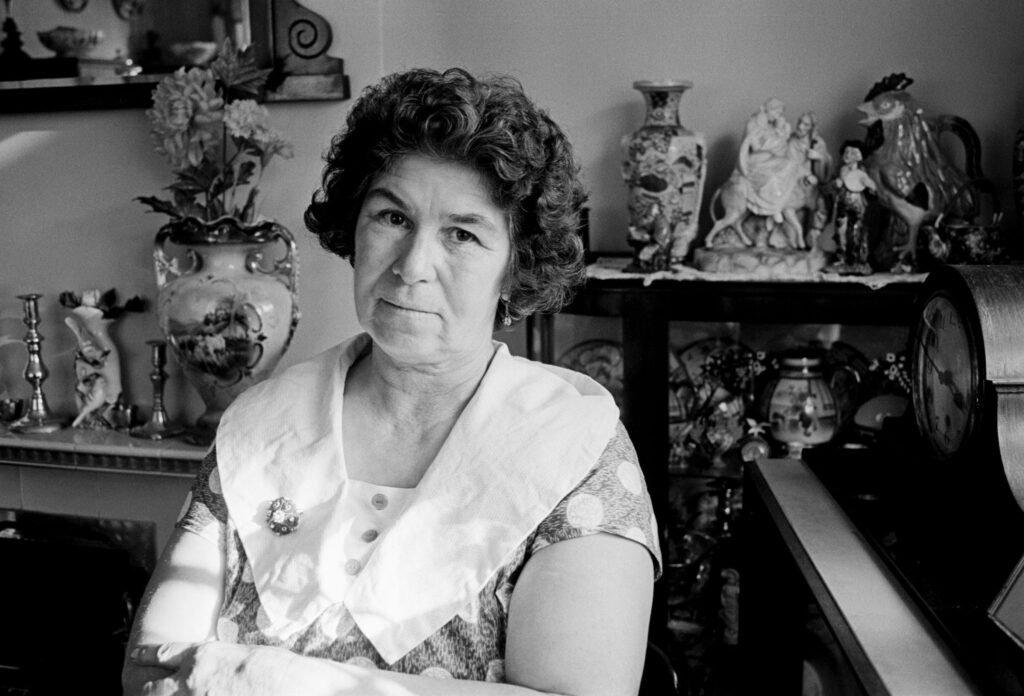
Phoebe Smith at her home in Woodbridge, Suffolk, 1969.
Phoebe Smith at her home in Woodbridge, Suffolk, 1969. Photograph © Brian Shuel, reproduced with permission.

The Romany gypsy Phoebe Smith is widely regarded as one of the greatest English traditional singers to have been recorded. When recorded by folk song collectors, from the 1950s onwards, she was living with her husband Joe near Woodbridge in Suffolk. However she was born in Faversham, spent much of her early life in Kent, and acquired her repertoire of songs primarily from family members..

It is usually stated that she was born in Tanner Street (now Tanners Street), Faversham in 1913. Certainly her birth was registered in the first quarter of 1913, and she was baptised at Elmsted on 4th April 1913. In the 1939 Register her birth date is given as 7th March 1912, but 7th March 1913 is the more likely date – this was the date given when her death was registered in 2001.  She was the youngest of at least eight children born to Bill Scamp and his second wife Ann, née Jones. Bill Scamp was born at Selling on 18th December 1851, Ann in 1873 at Forest Row, between East Grinsted and Crowborough in Sussex. Bill’s first wife, Louisa née Lee (1850-1892), bore him sixteen children between 1870 and 1890, giving birth to her youngest child one week prior to being admitted to Cane Hill Asylum, Coulsdon, Surrey, where she died and was buried in 1892.1

Phoebe’s parents had settled, and worked on fruit farms in East Kent, but would still travel around Kent and Essex for seasonal work, as Phoebe’s son Manny told Mike Yates:

I suppose life was like a holiday in those days: we would spend a couple of months here to work, then move on to another area for the next harvest, and we’d meet up with our aunties and uncles and cousins. It would be Essex, near Chelmsford for the sugarbeeting, Kent for the cherries, apples, plums and pears, then up to the Fens for the potatoes. That would be the times when the singing was practised. You’d be by yourself six or seven hours, no-one to please, no-one to offend, and an old uncle in the next orchard would shout over, ‘Have you heard this one?2

When she was about four years old the family went to live in Herne Bay. They moved again, to Ramsgate, when she was about ten, and later to Ickham. No Scamps appear in Faversham or any of those other locations in the early 20th century census records, but there were numerous Scamps living in East Kent, often with occupations such as “horse dealer” which suggest that they might be of Romany stock (also “hawker”, “general dealer”, “vagrant” or, occasionally, simply “gypsy”). At the time of the 1861 census Phoebe’s forebears were recorded as living “In Tents, Broom Street, Graveney, Faversham”. The head of the household was Riley Scamp, occupation shown as “Vagrant”. Living with him were his wife Sarah, née Lee, six sons (Oliver, Riley, William, Samson, Clarence and George) and three daughters (Charlotte, Cinamentta and Mary). All of the family had been born in Kent. Riley Scamp was born in 1819, and when he died in 1899 his funeral merited a mention in the Folkestone Express, Sandgate, Shorncliffe & Hythe Advertiser, 8th March 1899:

A ROMANY FUNERAL. —Last week at Ramsgate Cemetery, the funeral took place of Riley Scamp, a picturesque figure in Thanet for many years, and the head of a gipsy family well known throughout East

Kent. The deceased, who was of the Romany type, was 79 years old. Formerly he was a van-dweller ; latterly he abandoned that free mode of life. At the funeral quite large crowd assembled, including many of the gipsy tribe.

Comments by family members on various internet forums revealed that the Scamps sometimes went by the surname Matthews, and in fact it was under this name that Phoebe’s family were listed in the 1921 census, camped with other families including Lees and Ripleys, at Mystole Encampment, near Chilham. Her father William Matthews was listed as “General Dealer”, her mother as “Licence Hawker”. With them were 6 sons and 2 daughters, Louisa (14 years old) and Phoebe (7 years old). The places of birth of the children attest to the family’s travelling lifestyle: Bexhill in Sussex, Hunton, Tenterden, Chilham and Faversham. Phoebe’s birth place is given here – probably erroneously – as Preston in Kent.

Phoebe’s family were living at Ickham when she married Joe Smith, a scrap dealer, in 1931. They had met the previous year, at hop-picking time:

Joe: Well, round the campfire at night after we finished hop-picking. She come down to see my sister-in-law, you see, to have a word or two with her, I suppose. And I sat there playing the violin. And we started speaking, and…

Phoebe: My husband, he started to talk about the hop picking, and I was rather bashful and shy.  And I didn’t know much to say at all. As a matter of fact, I was afraid, really, to speak to him, thinking my father and mother would hear me.

Joe: Well… I thought you were shy and so was I.

Phoebe: I were really smiling at him playing the fiddle, you know, and his brother, you see. Keep looking at me and he keep nodding his head, you see, ‘awards ‘im playing this fiddle, because his brother just couldn’t stand the row. We were grinning at each other, you know, but at the time being I never had any more thought of courting or marrying him than flying. And then he said to me “I’d like to write to you when I go home, would you  like to write to me?” I said “Well, you can write and I’ll answer your letters”. And then next year, they come down hop-picking and you said to me, “Would you marry me?” I said, “Well, I’m not old enough really. I’m only seventeen”. So he said there’s lots of girls and boys get married at seventeen and eighteen.

Joe: She was a trouble. I kept writing, you know? And she kept saying she’d see, and all this sort of thing and I got fed up. And every weekend I had off I used to go down there. Never used to go down home because I wouldn’t dare, you see. Her father wouldn’t let her out if I went down home. She say to me “Well, I’ll meet you at the bus stop at Canterbury”, which was the nearest point, you see, where the buses come in, and that’s how we done our courting, and we never did go to the pictures.3

Phoebe recalled that she was desperate to go to see Sonny Boy, the first talkie to come to Canterbury (actually she probably meant the film The Singing Fool, Al Jolson’s follow-up to The Jazz Singer, which featured the song ‘Sonny Boy’, and which was released in the UK in November 1928). But her brother Charlie said “it’s not good for girls to go to the pictures… it learns them things they never ought to know” and the resultant argument led to her father forbidding either of them from going.

Joe: We never  did go to the pictures and I never did walk nowhere with her, only from the bus to the bus stop, put her on the bus that used to go home. That’s where I used to meet her and where I used to leave her, at the bus stop. That used to annoy me, you know, I used to get fair bored with it. All my worries were not getting her in a row, you see […]

Phoebe: So of course we just signed the register and away we come out. He got hold of my hand, and then he said “God bless you, Phoebe, you’re a nice girl”.

Joe: I remember that. I remember saying that, and I remember you wished me the best of luck.

Their marriage was registered West Tilbury in Essex on 27th October 1930. The bride’s name was recorded as Phoebe Matthews. Phoebe’s father said that he wouldn’t have given consent for her to marry so young, only when she was 21, but “that’s three more years, perhaps I wouldn’t live that long anyway”. And indeed he died within a year. Phoebe said that “He died 12 months after I were married”; in fact he died aged 79 on 27th May 1931, at Minster-in-Thanet.4

Phoebe and Joe’s first child – also named Joe – arrived within a year of their marriage, and money was tight. Joe recalled that “It was very hard times then, wasn’t it? I’m working steady […] But still, we carried on. We didn’t owe anybody nothing. That was a job to make ends meet”. When she was able to, Phoebe started to make floral Christmas decorations to earn some extra cash, and also did farmwork, “fruit-picking or pea-picking or anything”.

Joe found them a home to move to at 57 St Chad’s Road, Tilbury, Essex, and they were living here at the time of the 1939 Register. Joe’s occupation was given as “Caterpillar Driver – Oil Co”. He was navvying with pick and shovel at the start of the war, but then  moved on to operating a D8 Caterpillar, cutting chalk. This may have been a sedentary job, but it was physically demanding – “I have come ‘ome of a night time with, with my arms aching so I could hardly make a cigarette”. Joe’s work took him to Scotland at one point, although Phoebe stayed behind in Essex, doing agricultural work. And then, when the farmwork stopped, “I’d go on making these wax roses, roses, daffs, tulips […] I think it’s the most nicest job I’ve ever done is going selling flowers”.

As a port town on the Thames, Tilbury was frequently the target of German air raids. During one heavy raid, when they had had to abandon their home and take shelter elsewhere, a policeman came to find Phoebe to tell her that her mother had died.

Then that’s when I began to realise that everything was gone. At the beginning, I didn’t bother about the ‘ome, I didn’t bother about anything, as long as we were alive. That was everything you see. But when I lost my mother, I thought, well, I don’t know, everything seemed to be going…

Her mother’s grave records that she did on 3rd September 1940, aged 67 years. She was buried in All Saints Churchyard, Biddenden.5

At some point after the war Phoebe and Joe moved to Melton near Woodbridge, where Joe ran a scrap-metal business, and this is where they remained for the rest of their lives. Frank Purslow described it thus:

Near a small Suffolk market town is a well-conducted scrap metal business run by Joe Smith and some of his sons. Next to the yard, in a neat garden, stands the Smiths’ bungalow (built mostly by family labour) surrounded by the trailers of the Smith boys and their families.6

Mike Yates recalled

In those days Phoebe and her husband Joe were living in a bungalow at the side of a moderately busy road. There was a small scrap yard at the side of their home, where Joe and his sons worked. I think what most impressed me on my first visit was Joe and Phoebe’s large collection of Crown Derby porcelain. Every shelf and furniture top seemed to be holding yet another prize piece. They clearly loved their collection and were only too happy to tell me how the horse-drawn gypsy waggons of old had always been full of similar items.7

Phoebe had learned most of her song repertoire in Kent. Mike Yates notes that “Phoebe learnt many of her songs as a young girl from her elder sisters. Her uncle, Oliver Scamp, a Kentish horse-dealer, was also an important source of songs”, while she told Frank Purslow that she learned one song from her favourite uncle, her father’s brother George. Peter Kennedy provides details of the specific sources for several songs: ‘The Oxford Girl’ came from her uncle Oliver, “a Ramsgate tinker who could make a kettle out of a penny”; she had ‘Young Ellender’ from her mother; and ‘Higher Germanie’ and ‘Molly Vaughan’ were learned “from her uncle, George Scamp, the horse-dealer”.8 Phoebe’s son Manny, quoted in the booklet to the 1998 CD The Yellow Handkerchief, said:

A lot of her songs she learned from her mother and father and ‘Higher Germany’ came from her oldest sister, Polly [born 1900, Blean] and her younger brother Henry had a good voice. Her uncles Bill and George were also great singers and Bill had a high pitched voice. If he was singing in another room and you couldn’t see him you would swear it was a woman singing.”

The different sources given for ‘Higher Germany’ are not necessarily contradictory – it’s likely that Phoebe had heard both her mother and older sister singing the song.

Peter Kennedy was the first to record Phoebe. When searching for songs in Kent in January 1954 he visited a “Mrs. Stanley (Bird)”, who was living in a caravan on a farm near the Three Chimneys pub, between Biddenden and Sissinghurst. Although Mrs Stanley had tonsilitis, Kennedy’s notes record that “She gave us address of her sister Mrs. Smith, Melton Meadows, Melton, Woodbridge, Suffolk. Her husband, Joe, plays fiddle and melodeon”9. This Mrs Stanley / Bird was probably Phoebe’s sister Mary, seemingly known as Polly who, when the 1939 Register was taken, was hop-picking at Frogs Hall Farm, Tenterden, along with various other people named Scamp and Matthews.

Over the next few days Kennedy recorded songs from Phoebe Smith’s brother Charlie Scamp at Chartham Hatch, and from Oliver Scamp (probably Phoebe’s brother-in-law) at Lower Halstow. He later noted that he first visited the Smiths in Suffolk in May 1954:

May 26th WednesdayMay 28th Friday: To Woodbridge Area. To Melton

Called on Smith’s (gypsies) – name given by Scamp’s in Kent — at first told they had moved! Eventually discovered that Joe Smith would be back later but was out scrap-metal dealing.

[…]

Spent evening with Joe Smith and wife (Mrs Smith is sister of Mrs Smith we recorded at Rainham and of Mrs Stanley alias Mrs Bird). Arranged recording evening Sunday. Joe Smith plays reels, hornpipes etc. on the fiddle — our first gipsy fiddler. 10

The reference to “Mrs Smith we recorded at Rainham” is probably a slip, and should actually say “Mrs Scamp” – this would be Phoebe’s older sister Louisa, who was married to Oliver Scamp.

The recording arranged for the following Sunday appears not to have taken place, and he would be unsuccessful again in June 1955:

JUNE 15th. Left London and collected caravan at Woodbridge. Were not able to record Smiths. (gypsy singer and fiddler) as they were away for a few days 11

As he wrote some years later he wrote “From the time I first met Phoebe it took nearly two years before she was able fully to record for me her family songs, in July 1956”12). This was as part of his collecting trip to East Anglia in July 1956. A copy of his report on this collecting trip can be found at https://www.peterkennedyarchive.org/1956-2/east-anglia-1956/. It commences

Friday 6th: Collected machines and tapes, drove to Woodbridge making a number of calls in Essex en route without much success.

Saturday 7th: Made a number of calls in Woodbridge and arranged to record the Smith’s, gipsies, and Jim Baldry a painter and decorator at Melton.

Sunday 9th: Recorded from Mrs Phoebe Smith (42). Joe her husband had unfortunately hurt his hand in the meantime and was unable to play step-dance tunes on fiddle.

The songs collected from Phoebe Smith on this occasion were:

  • A Blacksmith courted me
  • I am a Romany
  • Shannon Side (Captain Thunderbolt)
  • Molly Varden (Shooting of his dear)
  • Higher Germanie
  • Young Ellender
  • The Oxford Girl
  • Pretty Betsy.

He visited the Smiths again in 1962, and on this occasion was able to record Joe playing the fiddle, and their eldest son Joe singing ‘The Riddle Song’, and playing step-dance tunes on the harmonica.

Phoebe told Peter Kennedy that she had been a mouth organ player:

I used to love to play the mouth organ and I began to play it very well, but my father used to say to me, “Phoebe, you mustn’t play that. That’ll give you horrible thick lips”. And I said, “Well, you won’t stop me from dancing will you, Daddy?” Used to say “No. You Can Dance. I love to see you dance, love to hear you sing”.

The step dancing was not without its issues, however – once, when step dancing, she kicked the toes out of her best boots, with the result that her father bought her a pair of boy’s shoes to dance in.

Kennedy put out his recordings on a Folktrax cassette, noting

Although Phoebe & Joe were living in a bungalow with hop-plants in the garden, they still had their wagons there, alongside their scrap-metal business, and most of the chat and singing was around the campfire.13

The Folktrax cassette also included extracts from their conversation, but Phoebe was unhappy about this, when she came to know, as she had not been aware that the material would ever be made available to the public at large.14 It has to be said that, nearly 70 years on, these recordings have proved invaluable in assembling this biographical sketch, and they also show Phoebe and Joe in a very positive light, as a devoted and loving couple.

By the time Kennedy’s Foktrax cassette was released, Phoebe Smith’s singing could be heard on three LPs on the Topic record. The first of these was Once I Had a True Love (Topic 12T193) released in 1970. The songs on this LP were recorded by Paul Carter, but the sessions were directed by Frank Purslow. Phoebe Smith had been the first traditional singer that Purslow saw, when she performed at Ewan MacColl’s Ballads and Blues club and, as he wrote later, “Phoebe was a revelation!”. Another London appearance had attracted the attention of Paul Carter:

It must have been early 1969 when I went to Woodbridge to record Phoebe Smith. Her singing had much impressed me when I heard her at Cecil Sharp House, and I felt she should be represented in the Topic catalogue. I knew that Frank Purslow knew her quite well and was familiar with her repertoire, so an arrangement was made for Frank and I to visit her. I picked up Frank from Bampton. Frank had decided what Phoebe should be asked to sing. We went to Woodbridge the next day. I was there to press the buttons on my Uher portable, and that’s about all. I’ve no recollection of the visit, but there were things on my mind at the time. It turned out that I had picked up the wrong tape boxes, and what I had was not virgin tape but stuff for recycling. So although these songs played fine on my Uher and on the bigger machine I used for editing, when they got to London the previous recording on them showed through. 15

Although Carter argued that it was simply a matter of adjusting the head alignment on Topic’s machine, the record company said that these tapes were unusable, so Carter and Purslow went back to Suffolk, and recorded the songs for a second time. The Topic LP Once I had a True Love was released in 1970. Frank Purslow’s notes for the album describe Phoebe as “a warm, homely, motherly woman adored by her family, despite the strict upbringing they have received at her hands. To Phoebe the most important things in her life are her home, her husband, her family and her friends”. He continued

Both Joe and Phoebe come from backgrounds where the importance of making one’s own entertainment was a necessity – and a tradition. From her childhood Phoebe had been a stepper, tapper and singer.

[…] “In those days,” she told me, “people used to make their own amusements, used to have nice week-ends together, used to sit round and have a little sing-song; and of course you’d learn songs from your parents, and you’d learn them from the people that used to come round. They were made of things that really happened. I mean, years ago when I was a child – and I’m not all that old – we never had radios and that sort of thing; and of course things that happened they used to make songs about, and stories. People used to learn them by listening to other people singing them. I learned one particularly from my father’s brother George. He was my favourite uncle, and I remember he used to get me on his knee and give me sixpence to sing for him. I used to love to hear him sing, he used to be – well you know – so dedicated into his songs when he was singing . . . he used to help the songs.”

When l asked Phoebe what attracted her to a particular song, she was quite definite. “l like the words of a song to have a real, true meaning, and I like a tune that goes according to the words and the happenings in the song. You can imagine – I can – as well as feeling for them – things that happened – what they did. I can picture them, you know, in the sorrow parts as well as the happiness. They’re human. Oh! I sing modern songs as well; there’s some very very, nice modern songs, but I don’t think they hit you quite so deep inside, because a lot of the songs today are just made up from out of the wind. No, I never went out and had music lessons, or dancing or singing lessons. All I learned I was self taught or from my parents. And l think that is the only true way that anyone can call themselves a tapper or a singer. I mean, if you learn it yourself you’re interested, you’re dedicated. There’s a lot of people today that do it just to get around and some money and that sort of thing. They don’t do it for the love of it, they just do it for what they can get. I always did singing and tapping and dancing just to please myself and make other people happy.”

Purslow also explained that

I have long since wanted to see her on record, but she is rather a difficult singer to record satisfactorily. Attempts to record her at “special occasions” have failed to capture what I consider to be the real Phoebe. Faced with a strange audience she tends to put on a “performance”. So we sat with Phoebe and Joe in their lounge and chatted and drank tea and then recorded a few songs. The results were excellent. A few days later I visited them again and had a long chat with Phoebe about the songs and her attitude to them, which I taped, and which shows how aware she is of the content of the songs and their meaning – and the tradition behind them, a living tradition, of which she, and Joe, and the family are a vital part.

Reviewing Once I had a True Love in the 1971 Folk Music Journal, Peter Kennedy wrote that having Phoebe’s songs available on record “realizes a long- awaited dream”. The album did not meet an entirely positive reception, however. Frank Purslow considered that Phoebe’s uninhibited singing style in front of an audience represented a put on “performance”, and that he had captured the “real Phoebe”. Others held a diametrically opposite view. The singer Danny Stradling, who met Phoebe and heard her singing in the 1960s and 1970s, has called the album “a travesty”, and relates that

in the months after the release of this record she was very unhappy with the outcome, and told me “they kept telling me to do it again because I didn’t do it the same as last time”.16

The “last time” here presumably referring to Paul Carter and Frank Purslow’s first attempt to record her for Topic. But, really, they should have been aware that it was unrealistic (and insensitive) to expect any traditional singer – still less one from the travelling community – to turn in an identical rendition of a song on two separate occasions.

Phoebe’s son Manny, quoted in the booklet to the Veteran CD The Yellow Handkerchief, gives a further reason for dissatisfaction with the LP:

Mum had such a clear voice and when she’d had a glass or two of Guinness she would sing and you could hear her at the other end of the village, but when she was recorded for the record (Once I Had a True Love) they wanted her to sound like a folk singer, so her singing is subdued.

This suggests that, as far as her family were concerned, these more restrained performances did not represent the “real Phoebe”.  

It’s worth noting that Paul Carter was probably aware that the recording equipment at his disposal was simply not capable of dealing with the wild, unrestrained style of singing that Phoebe was wont to adopt in public performances. Indeed Musical Traditions editor Rod Stradling believed that “in those days, there was not any microphone available that could record her very dynamic singing properly”, and that it was impossible for any recording to do justice to her singing – “you needed to ‘be there’ to properly appreciate England’s finest female traditional singer”.

Mike Yates, writing in the magazine Traditional Music in 1977 advanced a further theory about the relationship between Phoebe and folk song collectors:

I have heard it suggested that when Hamish Henderson discovered Jeannie Robertson and played those first tapes to English and American collectors, some or those collectors then went out determined to find an English female singer of equal stature. The implication, of course, is that Phoebe Smith was that discovery and that she was asked, directly or indirectly, to alter her singing style, to slow down her pace, to emphasise certain notes in far greater detail etc. Some readers may dismiss this as rubbish ; but it intrigues me that Phoebe is the only English singer that I have heard who sings in this manner. The other members of her family – sisters and brothers including the Kent gypsy Charlie Scamp who now lives in Faversham – that I have heard certainly sound no different from most other gypsy singers. The matter is still unresolved in my mind.17

Mike Yates spent time with Phoebe in the 1970s, and some of the songs he recorded appear on the Topic LPs Songs of the Open Road (12T253, 1975) and The Travelling Songster (12TS304, 1977) and, subsequently, on the Veteran CD The Yellow Handkerchief (VT136CD, 1998). Mike wrote:

I first heard of Phoebe Smith in 1963, when I was working a Cecil Sharp House as an assistant to Peter Kennedy. Peter had recorded Phoebe as a part of the BBC collecting scheme and he was busy transcribing her songs when I first went to work for him. Some years later I began collecting songs from English gypsies and travellers and whilst in Faversham, Kent, I met Phoebe’s relatives who told me that she was still an active singer. They gave me her telephone number and, within days, I was in Suffolk, driving out of Woodbridge along the Melton road looking for her home.

[…]

When I visited Phoebe I was aware that she had also been recorded by Paul Carter […] on behalf of Topic Records. There seemed little point in going over old ground and so we worked on the songs that Phoebe had learnt in her youth, many of which lay half-buried in the depth of her memory. Some songs came back quickly. Others had to be coaxed, verse by verse, sometimes line by line, until she was happy that she could recall no more of the song. And what songs they were

[…]

Phoebe and Joe Smith came from large families and were used to entertaining. They loved social gatherings such as dances, where Joe would play his fiddle, or pub singsongs where Phoebe would sing and step-dance, and they especially loved the company of other people. I think that they were two of the kindest and most likeable people that I ever met, and I am very glad that John Howson is now able to make so many of their songs available again. I know that Phoebe and Joe would approve.

Phoebe Smith died on 8th November 2001 at  the age of eighty-eight. She and Joe had seven sons: Joe, Henry, Nick, John, Manny, Fred and Tom, and by the time of her death the family had expanded to include thirty grandchildren, fifty-four great grandchildren and twenty great, great grand-children.  

Songs

Recorded by Peter Kennedy:

  • A Blacksmith Courted Me (Roud 816)
  • Captain Thunderbolt (Roud 1453)
  • Down by the Sheepfold (Roud 559)
  • Higher Germanie (Roud 904)
  • The Hopping Song (Roud 1715)
  • I am a Romany (Roud 4844)
  • Jolly Herring (The Herring Song ) (Roud 128)
  • Molly Varden (Roud 166)
  • The Oxford Girl (Roud 263)
  • Young Ellender (Roud 1417)

Recorded by Paul Carter and Frank Purslow:

  • A Blacksmith Courted Me (Roud 816)
  • The Dear Little Maiden (Roud 1751)
  • Higher Germany (Roud 904)
  • Molly Vaughan (Roud 166)
  • Once I Had a True Love (Roud 170)
  • The Tan Yard Side (Roud 1021)
  • The Wexport Girl (Roud 263)
  • The Yellow Handkerchief (Roud 954)
  • Young Ellender (Roud 1417)

Recorded by Mike Yates:

  • Barbara Allen (Roud 54, Child 84)
  • Captain Thunderbold (Roud 1453)
  • Dear Louise (Roud 23792)
  • Green Bushes (Roud 1040)
  • Jolly Herring (Roud 128)
  • Johnny Abourne (Roud 600)
  • Lavender (Roud 854)
  • Old Gypsy’s Waggon (Romany Rye) (Roud 13213)
  • Raking the Hay (Roud 855)
  • The Sheepfold (Roud 559)
  • Wings of a Swallow (Old Rocky Road) (Roud 13214)
  • Young Morgan (Roud 5369)

Others:

Discography

Songs by Phoebe Smith also appear on

and on several volumes of Topic Records’ Voice of the People series – see the discography on the Mainly Norfolk website https://mainlynorfolk.info/folk/records/phoebesmith.html


  1. Louisa Lee Scamp, Find a Grave, https://www.findagrave.com/memorial/242771238/louisa-scamp ↩︎
  2. Quoted by Mike Yates, notes to The Yellow Handkerchief, Veteran VT136CD (2001) ↩︎
  3. I am a Romany, Folktrax FTX100 (1975) ↩︎
  4. William Scamp, Find a Grave, https://www.findagrave.com/memorial/244201038/william-scamp ↩︎
  5. Mary Ann Jones Matthews, Find a Grave, https://www.findagrave.com/memorial/244418813/mary_ann-matthews ↩︎
  6. Frank Purslow, notes to Once I Had a True Love, Topic TSDL193 (1970) ↩︎
  7. Mike Yates, notes to The Yellow Handkerchief, Veteran VT136CD (2001) ↩︎
  8. Peter Kennedy, review of Once I had a True Love, Folk Music Journal, Vol. 2, No. 2 (1971) ↩︎
  9. Peter Kennedy, Kent Trip January 1954, https://www.peterkennedyarchive.org/1954-2/kent-1954/ ↩︎
  10. Peter Kennedy, report to Marie Slocombe headed Recording Trip: The Border Country: June-July 1954, https://www.peterkennedyarchive.org/1954-2/northumberland-1954/ ↩︎
  11. Peter Kennedy, report to Marie Slocombe headed Report: 1955 Scottish trip including Orkney Islands, https://www.peterkennedyarchive.org/1955-2/orkneys-1955/ ↩︎
  12. Peter Kennedy, review of Once I had a True Love, Folk Music Journal, Vol. 2, No. 2 (1971) ↩︎
  13. Peter Kennedy, notes to I am a Romany, Folktrax FTX100 (1975) ↩︎
  14. Mike Yates, Review of I am a Romany, Traditional Music No. 6, 1977 ↩︎
  15. Paul Carter, quoted in Mike Butler, Sounding the Century: Bill Leader & Co. Vol. 3, Troubador, 2023, p172-173 ↩︎
  16. Danny Stradling, review of The Yellow Handkerchief, Musical Traditions, 1998, https://www.mustrad.org.uk/reviews/p_smith.htm ↩︎
  17. Mike Yates, Review of ‘I am a Romany’, Traditional Music No. 6, 1977 ↩︎

Proudly powered by WordPress | Theme: Baskerville 2 by Anders Noren.

Up ↑